
Next steps in the evolution of seamless transit
This year, the Bay Area’s transit system is taking stock of progress toward a more well-coordinated, rider-friendly system among its 27 agencies, and setting a course toward the next steps of improvement.
In five years since the approval of a Transit Transformation Action Plan in 2021, the Bay Area has made significant strides toward a more well-coordinated, rider-friendly system. This has included progress on:
Fares: Free transfers, standard low-income discounts and an expanded all-agency transit pass for organization
Schedule coordination and network planning, with improved transfers, and progress on the region’s first transit priority network
Integrated maps and signs, with a regional map and a pilot all-agency system of signs starting a pilot rollout
A coordinated ballot measure to bring in funding to protect service from major cuts and fund key coordination initiatives
A network management structure to foster the coordination initiative
A 2-year review to take stock
Since 2023, the regional coordination initiatives have been managed by a “Network Management Council” composed of executives of transit agencies and MTC, guided by a policy body composed of MTC commissioners and two transit board members, and advised by a Customer Advisory Group. (The author of the blog post has been chairing the advisory group).
When the network management structure was set up, a progress review was planned at the two year mark. MTC hired KPMG to perform the 2-year assessment.
The 2-year assessment notes the continued progress, but also notes that the progress has been slower than projected. The report notes differences of opinion about whether the pace should be faster. We were interviewed for the report, and were among those who said that it should be possible to make faster and more decisive progress.
Get things done; measure and communicate results
The Network Management Council and the Network Management Committee agreed that there has been progress, and agreed that most important in a ballot measure year is to keep a focus on execution, and on communicating results to policymakers and the public.
The need for better communication was painfully clear in the discussions at transit agency and county funding authority boards about SB63, the law that eventually passed which authorized the regional transit funding measure, providing funding to prevent severe cuts to Bay Area transit and to fund initiatives that make the system more coordinated to increase ridership.
Many of the board members and staff, whose support was essential for the funding measure, started with poor understanding of the network management initiatives - what they are, and their role in customer satisfaction and increasing ridership. For example, with funding for fare integration and wayfinding, MTC doesn’t keep the money! The money goes to transit agencies, in a way that makes the system work better for users.
Better Execution with Fares and Payment - Merge Clipper Executive Board and RNM Council
The region’s initiative to roll out the next generation of coordinated fares and payment is facing a very bumpy ride, with a launch that is more than two years later than planned and still not fully working. Part of the problem with the Clipper 2.0 rollout is Cubic, the transit and defense contractor owned by a private equity firm that is infamous for rollouts that are slow to nonexistent.
But part of the problem is the structure of the initiative which has not had the same integrated team structure as other, more successful initiatives for coordinated fares and schedules. After the initial Clipper rollout, the Clipper Executive Board and RNM Council are expected to merge, and this has already started with joint meetings.
Progress on network planning - with more subregional network plans
Since the Transformation Action Plan was approved, the region has made incremental progress on initiatives advancing greater coordination in running and planning the region’s network, including:
Improving transfers at selected hubs around the region.
Developing a transit priority policy and draft transit priority network for the region
Creating the region’s first subregional plan, the MASCOTS plan in the North Bay, reorganizing the network so that 6 transit agencies work together as one system for riders, resulting in a rapid 20% increase in ridership [LINK HERE]
Updating the region’s long-range transit plan considering service and a connected network for the first time in history.
However, these initiatives have been disconnected from each other. This is unfortunate because service-led planning is a proven recipe to deliver a stream of highly cost-effective improvements, which will be especially important when funding is expected to continue to be tight in the coming years.
The 2-year assessment shies away from moving toward world-class service-led network planning for the region as a whole in a single step, describing it as “a significant undertaking that could require substantial resources, including dedicated staff time from both MTC and operators for technical analysis, modeling, and planning support.”
Instead, the RNM Council and Committee supported an approach identified in the 2-year assessment reports, whereby “the process could begin via sub-regional service visions as a manageable first step. By starting at a smaller scale, operators and partners could more easily build consensus on local integration priorities, potentially reducing the initial resource requirements. These subregional plans could then be woven together to form the foundation of a more comprehensive, unified regional vision.”
YOU ARE HERE - visible progress on a longer path
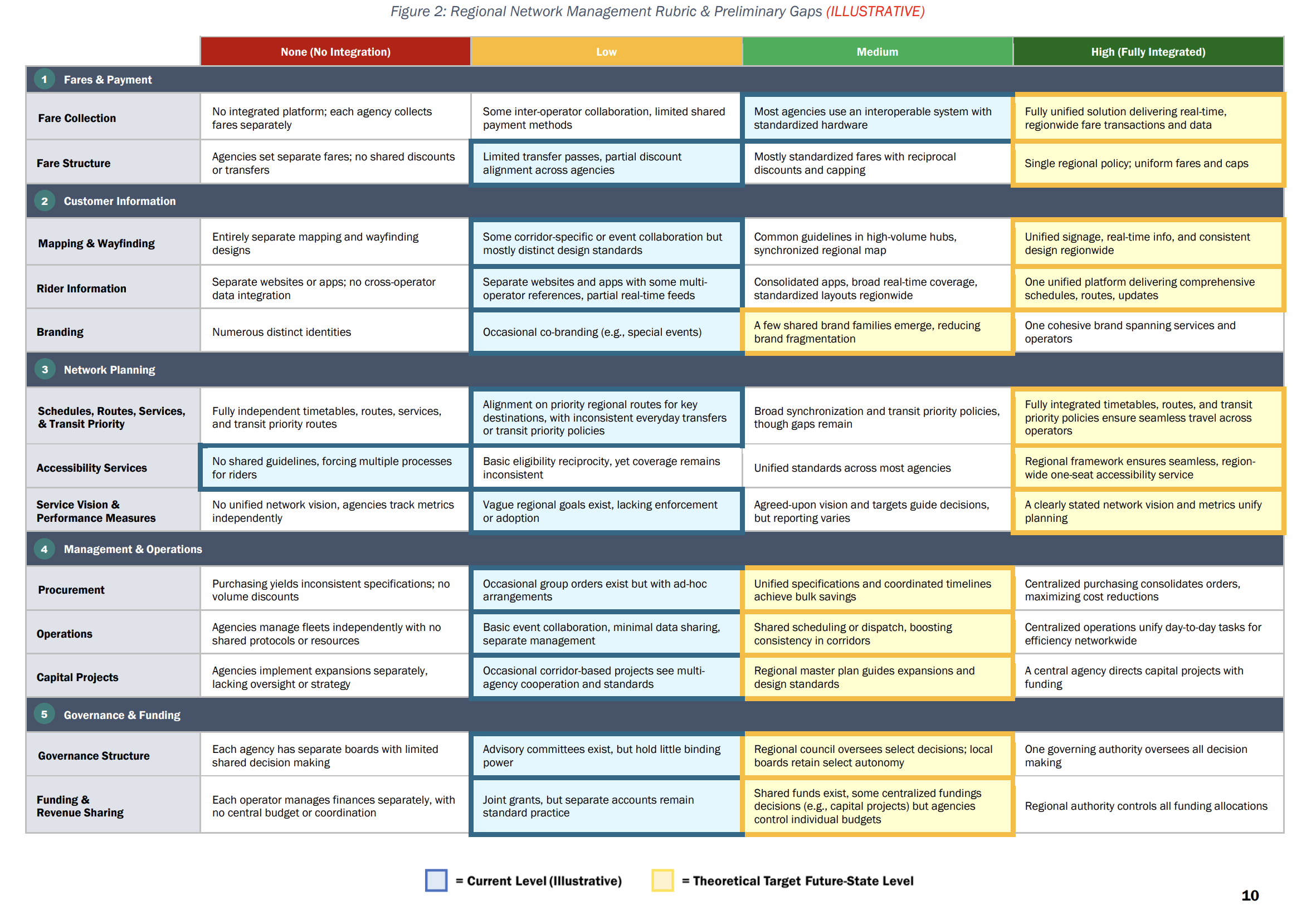
The consultant hired to support the 2-year assessment observed, in line with earlier research [LINK], that many regions around the world have travelled a path from a less coordinated to a more coordinated state. The Bay Area has made progress since 2021, and there are further steps along the path.
The report included a rubric of regional network management potential evolution that the Bay Area could use to plot a course toward further progress.
MTC and agencies are hesitant to think systematically this year when funding is uncertain. If and when the Connect Bay Area ballot measure passes, we strongly encourage Bay Area Network Management to use this rubric to plan out a trajectory toward stronger coordination across multiple years, with a goal to increase ridership with cost-effective improvements.
Increasing speed and scale of delivery - capacity, cost-effectiveness, and program funding
The report discusses strategies to increase the speed and scale to deliver improvements. One strategy that has been successful and could be built upon is the co-pm model - a lead from MTC with an operators’ lead to help manage the implementation of coordination initiatives. This takes advantage of MTC’s regionwide scope, and the in-depth operational expertise of the transit agency staff. The RNM Council supported continuing this strategy at their last meeting [LINK HERE]
The 2-year assessment report proposes building on this method by instituting “a formal or informal ‘rotational’ staff program. This type of program could support staff from transit operator agencies to be embedded within the MTC RNM team for defined, short-term assignments. Such a program could provide the RNM with invaluable, on-the-ground operational expertise while giving operator staff direct experience in regional policy. A co-benefit is fostering mutual understanding and generating a talent pool of professionals with a regional perspective.” We strongly support this proposal, and believe this should be implemented in a way that develops career paths increasing avenues for advancement among professionals who gain the regionwide perspective.
The report also identifies limits to staff capacity at MTC and agencies, linked to the need for a long-term funding strategy. We strongly agree that public transit in California is underfunded compared to other states and metros with large transit systems.
We also believe that the case for funding would be bolstered by developing a stronger discipline of business planning to assess the cost-effectiveness of network investments. The current path toward integrated fares was launched when the Bay Area’s regional planning identified integrated, affordable fares as the most cost-effective investment in the long-term plan.
Similarly, staff analysis at VTA shows that pairing improvements to service frequency and transit priority has the potential to greatly increase the cost-effectiveness of local transit in the South Bay. This is similar to SFMTA’s systematic analysis of the cost-benefit improvements with its extended Muni Forward program.
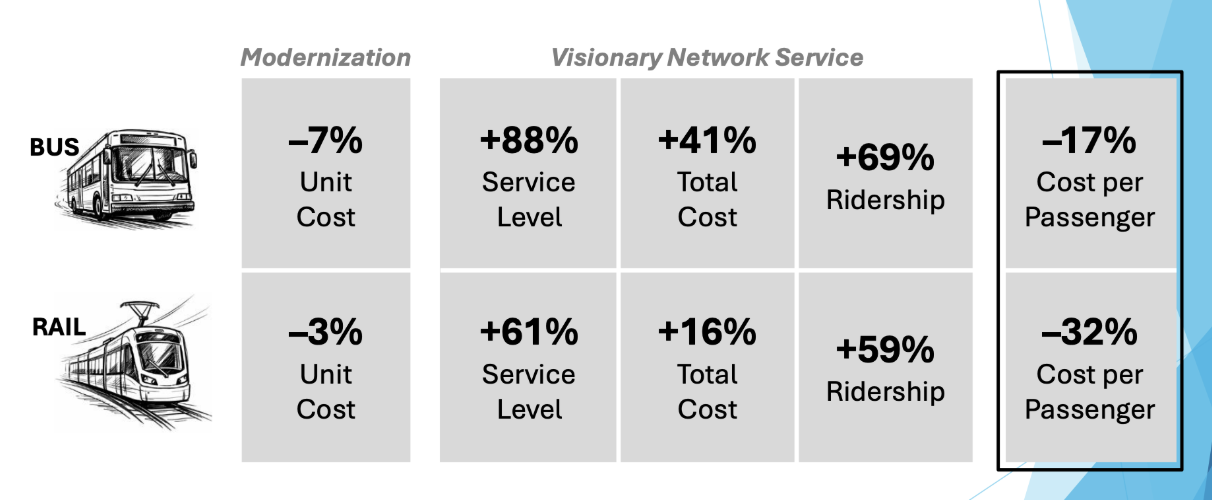
Another best practice that would be very helpful in providing sufficient staffing for regional coordination initiatives is program funding.
The region’s Transit Priority initiatives uses funding programs that scatter transit priority investments around the region. The Transit 2050+ long range plan includes bundles of investments in service improvements and local transit priority. However, these are forecast in long, 10 and 15-year increments with no certainty of funding.
The Bay Area - and California - would benefit by following the international best practice of program funding - identifying programs composed of smaller projects, designed together to achieve service goals, that are given funding certainty in four to five year increments. This approach can deliver major improvements to performance much faster than we are used to seeing results.
Future steps - governance
Last but least we also believe that future iterations of the Bay Area’s path toward well-coordinated transit should include strengthening of governance. The current system has significantly improved collaboration, building trust in an optional and consensus-based model, but progress is slow.
In the future, the system would benefit from a realignment where coordination is no longer optional, building on reforms such as are being implemented in the Chicago area. As in Chicago, structural reforms would be best implemented with funding that provides the resources needed to integrate fares and schedules.
In 2026, with funding uncertainty and an existentially important ballot measure is not the moment for structural changes.
Once this milestone has passed, it will be time to take a look at the larger rubric of opportunities to increase the coordination and cost-effectiveness of the system, including governance changes.