
Bay Area adopts first-step Transit Priority Policy
On January 28, the Bay Area’s regional transportation body (the Metropolitan Transportation Commission, MTC) adopted its first Transit Priority Policy for Roadways. The policy sets new requirements for cities and counties to coordinate with transit agencies when they plan MTC-funded changes to streets and roads.
MTC will next create a Transit Priority Network for the region, seek to provide financial incentives for these projects, and encourage more cities to adopt transit priority policies.
Advocacy for improvement and implementation
Seamless Bay Area has supported this initiative and advocated for a strong and effective policy, along with partners. We sent letters in December 2024 and June 2025, provided feedback at numerous public meetings, blogged, and met with the staff developing the policy.
Our overall goals are:
Advancing faster and more reliable bus service that is competitive with driving
Greater certainty and faster delivery for multi-jurisdictional projects
Shift ridership from cars toward transit in combination with walking, bicycling and rolling
Concrete and quantitative goals and metrics
Measuring and valuing transit priority as part of a network, including key transfers
The adopted Transit Priority Policy represents a first step, and there are many further steps available to enhance its effectiveness. The Policy notes that “MTC will continue to advocate for and advance transit priority through leadership at the regional level.” We have specific recommendations to coordinate agencies and cities around a shared regional recognition of the importance of transit priority and address the root causes of congested on-road transit.
The value of a regional transit priority initiative
It is good that MTC is seeking to increase transit priority across the region. Increasing congestion has slowed on-street transit over the last several decades. This is an issue that affects many parts of the region, and is especially challenging for the many Bay Area residents who cross city lines in their daily travel. It is not geometrically possible for everyone to drive to where they are going, but the transit riders helping to solve that problem are hampered by buses that get caught in general traffic.
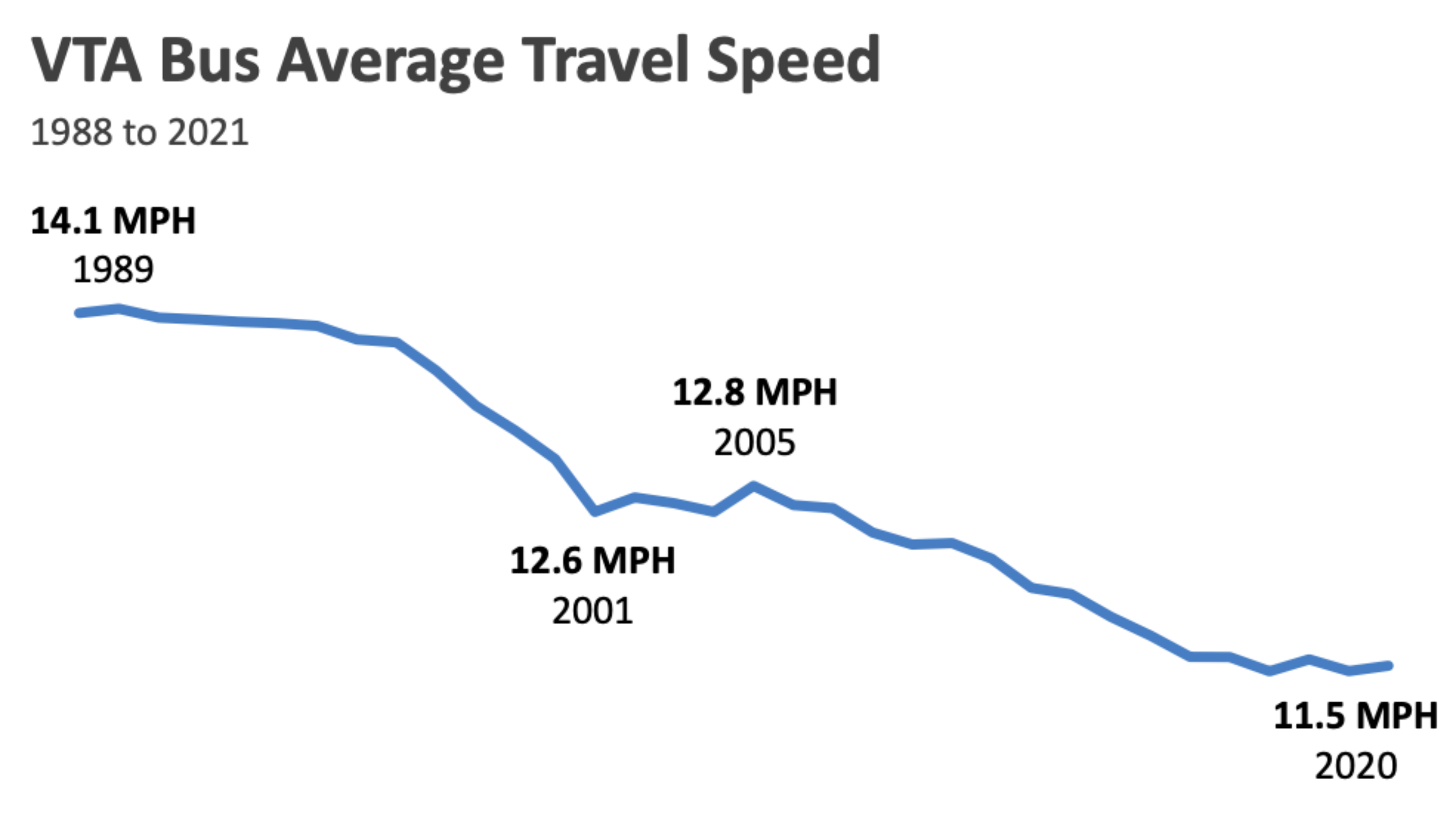
Bus routes stuck in traffic serve each stop less often, or are more expensive to run - VTA General Manager & CEO Carolyn Gonot said at an MTC Regional Network Management Council meeting on the Transit Priority Policy last month that “We’re putting…thousands of hours in our system every six months just to keep up with congestion - another $1 or $2 million of service. I would much rather put that toward new service, but we’re just using it to deal with congested roads. I think the more we can do to focus on signal priority, the better.” To incentivize mode shift, meet our climate goals, and increase economic access and development, it’s important that buses get priority over cars.
The creation of MTC’s Transit Priority Policy for Roadways has been a two-year process. The version of the Policy due to be adopted includes three primary policy mechanisms:
Any project that MTC funds with more than $250,000, on a street with bus (or tram) service, including streets that are bus non-revenue or detour routes and streets with planned & funded bus service, will have to obtain review by the local transit agency(ies), and make changes requested by the transit agency (or claim an exception).
MTC will develop a Transit Priority Network, by the end of 2026. Any MTC-funded project on a street along this network will have to incorporate “reasonable transit-supportive design elements.” MTC also says it will prioritize transportation priority investments for locations and streets on the Transit Priority Network.
MTC will produce a template resolution for cities and counties, to declare support for MTC’s Transit Priority Policy, adopt their own local transit priority policy, or include language on transit priority in a local plan. In the future, MTC may amend funding programs to provide incentives for cities that adopt such language.
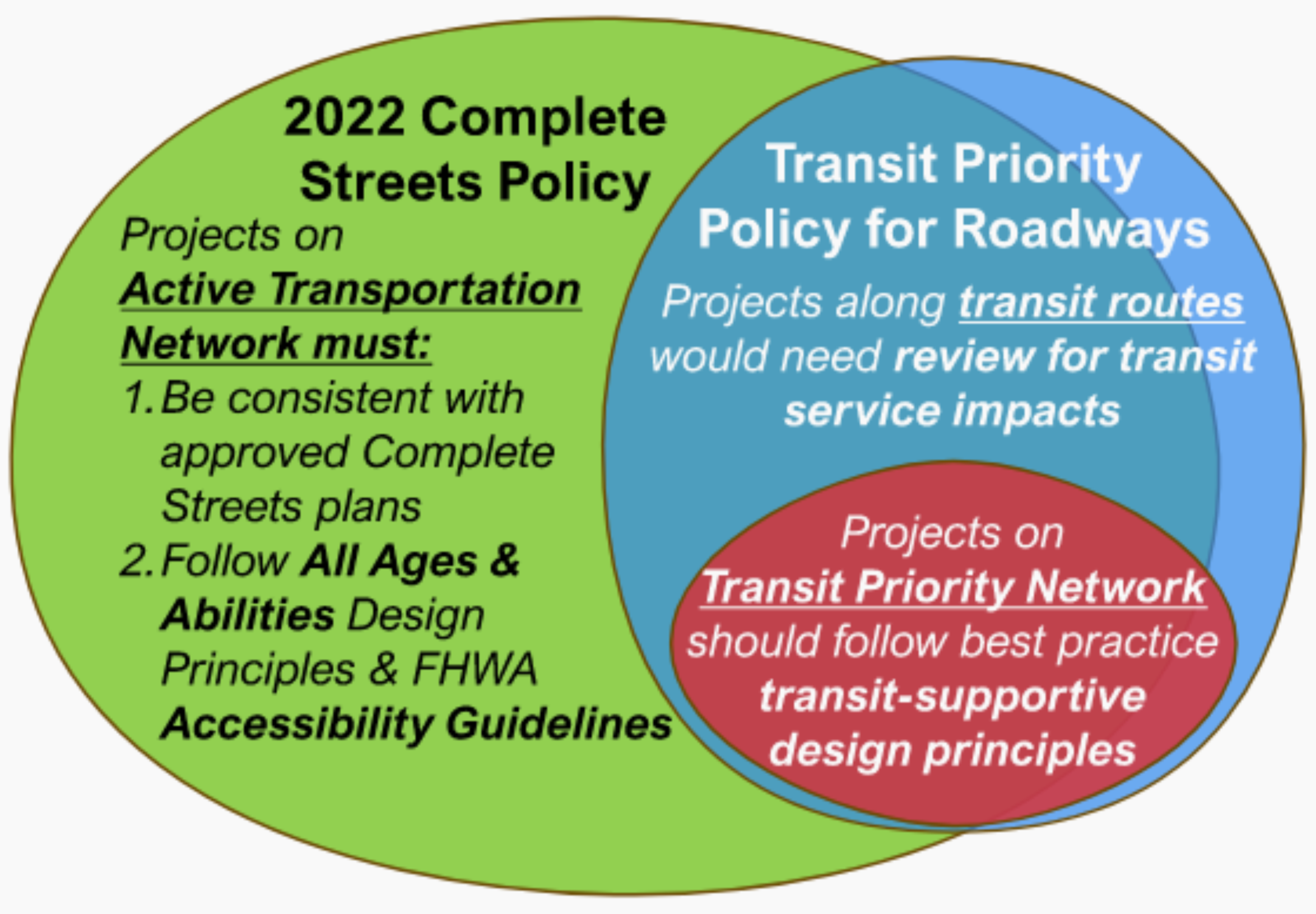
Source: Bay Area Transit Priority Policy for Roadways, December 2025 presentation to the Regional Network Management Council.
Current challenges for transit priority projects
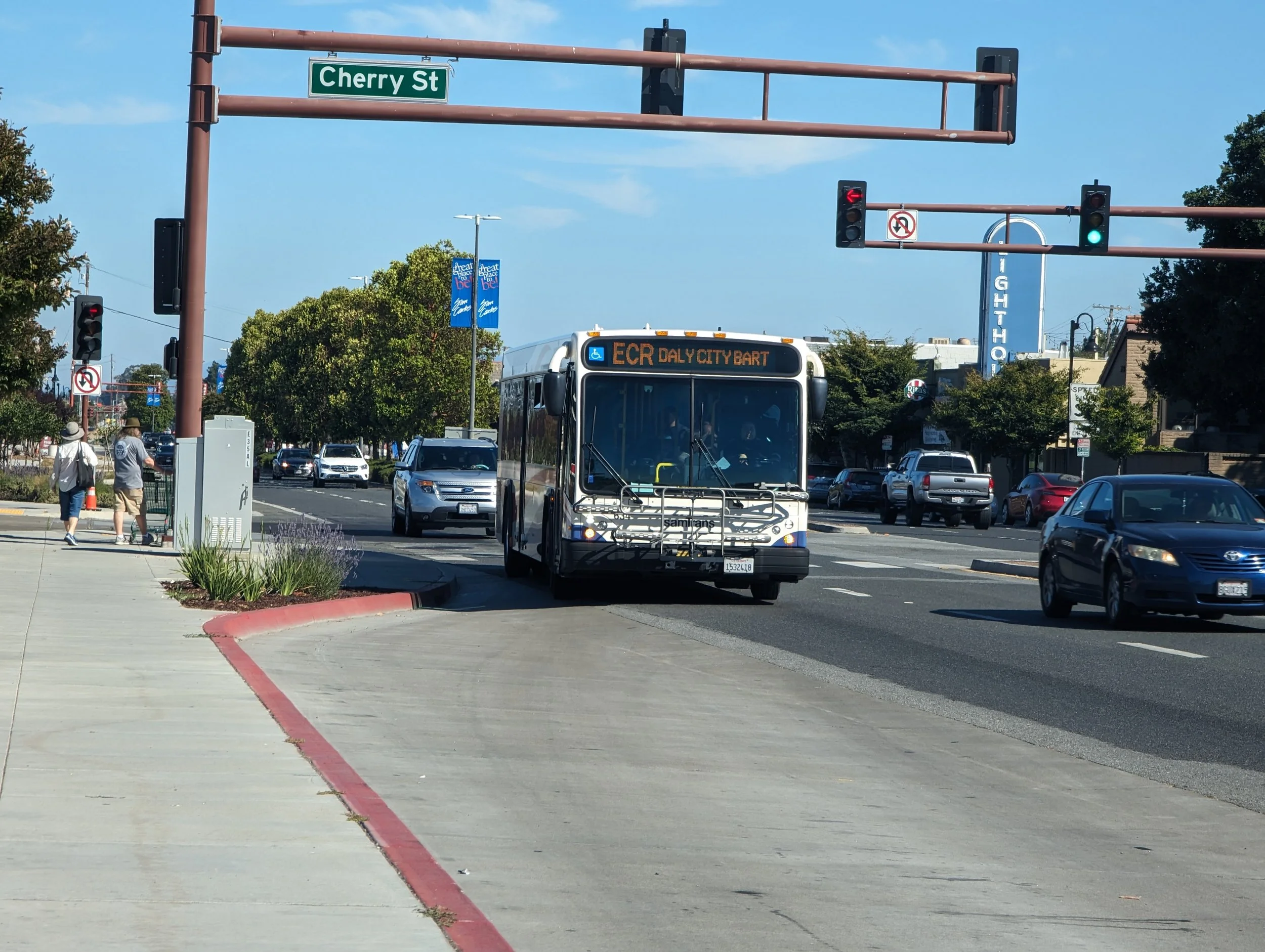
A SamTrans ECR bus on El Camino Real in San Carlos. SamTrans and San Mateo County cities are currently developing a multimodal plan for eight miles of El Camino Real.
Efforts to prioritize buses over cars in the Bay Area have faced headwinds over time, as cities have at times posed obstacles to transit priority initiatives. Multi-jurisdictional projects have been especially hard-hit, as even one city along a route can hold up or truncate a project.
Berkeley rejected participation in AC Transit’s BRT project in 2010; Tempo BRT now runs from San Leandro to Downtown Oakland, only.
A 2010s effort to put bus lanes on El Camino Real up the peninsula was ended in 2018 due to local opposition.
Today, Cupertino is pushing back on VTA bus lanes along Stevens Creek Boulevard.
County Connection’s General Manager, discussing the new Transit Priority Policy, noted that small transit operators, too, “...are often very challenged in working with our various jurisdictions and ensuring that we get transit priority.”
Even projects that do go ahead face scope reduction and setbacks. An example: In 2014, AC Transit removed bus lanes from a project along its busy University Avenue route 51B in Berkeley due to the city’s parking concerns. The agency’s 2018 review of the completed project found that the project had then been watered down further by the city, leaving an installed queue-jump signal deactivated and limiting signal priority activation to every fifth light cycle.
This detailed public view of how transit priority projects are hindered by local opposition is rare - more projects do not get off the ground behind closed doors, or are never pursued due to tacitly understood opposition. And, though the Berkeley City Council now supports bus lanes on University Avenue and San Pablo Avenue, the nature of our current multi-year infrastructure development process means it has missed its opportunities - opposition by a local government majority at any stage of a project’s lifecycle can truncate or end the project for a generation.
This primary problem - cities refusing, watering down or delaying transit agency-led transit priority projects due to hyper-local traffic and parking concerns - is not fully addressed by MTC’s Transit Priority Policy for Roadways. Berkeley’s local transit-first policy, which has been in place since 1987 and which MTC cites as an example of a local policy that could help it earn funding priority in the future under the Policy, did not prevent it from cancelling or downgrading transit priority efforts.
The proposed policy includes a timeline for transit agencies to review proposals for street changes by cities, but does not include a timeline for cities to review proposals for transit priority projects from agencies.
There are other challenges posed, not by opposition, but by every jurisdiction handling things a little bit differently. This can lead to a situation with different guidelines or standards for every agency and jurisdiction. This can slow approvals for either a transit agency seeking city, county, and Caltrans permits or a local jurisdiction seeking transit agency approvals. And having the Bay Area’s more than 100 jurisdictions each choose their own set of guidelines to follow reduces the opportunity overall to leverage international good practices and to deploy projects in a timely manner.
New conditions for complete streets projects
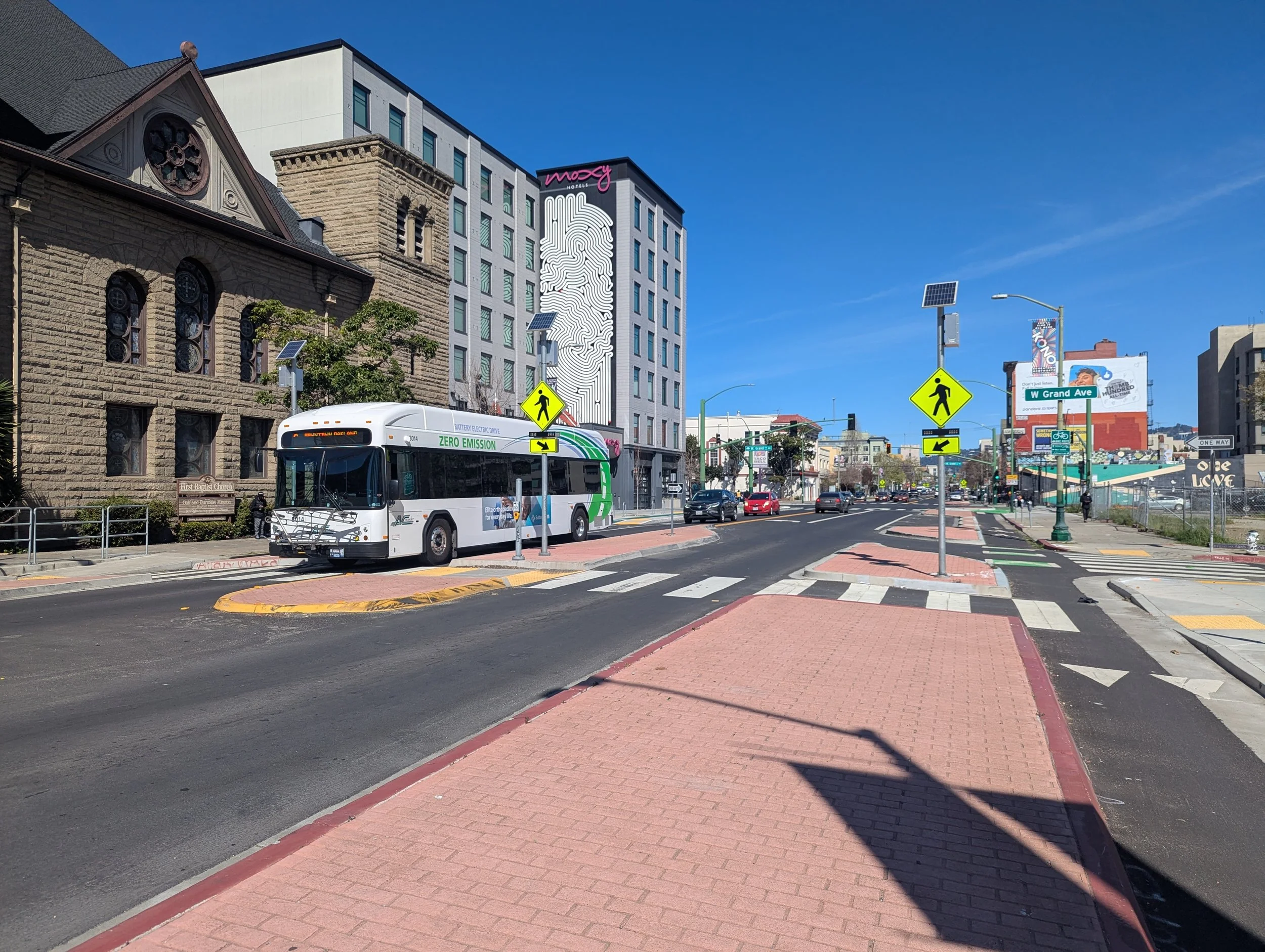
Telegraph Avenue in Oakland, after a 4-to-3-lane road diet.
The main mechanism that MTC was able to include in the Policy - conditioning MTC funding on coordination with the local transit agency - will primarily affect cities seeking to grant funds from MTC. The Policy will take effect in time for MTC’s fourth cycle of the One Bay Area Grant (OBAG), which is the region’s method for distributing federal formula funds. The previous round allocated $750 million to projects for the years 2023-2026. As can be seen from the full lists of projects, the money that MTC distributes, which will fall under the new Transit Priority Policy, goes toward:
Growth planning (roadways unaffected),
Mobility hubs, bikeshare, electric cars and charging, commuter benefits (roadways unaffected),
Habitat restoration and park trails (roadways unaffected),
Complete streets, including safety projects and active transportation (roadways quite affected), and
Transit priority projects (already prioritizing transit)
This mechanism of MTC’s Transit Priority Policy for Roadways will therefore mainly impact complete streets projects - road diets, safety upgrades, and bike lanes.
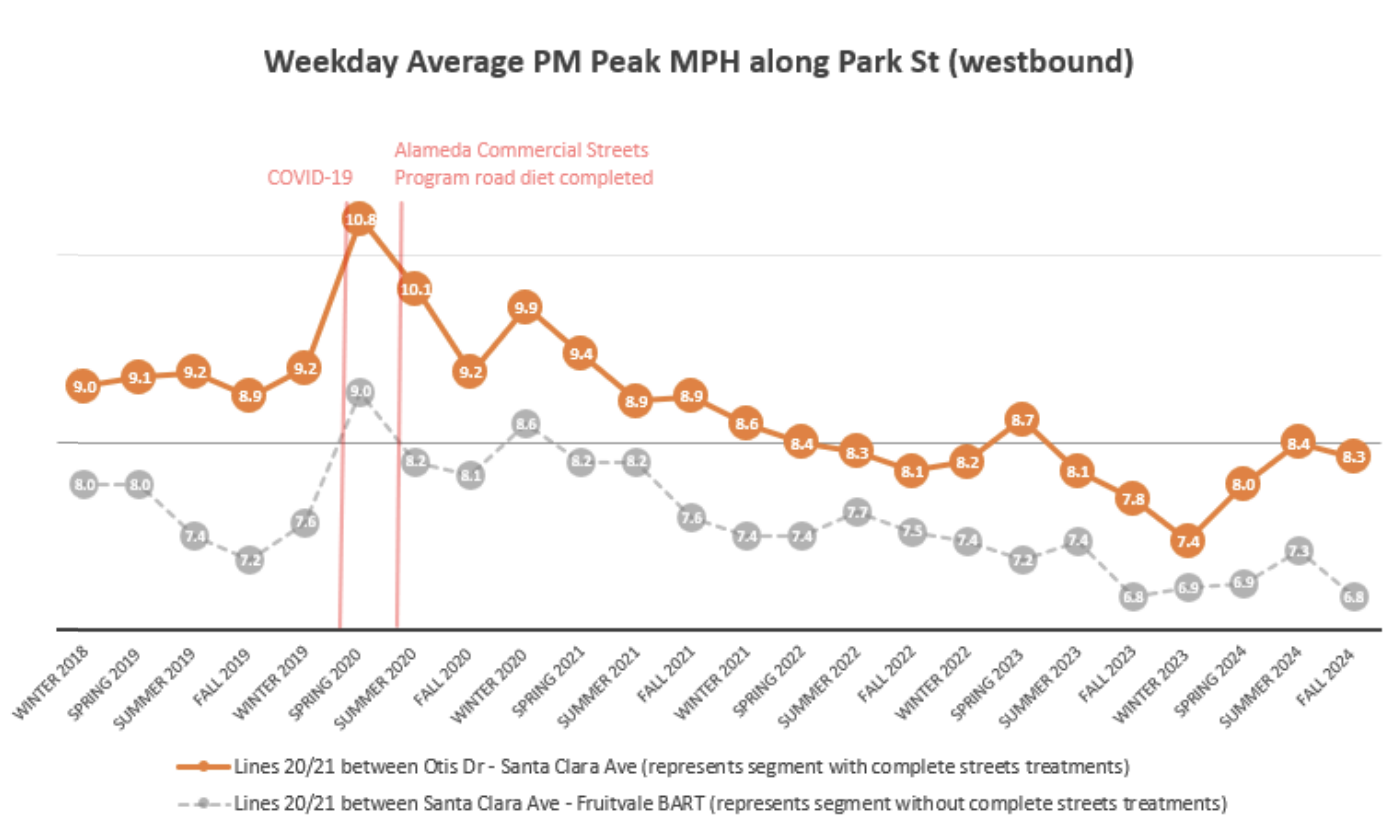
Some transit agencies believe that these projects have been responsible for slowing down the bus. Earlier this year, AC Transit shared its analysis, arguing that road diets on Telegraph Avenue in Oakland and Park Street in Alameda slowed buses down. However, the trendlines instead make clear that there was no step-change in speed after the improvements went in, and bus speeds on segments with and without the road diets fluctuated together, according to the amount of car traffic.
Requiring cities to adjust road diets and bike lane projects to transit agencies’ requests could cause these projects to become more difficult, or less effective for mode shift and safety. As AC Transit developed its Transit-Supportive Design Guidelines, which it adopted last year, advocates raised concern that these standards would prevent cities from reducing the number of lanes on a road, would require wide turn radii and long pedestrian crossings, would seek to push bikes to side streets, and would prevent the installation of speed bumps and raised crosswalks.
The Policy allows cities to claim exceptions from agency requests for reasons of excess cost, evacuation routes, and fire code, but does not provide an exception for pedestrian and bike rider safety. As with fire department requirements, the impact of the Transit Priority Policy on safety projects will depend on how transit agencies choose to provide and negotiate on feedback.
Transit agencies should approach street design with an objective of mode shift from cars, rather than focusing on keeping car traffic fast so that the bus can be, too. In adopting standards and reviewing city- and county-led road diets and active transportation projects under the new Policy, transit agencies should distinguish between required minimum geometry for operations and preferred designs for speed.
The Transit Priority Network
As the second measure of the Transit Priority Policy for Roadways, MTC and agencies will take the important step to develop a “Transit Priority Network” in 2026. This will start with an assessment of the current baseline - ridership, speed, and existing priority infrastructure. Next, they will select key transit corridors where design changes would have the biggest impact on travel time and reliability, and identify “hot spots” where transit riders are delayed the most.
In future grant cycles, streets on the Transit Priority Network will be prioritized for transit priority project funding, which will help ensure riders see the most significant and timely improvements for the investment.
Once the Transit Priority Network is identified, projects along streets that are part of it will also have to “incorporate reasonable transit-supportive design elements from best practice national, state, and local design guidance to improve transit travel time and reliability,” up to 20% of the project’s overall cost.
Creating the Transit Priority Network is a good step toward faster and more reliable service. Its first iteration will be timed to be ready for assessing OBAG 4 grant applications later in 2026.
Seamless strongly supports meeting this deadline to be able to use OBAG grant funding as an incentive.
We also have been advocating strongly for the transit priority network to include quantitative goals for speed and reliability, and to consider transfer quality as a network goal, where service is not so frequent that transfer time is irrelevant.
So far, MTC staff has been unsure whether the first iteration of the Transit Priority Network will have quantitative goals. If not, we strongly believe the Transit Priority Network should be updated soon thereafter, incorporating quantitative goals for travel times and transfer reliability.
The iterative approach that SFMTA has taken with its Muni Forward initiative is a positive role model, where that agency has set goals and then continually rolled out sets of improvements to make buses faster and more reliable, leading to cost savings and ridership increases.
Executive leadership seems to support the direction for a data-driven approach. Discussing the Transit Priority Policy, MTC Executive Director Andrew Fremier asked “What are we going to do to measure success and then market opportunities?”
Balancing street designs
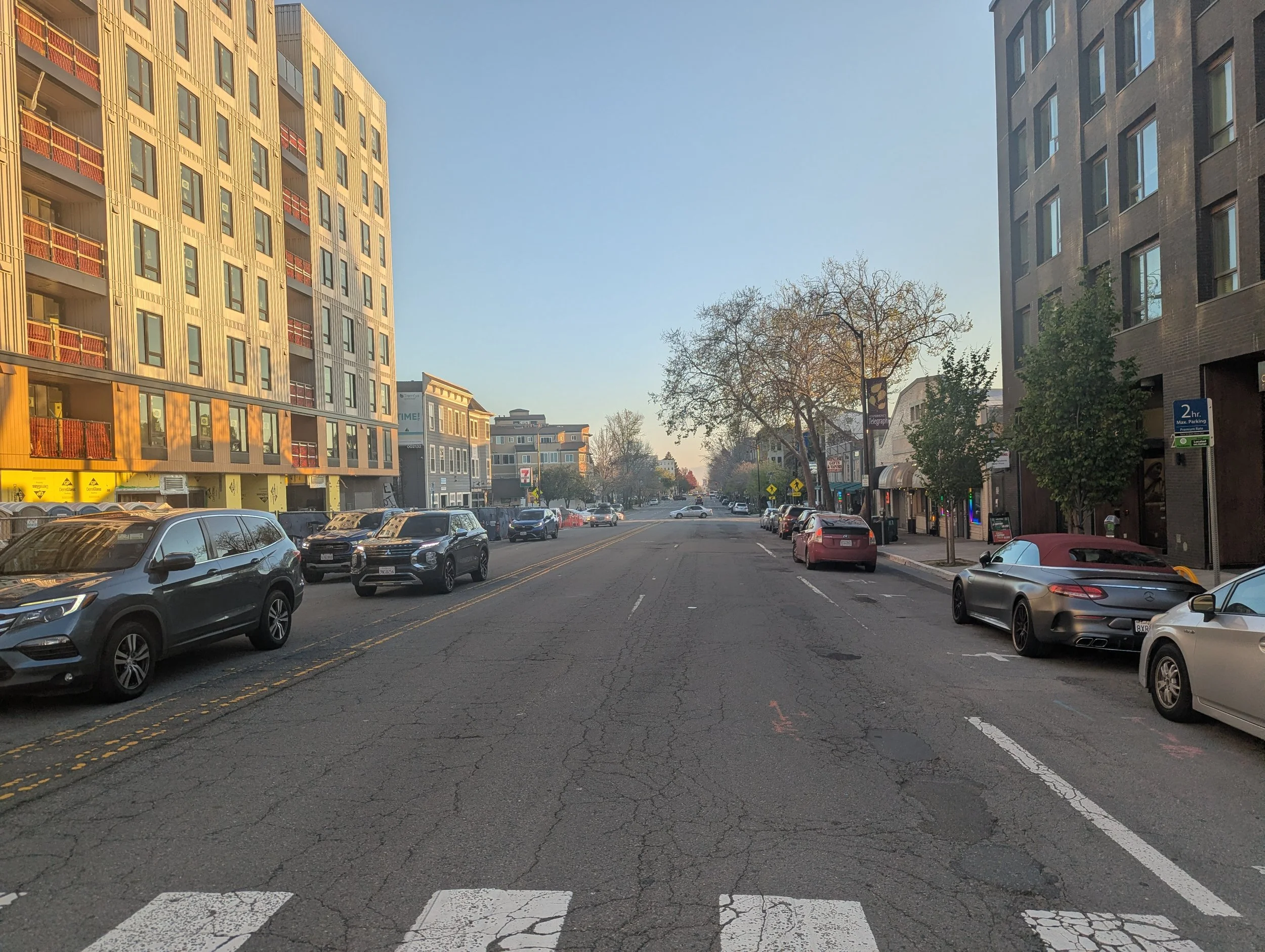
4-lane Telegraph Avenue in Berkeley, under planning for a road diet.
With future development of quantitative goals, the Transit Priority Network could provide greater clarity and support problem-solving among transit agencies and cities regarding the organization of street space, that would help make transit faster and more reliable while supporting complete street safety projects.
Advocates know well that the allocation of street space is contentious. Parking and traffic lanes are difficult to reprogram to space for pedestrians, bikes, and transit. Walking, biking, and using transit are complementary ways for people to reduce their reliance on cars, so transit priority should focus on improving bus trip times compared with car trip times, while also improving safe bike and pedestrian access.
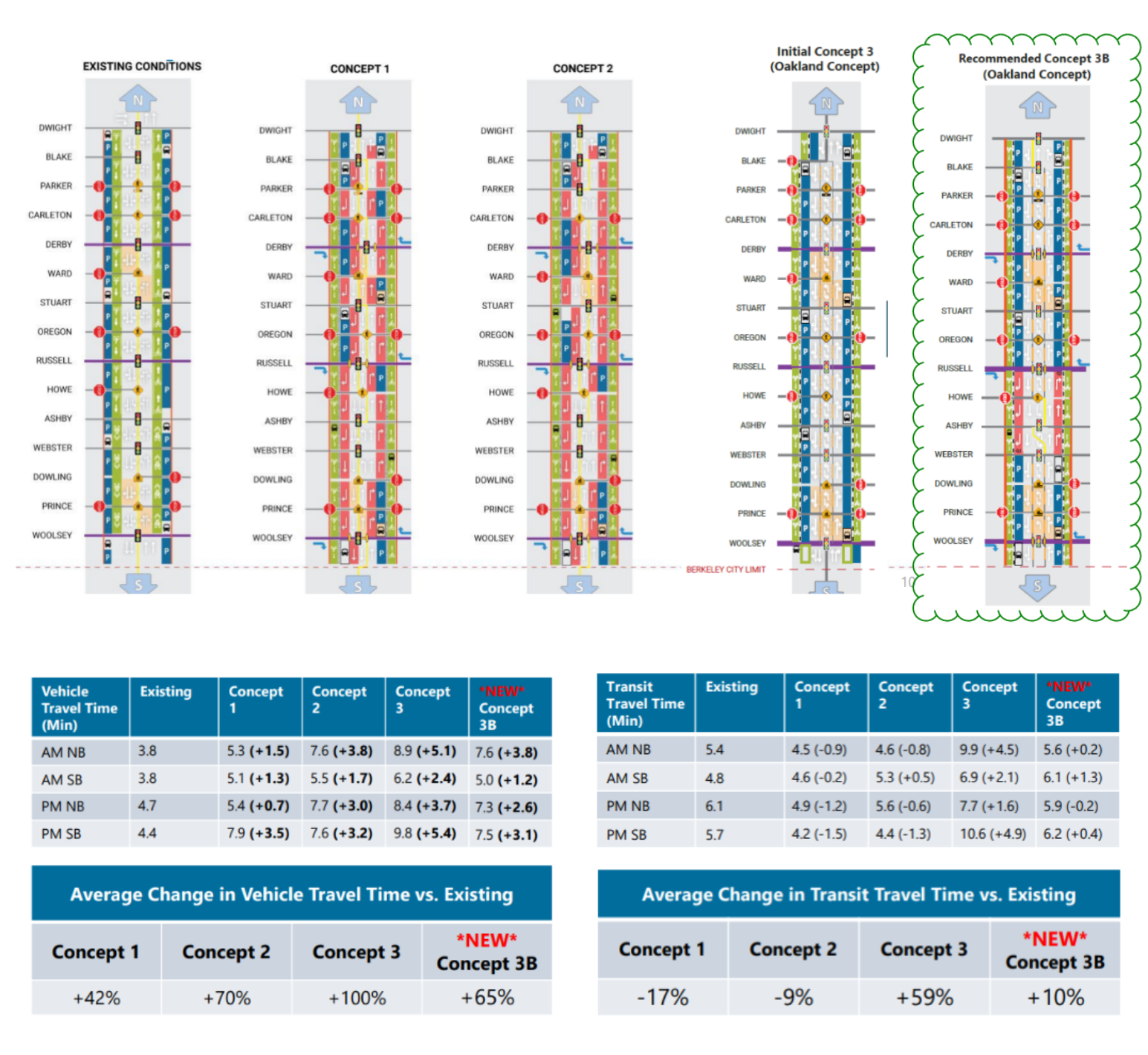
Berkeley - now under a more transit- and bike-supportive administration - recently selected a design for its northern portion of Telegraph Avenue, the street where it rejected BRT in 2010, and where AC Transit maintains that Oakland’s subsequent 4-to-3-lane road diet has slowed buses. Berkeley’s decision for its portion of the road is to install a similar road diet, which provides the shortest pedestrian crossings, most-protected bike lanes, and most car parking. However, Berkeley will also provide dedicated bus lanes and a queue jump in the most-congested section of the corridor. As a result, the road diet is projected to slow cars by 1.2-3.8 minutes and to slow buses by only 0-1.3 minutes. A separate, AC Transit project will provide transit signal priority to speed buses up.
Without measurable goals for this corridor, it is not possible to say whether Berkeley’s decision is good for transit. In contrast, other street uses have clearer design expectations. Bike networks can be built according to planned levels of infrastructure, and parking needs can be studied. As the Transit Priority Network evolves, it should include goals for travel times and early infrastructure plans. If travel times and conceptual transit priority treatments can be negotiated up front during development of the network plan, this will simplify the design of specific projects, easing tensions between cities and transit agencies and clarifying the need to make street space decisions such as parking relocation.
Street space is at a premium, and the cross section of the one-dimensional street where a bus route runs is not the full story. The Bay should learn the international best practice of two-dimensional circulation planning, which sets out the route traffic will take to access all destinations while ensuring transit’s path is kept clear and reliable. Managing the flow of vehicles with tools such as turn restrictions, the insertion of dedicated transit signal phases, and modal filters can give transit high priority even where there is not room for full bus lanes.
Recommendations to advance transit priority
Building further on MTC’s Transit Priority Policy for Roadways will be important to create transformative outcomes:
MTC should adopt an affirmative, “transit-first” value statement that it is the Bay Area’s policy to make transit use time-competitive with driving, and to shift more travel to transit and active transportation, recognizing the importance to climate goals, equitable mobility and economic vibrancy.
MTC should produce a live dashboard map of transit priority projects, providing transparency and focus on status, implementation schedules, and measurable benefits.
Cities should adopt ambitious transit priority policies, and follow them. Cities should not only coordinate road diets with transit agencies but should proactively incorporate transit priority into routine repaving and signal replacement.
Transit agencies and cities should negotiate flexibly so that road diets and active transportation projects can go ahead while including transit priority treatments that fit these projects’ overall safety intent. Cities and active transportation advocates should track impacts of transit agency requests on safety projects, to ensure that the Transit Priority Policy focuses effectively on mode shift.
Transit agencies, counties, and MTC should draw on the example of Muni Forward to set goals for speed, travel time, and transfer reliability (goals will differ), and systematically and publicly measure and communicate the outcomes of transit priority efforts toward the goals.
In addition to providing timelines for agencies to review proposals from cities for street changes, subsequent versions of a Transit Priority Policy should set timelines for cities to review and approve transit priority policies from agencies. Once a city approves a project, there should be penalties for later attempting to withdraw.
The Transit Priority Policy calls for MTC to provide technical assistance “as resources allow.” MTC should build up its resources to support transit agencies and cities in prioritizing transit. The Transit Priority Network’s “hot spot” identification is a great start. Other technical assistance resources should support best practices for studying parking usage and solutions that also facilitate transit priority and active transportation.
In the interest of moving toward a common set of guidelines, as a first step MTC and Caltrans should develop a library of local, national, and international transit priority treatments. NACTO should also incorporate international transit priority measures, as described in the Marron Institute’s forthcoming Transit Priority Atlas, into its design guidelines.
Over time, additional funding for transit priority improvements should be provided, and should be strategically prioritized toward the highest-benefit projects, such as those on the Transit Priority Network.
Infrastructure Weak (Bluesky) is a a bike and transit rider who posts about safe street design and transit projects.