
Service-Led Planning: A key to rider-friendly, cost-effective transit
In order to have a seamless transit network that gets people where they need to go conveniently and reliably, transit service must be planned as a network. This has been difficult in the Bay Area over time due to the region’s fragmentation with 27 transit agencies and 101 city and county jurisdictions.
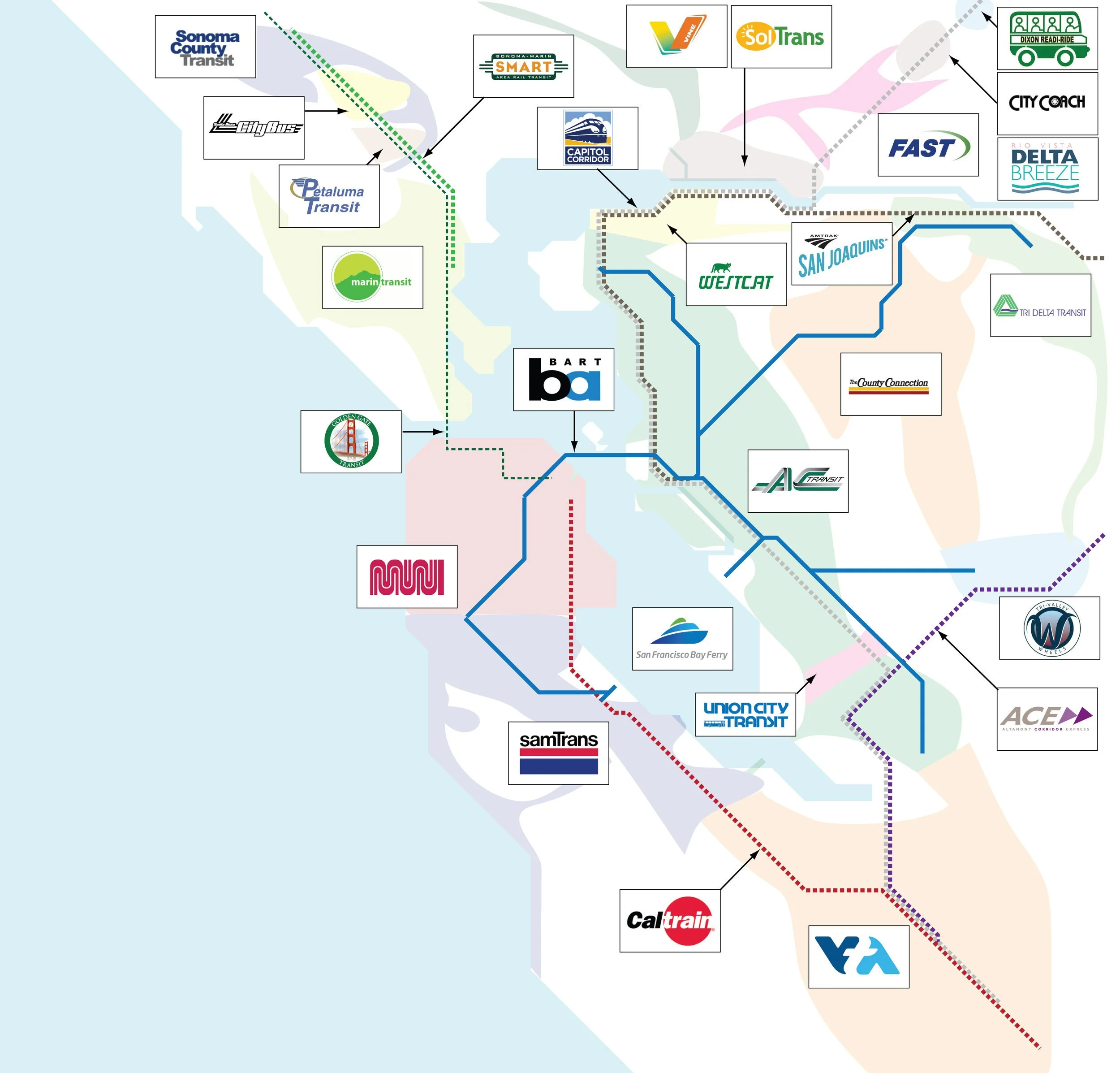
Running and planning Bay Area transit as a network is core to the Seamless Transit Principles, a resolution that has been endorsed by over 100 public and private organizations and thousands of individuals.
This blog post will provide an overview of what Service-Led Planning is and why it has been so successful in generating ridership in the places where it’s been deployed effectively. Then we’ll summarize in greater detail the steps the Bay Area has taken toward more coordinated service, and what additional steps are needed to get to Service-Led Planning that can make transit significantly more convenient and cost-effective. Finally, we’ll share how riders can speak up for these changes in 2026.
Progress in the last 5 years
Since 2021, the Bay Area has taken a set of helpful incremental steps toward planning the transit to function as a network, through the Regional Network Management structure set up with the Metropolitan Transportation Commission (MTC). These steps including:
Initiating a ‘Connected Network Plan’ for Bay Area Transit (later renamed Transit 2050+, and completed as part of an update to Plan Bay Area 2050+, the region’s long-range transportation plan), which identified key centers across the region, service gaps, and high level goals for improving service along key corridors
The “Transfer Plan, known informally as the “Big Sync”, a twice-per-year coordinated update of schedules among the Bay Area’s major transit agencies to improve timing of transfers at key hubs
The MASCOTS plan, an initiative to coordinate service among bus and rail in Marin and Sonoma Counties
Initiating a Transit Priority Network as part of a regional Transit Priority Policy to align transit agencies, cities and counties to make surface transit faster and more reliable, and to invest in alleviating key bottlenecks
But these have been individual, disconnected steps that still have not planned or delivered a truly coordinated network for riders. These steps fall short of the international best practice of “Service-Led Planning”, a method of planning across agency and jurisdictional boundaries that delivers service that is more convenient,well-coordinated, cost-effective to operate, and cost-effective to improve.
What is Service-Led Planning?
“Service Led Planning” refers to a method of planning transit service as a network, guided primarily by access goals – how long it should take to get between places, and how frequently service should be run. It was one of the key lessons from the 2023 study delegation to Switzerland that Seamless Bay Area coordinated for agency staff and political leaders.
Service Led Planning starts by creating a vision of a connected network around the region:
Create a network vision with the focus on increasing access to key labor, educational and recreational points;
Develop a timetable to serve those travel destinations;
Identify where and how the existing service falls short at realizing the desired timetable;
Identify improvements to organization, electronics, and infrastructure - in that order - to improve service cost-effectively;
Fund and implement sets of improvements;
Measure the resulting service improvements against the desired timetable and adjust with the next set of plans for improvement.
With specific service goals in mind, planners can identify the most cost-effective sets of improvements that will deliver the service goals.
This method is very different from the way the Bay Area has traditionally done planning, in which every agency and jurisdiction has separately identified capital projects, and the MTC collated and stapled collections of projects that would be eligible for state and federal investments.
Previously, planning focused on major projects that were intended to deliver big benefits and big credits to leaders. But without a focus on specific service goals and cost-effectiveness, the result has often been sets of projects that take 10-20 years or more to deliver. This process resulted in a network where it is sometimes challenging or even impossible to get to where you want to go.
Connected Network Plan
The region’s first move toward planning transit as a network was an action item in the 2021 Transformation Action Plan calling for the creation of a “Connected Network Plan.” Later renamed “Transit 2050+” and done as part of the updating of Plan Bay Area 2050+, the plan for the first time identified a set of major activity centers across the regions, key gaps in service, high level goals for increasing frequency between key centers, and a stronger focus on transit priority investments.
However, the plan did not identify target travel times between activity centers, and did little to connect the articulated service vision and priorities for capital and service investments. Agencies submitted loosely defined proposals for service improvements, and the investments are described in large ten and fifteen year buckets in a way that it is difficult or impossible for members of the public to see clearly what is proposed to happen, which would enable transit supporters to advocate to fund and implement what is in the plan, and track with certainty whether it is happening.
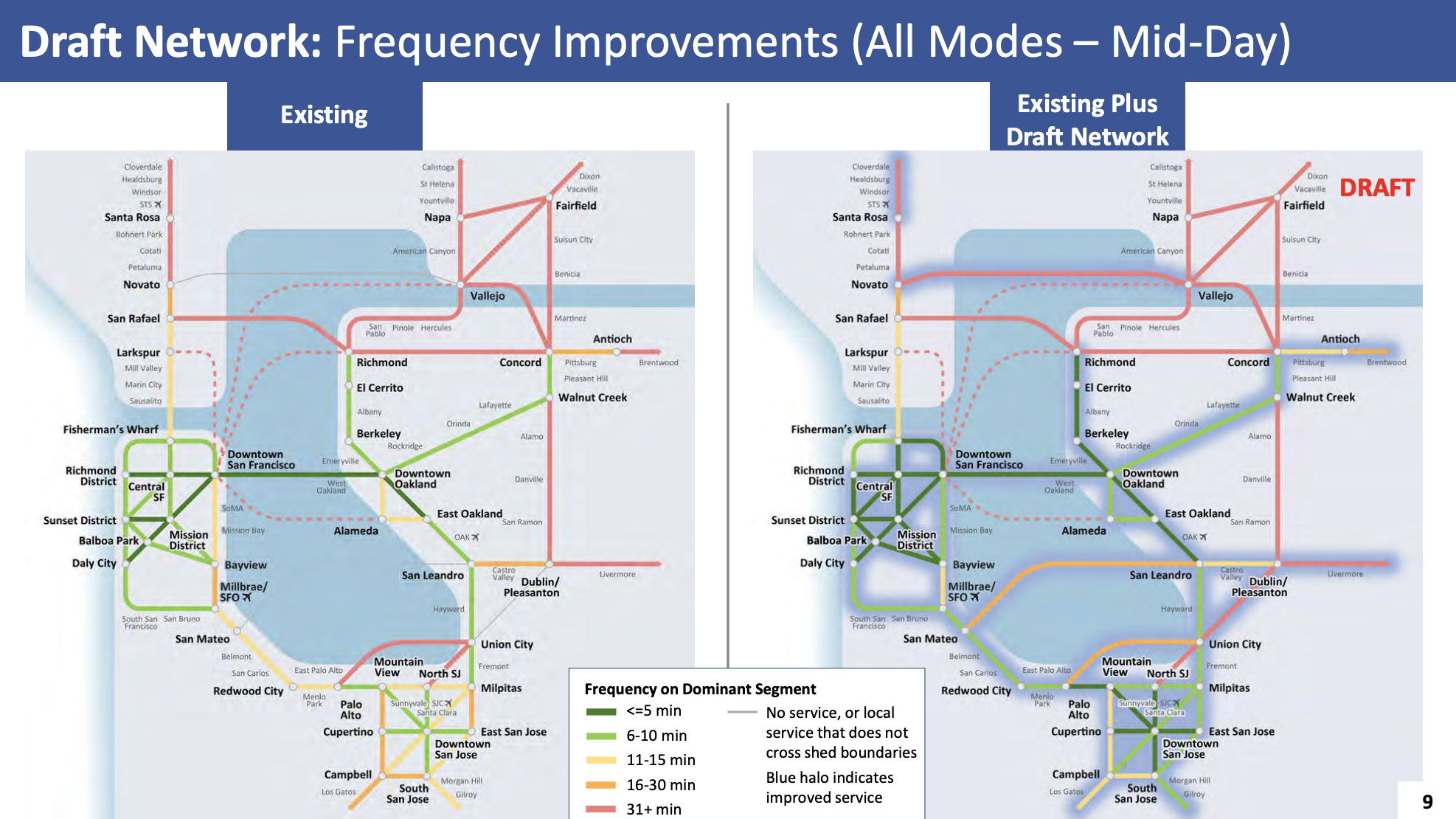
Source: MTC Planning Committee, Transit 2050+ Draft Project Performance & Draft Transit Network
Progress toward coordinating schedules around the region
The Big Sync (formally called the TRANSFER plan) is a twice-a-year initiative of Regional Network Management to coordinate transfers between operators. Operators assess wait times and tighten transfers at key hubs around the region to approach optimal transfer quality.
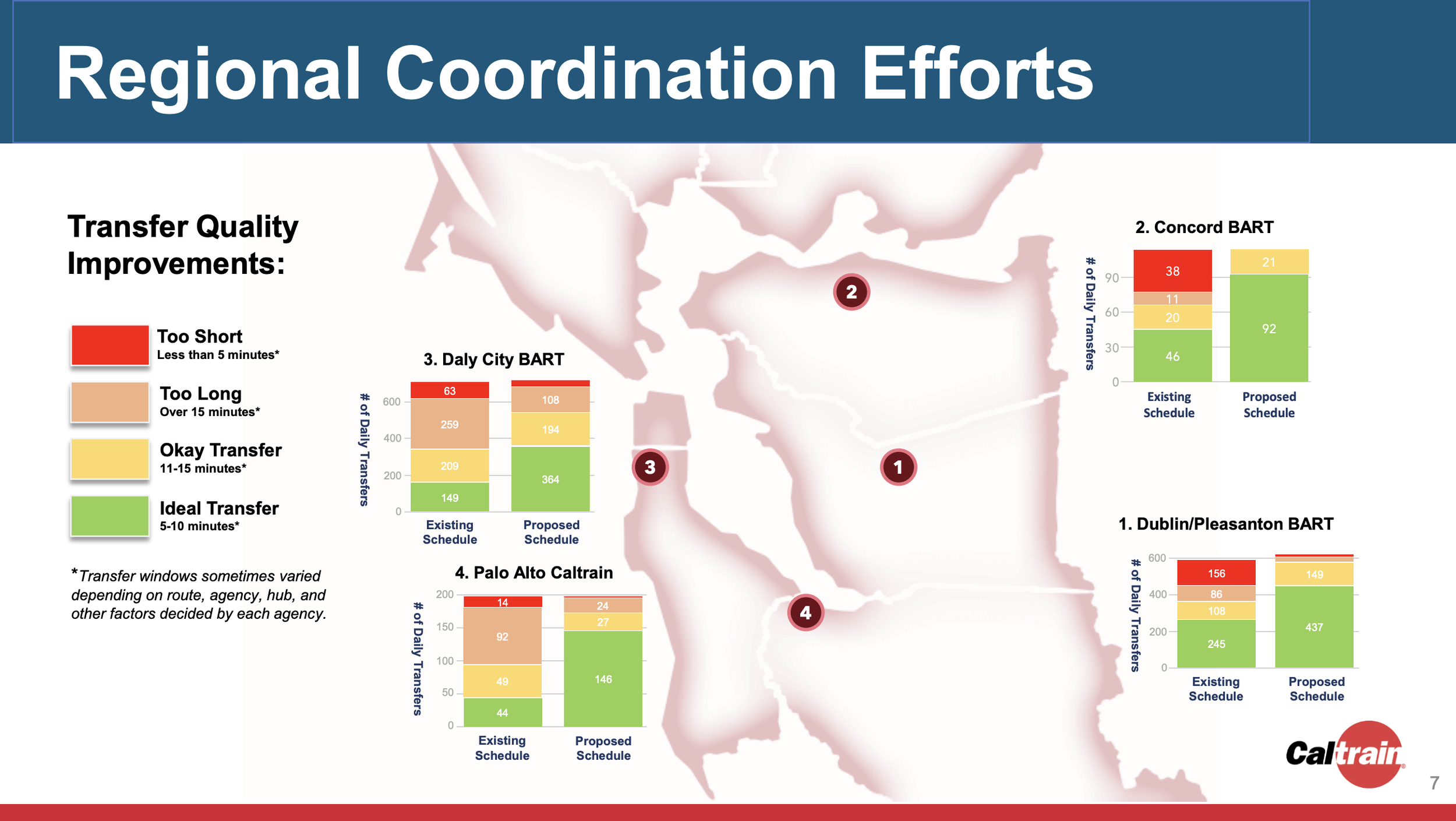
Source: Caltrain Citizens Advisory Committee, Service Planning and Regional Coordination
This initiative saves travel time for riders, making destinations more accessible and transit more useful. For example, with the Big Sync in 2025, agencies were able to save 14-17 minutes for riders transferring between Daly City BART and SamTrans buses, and riders between Dublin or Livermore were able to save 17 minutes on their trips to San Francisco.
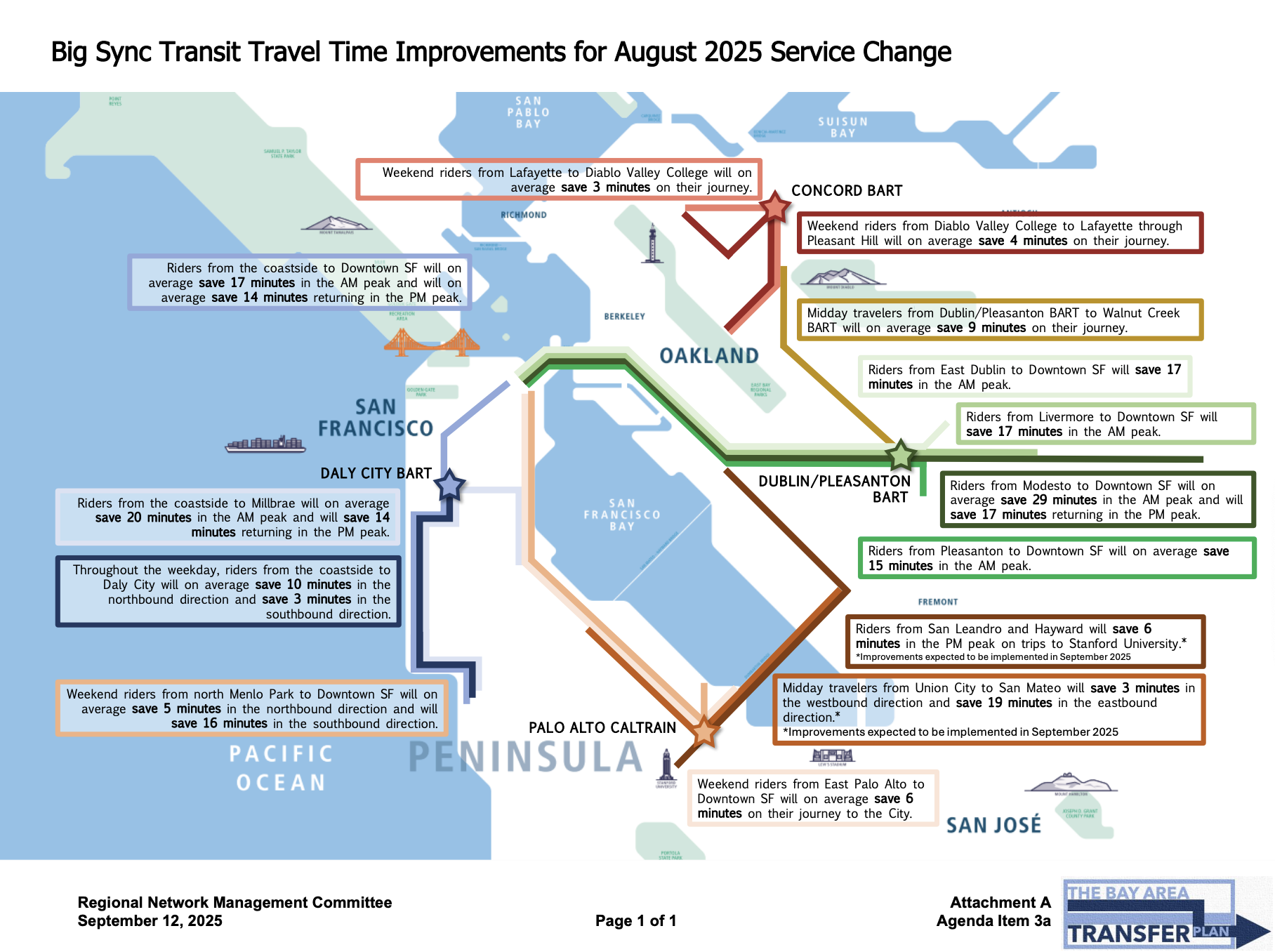
However, the Big Sync has limitations. It is required to be cost-neutral so that improvements can be made in the current budget cycles, in order to roll out changes immediately. It is very good to be able to roll out changes quickly.
Unfortunately, however, there is no defined process to take learnings from the Big Sync to prioritize additional capital and operating investments that would further improve transfers. For example, some transfer windows between a train and connecting bus are long because the connecting bus gets stuck in traffic. There is no explicit way to capture and prioritize important transit priority improvements to ensure that those connections improve over time.
Transit Priority Network in the works
Another current effort of the Regional Network Management structure is the Transit Priority Network. As the first step following the region’s new Transit Priority Policy, the Transit Priority Network is intended to outline a high-level vision for where transit priority investments will be focused across the region.
The first version of the Transit Priority Network is being defined in 2026 with a deadline this year to be able to use the next round of One Bay Area Grant funding as incentives. Having this deadline will be helpful to incent and fund more transit priority improvements. But because of this initial deadline, the first version of the “transit priority network” is focused on corridors and not networks, will not consider transfers, and may not include quantitative goals for speed and reliability improvements.
(The map below shows a preliminary set of transit priority projects proposed for Transit 2050+ in the PlanBayArea 2050+ regional transportation plan; the plan called for additional work to define the transit priority network).
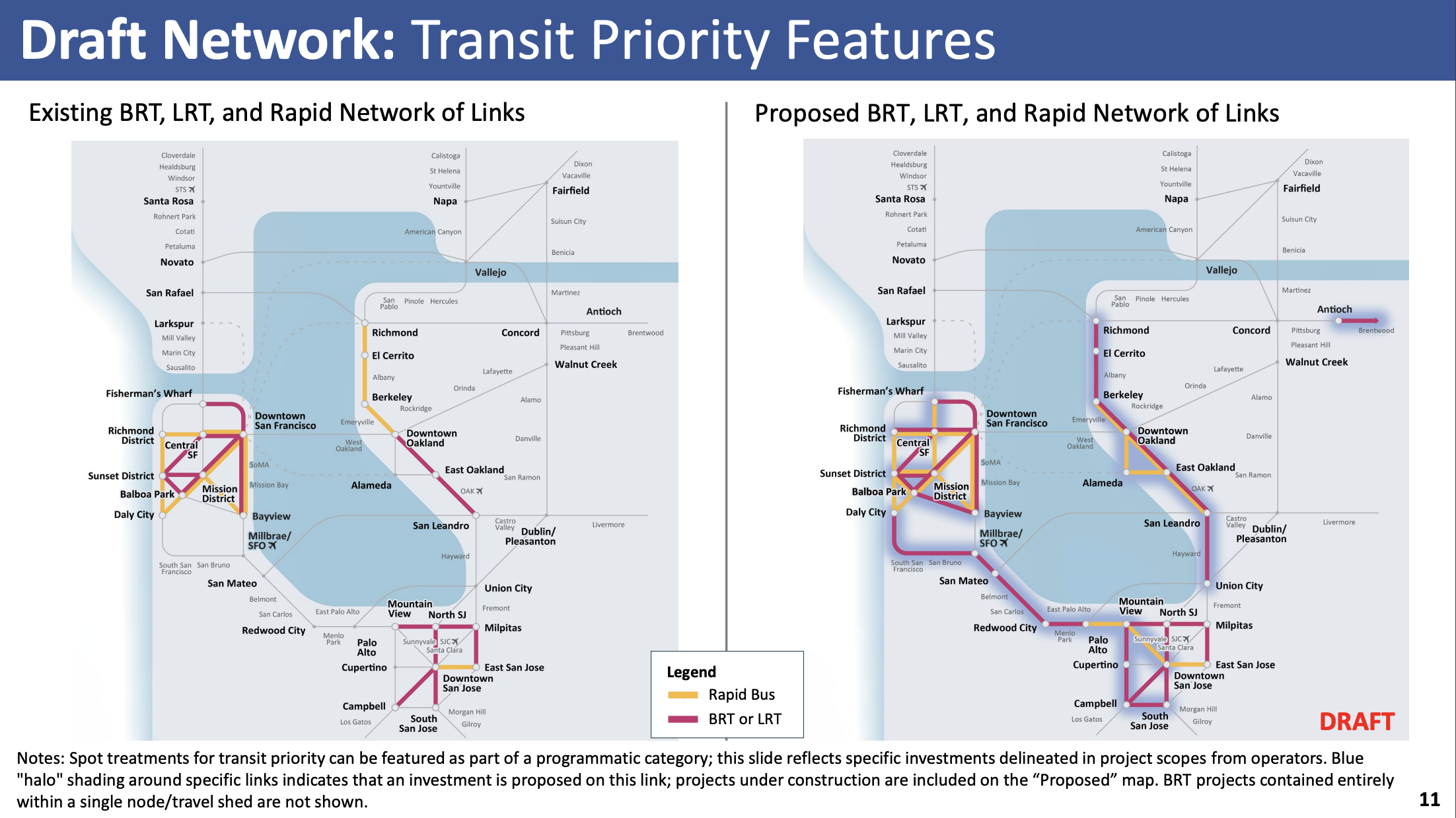
Source: MTC Planning Committee, Transit 2050+ Draft Project Performance & Draft Transit Network
Subregional network planning: MASCOTS
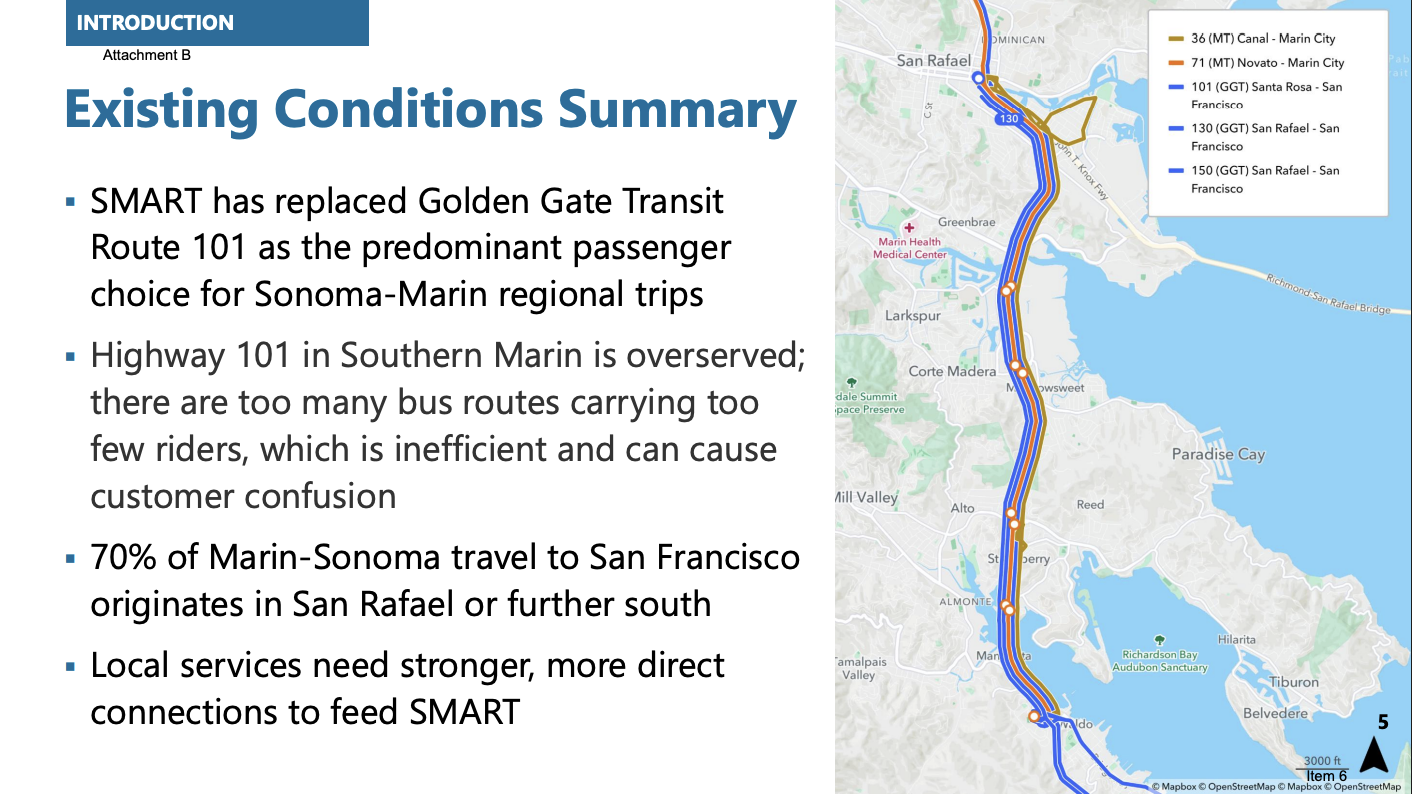
In 2025, Marin and Sonoma Counties initiated a subregional plan to coordinate transit service among six rail and bus agencies in the two counties. Starting in the Spring of 2026, the plan will re-organize service with agencies working together to deliver coordinated service for riders.
The plan recognizes that the SMART train has become the backbone for service in the region, and realigns bus service to connect to SMART.
However, the first version of the MASCOTS plan does not set travel time goals. Network connections are also hindered by the fact that SMART trains come every 32 minutes, which makes it difficult to have well-timed bus connections. SMART does have a capital project planned to bring the headway to an even 30 minutes, which would be easier to connect to. But the region does not have a clear process to prioritize improvements that would turbocharge connections.
Service-Led Planning delivering results in San Francisco
A Service Led Planning approach is already delivering results in the Bay Area, in San Francisco. SFMTA’s Muni Forward Program started in 2014 and set a service vision to provide a network of routes with 5-minute frequencies to create access to different job and amenity-rich parts of the city within 30 minutes.
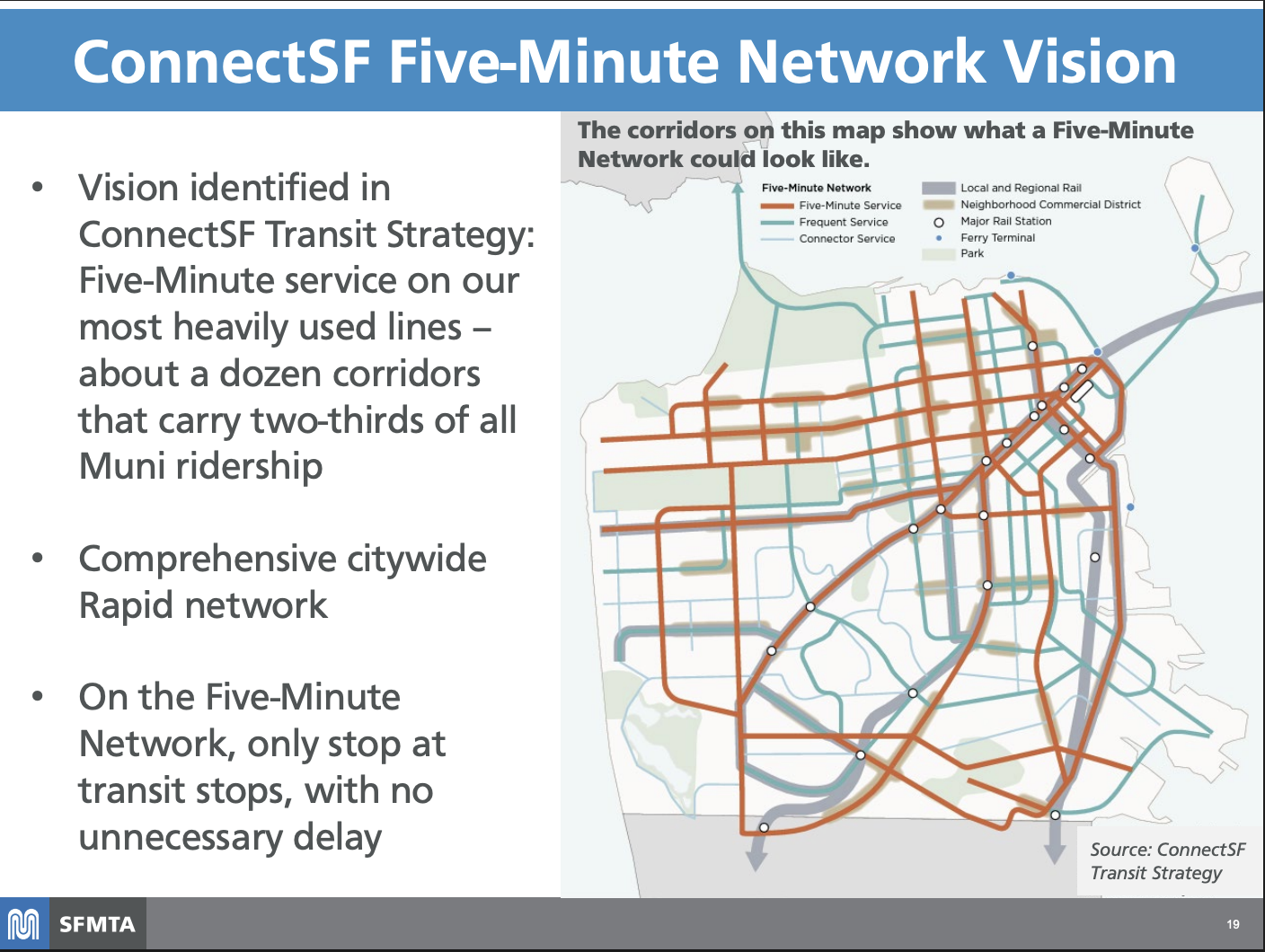
Source: Muni Forward Update
After developing this vision and service goals, SFMTA identified ways to improve existing service which was often notoriously slow. To do so, they identified bottlenecks in the network where transit was slow or frequently delayed.
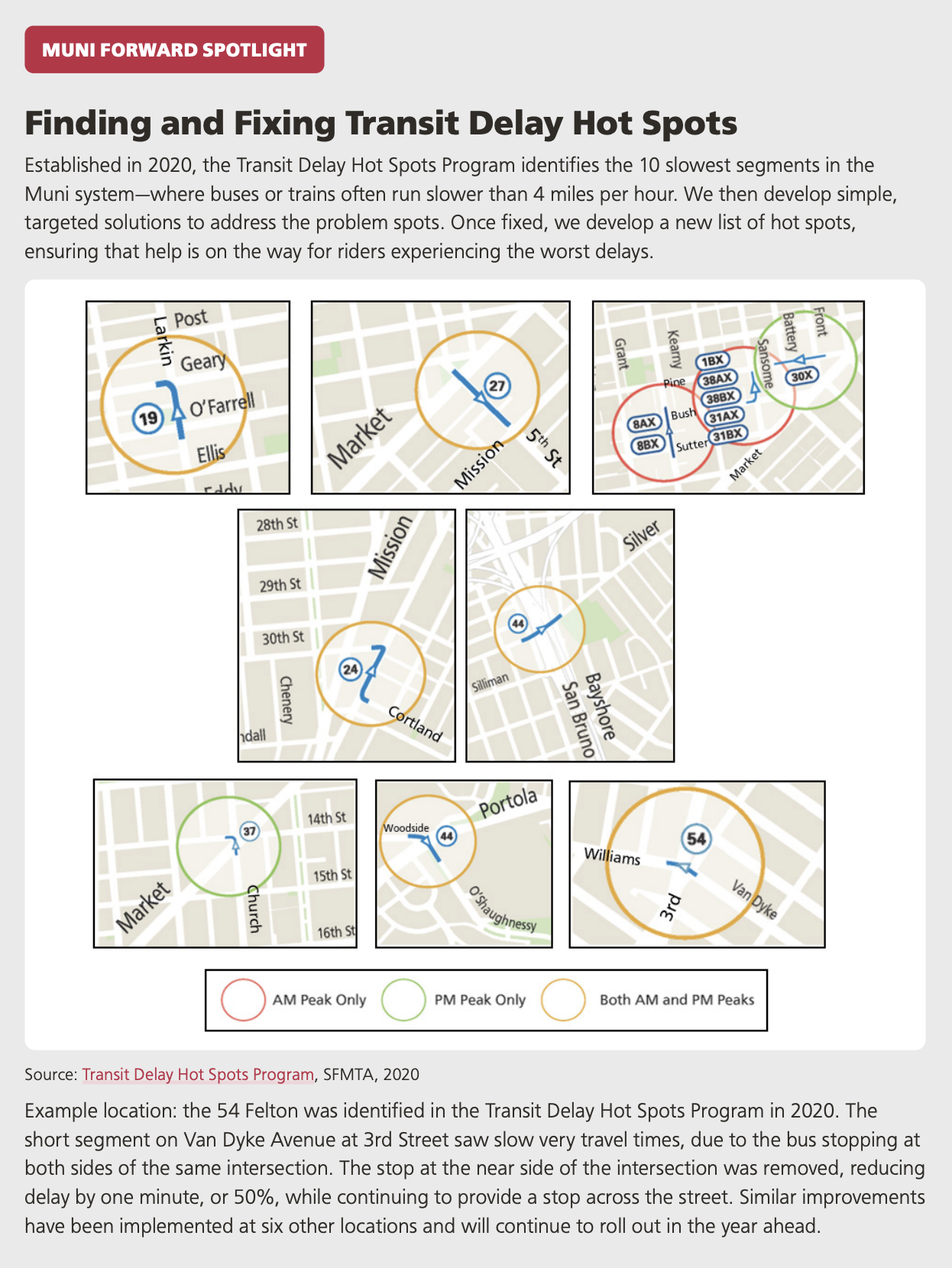
Source: Fast Forward: 10 Years of Muni Forward 2014-2024, SFMTA
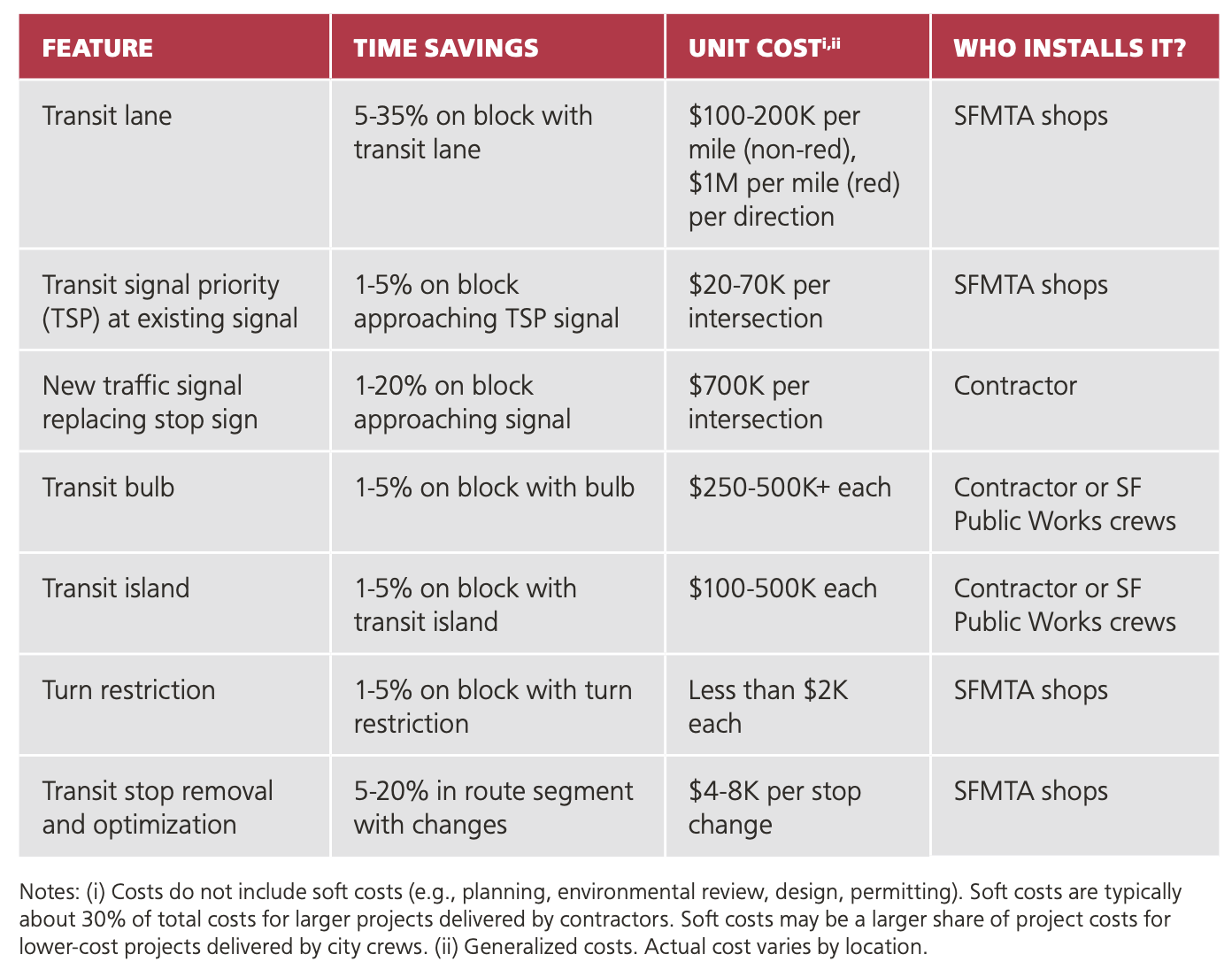
SFMTA then scoped out sets of low-cost, high value improvements that made progress toward the goal of saving travel time. They implemented the improvements, measured the results, and moved on to identify the next set of improvements.
Source: Fast Forward: 10 Years of Muni Forward 2014-2024, SFMTA
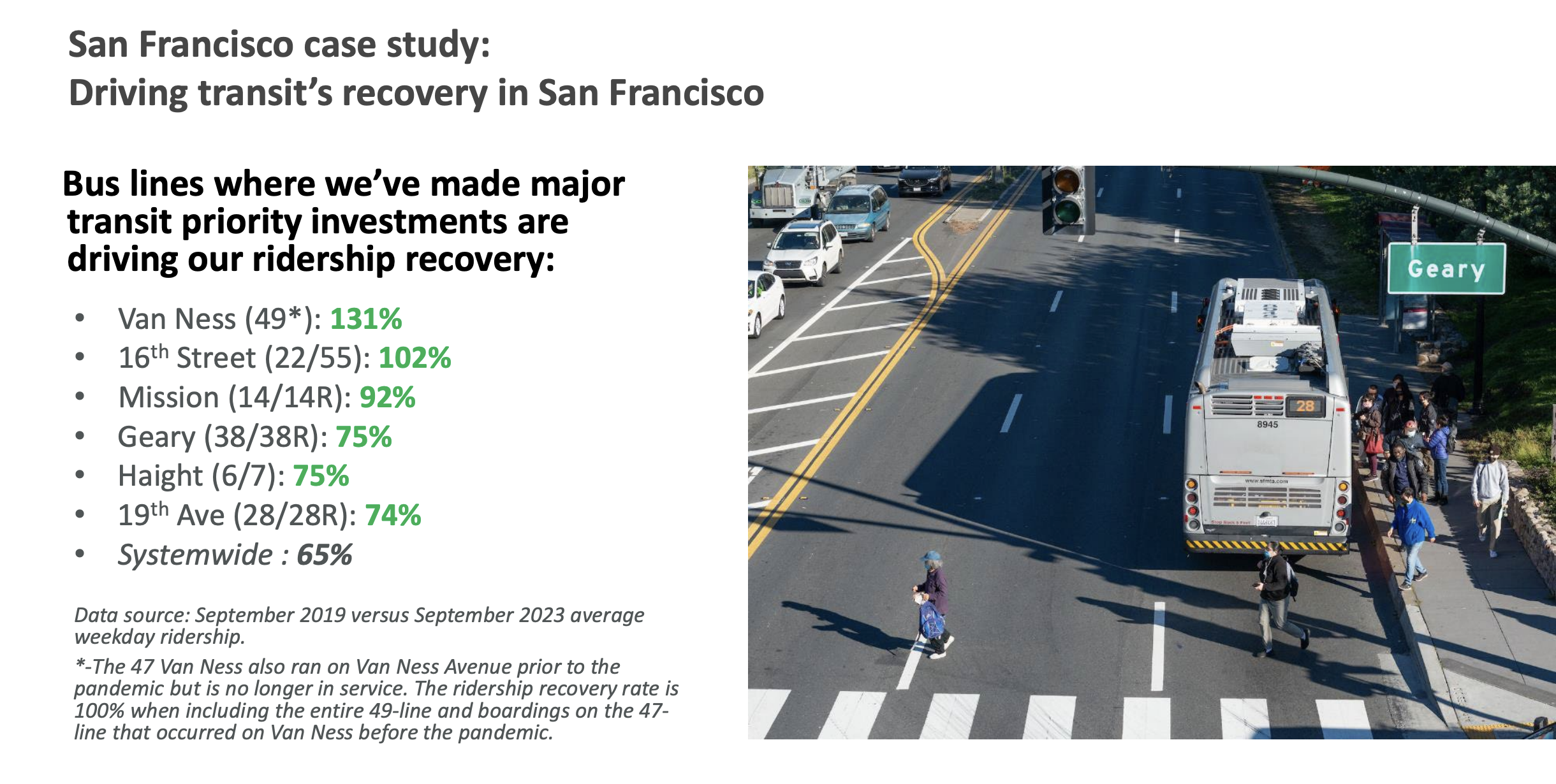
The result has been a staggering success. For riders, SFMTA was able to reduce travel times and delay significantly across a dozen lines. For taxpayers, Muni Forward was able to achieve savings of $5-$10M per year. Using this approach, SFMTA was able to increase ridership dramatically on lines where investments were made.
Service-Led Planning - Different goals for different places
Service-Led Planning always starts with quantitative service goals, but the goals can be different in different parts of the region. In San Francisco’s case, the goal was to improve travel time - San Francisco’s surface transit was among the slowest in the nation on congested streets in dense areas.
Other parts of the region will have different goals. In places like downtown San Francisco when buses come every few minutes, planning transfers is not needed and irrelevant, and headway - making sure the bus comes every 5 minutes without bunching - is more important than keeping to a specific schedule.
In other parts of the region, with less dense areas that have less frequent service, transfer time and keeping to schedule is much more important. The specific goals may differ across the region, what is universal is setting a service vision with quantitative goals, identifying a set of cost-effective improvements to advance the goals, funding and implementing, measuring again, and repeating the cycle.
Organization Before Electronics Before Concrete
Another common thread in SFMTA’s experience of service-led planning is following the European transit planning maxim, “organization before electronics before concrete.”
What this means is identifying improvements that are right-sized to solve a specific problem, starting with the lowest cost improvements such as moving a bus stop, then considering improvements in technology and equipment such as signal priority, and then considering larger capital investments such as a queue jump or a bus lane, or expensive projects such as grade-separating the bus or train from the roadway.
State Rail Plan
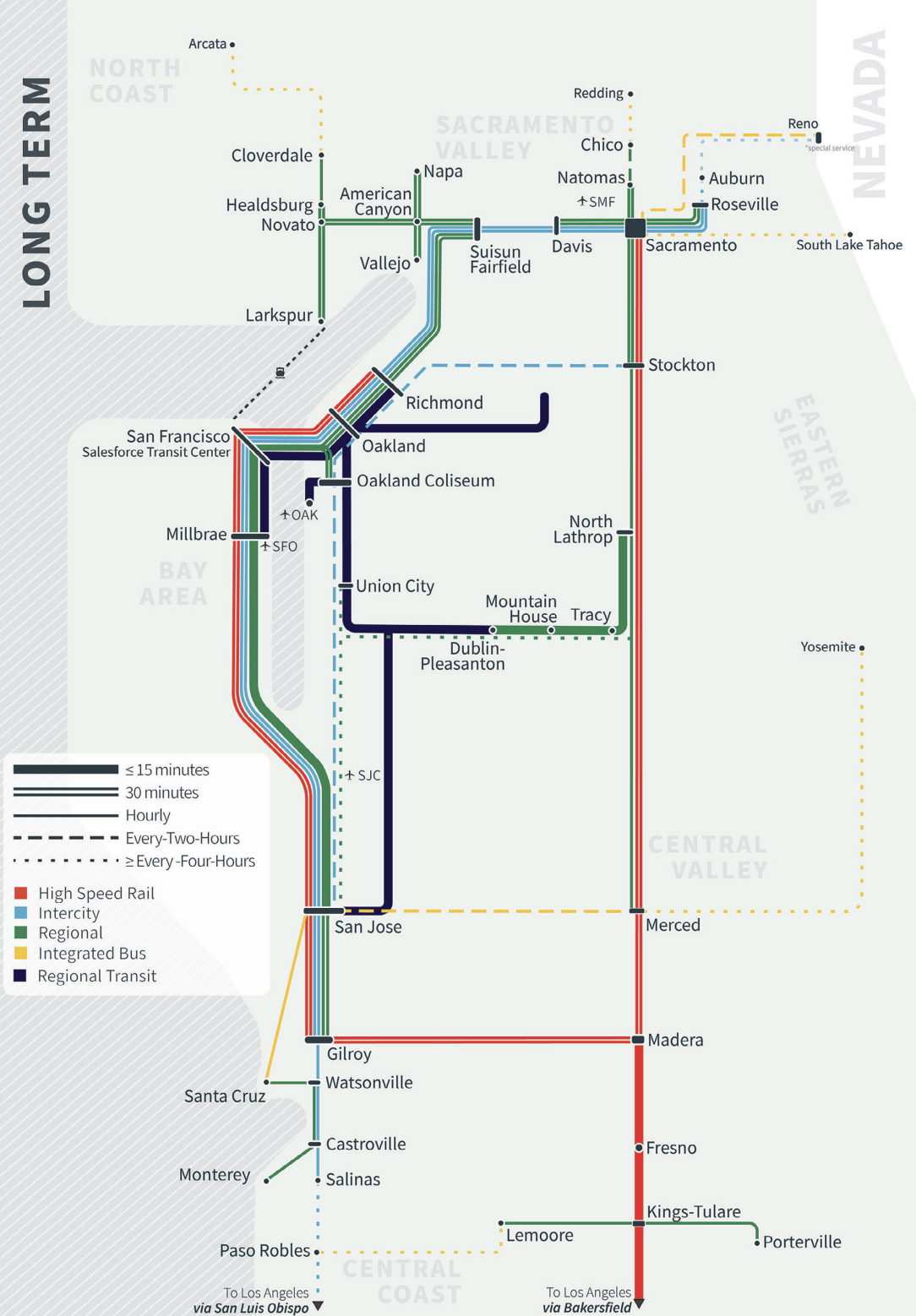
The State of California is using service-led planning as part of the California State Rail Plan.
While the State Rail Plan focuses on the state’s intercity rail network and is financially unconstrained, this approach is also relevant and valuable for service within the region, and can be used with financially constrained planning by identifying subsets of improvements that can be achieved within a defined time period.
Service-Led planning is key to improving cost-effectiveness
The “Service-Led Planning” approach is key to increasing cost-effectiveness of running the system, and increasing the cost-effectiveness of improving the system.
Making transit faster and more reliable in a quantified manner saves operating dollars, moving more people for the same amount of money. The savings can be reinvested in running more service or other improvements.
And using the “organization before electronics before concrete” approach is a secret to improving the system more cost-effectively. Using this approach identifies the most cost-effective set of improvements to achieve a defined goal of improving service for customers.
Taking the next big steps - building on Network Management Review
An important step to make bolder progress toward world-class service led planning is deciding to do it at the executive level. In 2026, the Regional Network Management system will conduct a 2-year review, learning from progress to date.
In the initial steps since 2021, agencies and MTC have been working incrementally. At first the larger goal of a regional service vision seemed daunting, especially with the historical challenges of collaborating among agencies. Now, with the success of the initial steps, and the good practice of agencies working together, the network management review is an opportunity to learn from the good and incremental progress at coordinated planning to set more ambitious goals to prioritize service-led planning to make progress toward a rider-friendly system.
At a time when budgets are tight, it is especially valuable to adopt service-led planning which is key to making it more cost-effective to run the system, and more cost-effective to improve the system.
In 2026, transit supporters have one big opportunity, and several medium-sized opportunities
The big opportunity: demand service-led planning as a goal of the network management review. When Network Management Review comes forward in public meetings this year, speak up and write in demanding the next big step for a regional network vision and a quantified, service-led planning approach.
A medium-sized regional opportunity: When the Transit Priority Network comes forward in public meetings this year, speak up and write in to demand quantified service goals, including goals to consider transfers.
More medium-sized local opportunities. When your county is considering expenditure plans for the Connect Bay Area ballot measure, and in the future for county measures, urge the counties to use a service-led planning approach to plan and prioritize improvements to service and capital projects.
Thanks to many transit supporters speaking up, we now have free transfers. Your voice will be important in the coming year to make much more rapid progress toward a rider-friendly, fast, frequent, well-connected network. We’ll keep you posted as these opportunities come up throughout the year.
Sign up here to get our blog posts sent directly to your email.