Bay Area transit executives support progress on integrated, affordable fares
Leaders of the Bay Area’s major transit agencies were strongly in favor of moving forward with next steps toward more integrated and affordable fares, at the most recent meeting of the region’s primary transit coordination forum, the Regional Network Management Council.
The support of the executives was based on strong results with the BayPass all agency transit pass pilot, which increased ridership by 30% or more at colleges/universities and other organizations; rapidly growing participation in the Clipper START program which provides a 50% discount to low income households; and vocal public support including rider comments at the meeting.
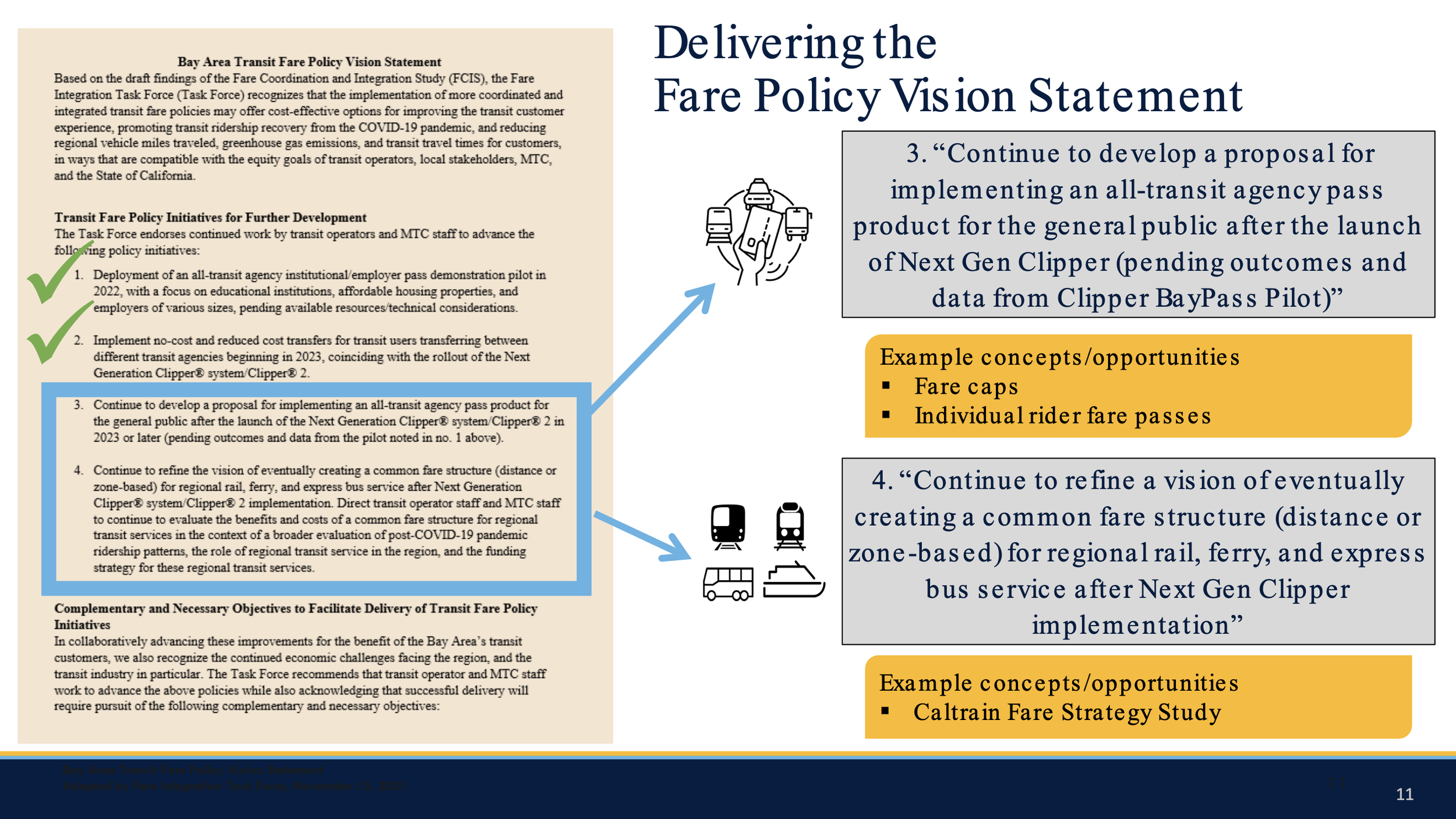
The next parts of the fare policy vision that are slated to move forward are having “BayPass for individuals” - an individual pass or cap to complement the successful BayPass program for organizations - and standardizing regional fares (BART, Caltrain, ferries).
Leaders of agencies that had been nervous or skeptical years ago are now strongly enthusiastic.
Greg Richardson of VTA said that “Clipper BayPass is the very best thing I've seen us do. For us, ridership is everything.”
Michelle Bouchard, Executive Director of Caltrain said that she is happy to have Caltrain's upcoming fare study to include other agencies and the potential to standardize regional fares. Bouchard’s statement was a big announcement and potentially a major step forward, since standardizing regional fares was analyzed to have the potential to substantially increase ridership.
Seamus Murphy of the San Francisco Bay Ferry (WETA) agreed that “BayPass is the best investment we can make, and we're in store for even more progress with the other policies that are in the queue.” Murphy described the major increases in ridership that resulted when his agency unilaterally changed their fares to match other regional services.
What should a “BayPass for Individuals” be?
Executives brainstormed ideas about what a multi-agency pass or cap for individuals might be. Figuring this out will take much more work to analyze and consider options.
Julie Kirshbaum of SFMTA suggested starting with a multi-agency day pass which is used in a variety of other regions, and maybe using a zone system to address the more common travel patterns
Danielle Schmitz of Napa Valley suggests also having subregional fare options because a lot of people in the North Bay travel locally only.
Integrated fares and payment to support low-income transit riders
Several executives noted how integrated and affordable fares benefit low-income riders and have the potential for greater benefits with more improvement.
Alix Bockelman of the Metropolitan Transportation Commission observed that the Clipper START low-income discount program only started growing rapidly once there was a program that was standardized around the region.
Sal Llamas, General Manager of AC Transit, urged progress on solutions for low income people who need places to add cash to Clipper cards, as well as other convenient payment solutions for people who are unbanked and underbanked. Llamas also suggested the need for group fares for families.
Rollout depends on Clipper - but don’t wait to plan next steps
Unfortunately, even getting current fare integration features to transit riders depends on the rollout of the next-generation Clipper system which has been very slow. Just over half of Bay Area Clipper transit transactions are on the new system which started to roll out seven months ago in December. Full rollout is awaiting fixes to some remaining problems including Caltrain’s fare readers and BART’s ticket vending machines.
Agency leaders continued to express frustration with the slow pace of Clipper rollout. Bob Powers of BART said that he is angry and embarrassed that the Clipper system is not fully working yet, and the problems are causing impacts on front line employees. Powers chastised Clipper staff reports that the number of problems blocking full rollout is getting smaller. “‘We're making progress’ is not satisfying when the fare inspection devices and fare vending machines are not working.”
Agency leaders did not want to wait for the rollout in order to start planning for the next set of improvements for more integrated and affordable fares. Bob Powers of BART pushed back against the current "waterfall" software development process, where the MTC team has been waiting for Clipper 2 to be fully rolled out to even start to think about what the next steps would be for integrated, affordable fares.
Organizational steps needed for success
The transit executives talked about organizational changes needed to make progress on more integrated and affordable fares. Until Monday, there were two different groups of transit executives, one group, the Regional Network Management Council, charged with implementing initiatives to coordinate fares, schedules and wayfinding; and an overlapping group, the Clipper Executive Board, charged with overseeing the fare payment technology.
The region’s two-year review of transit coordination efforts recommended merging these two bodies, since fare integration policy and payment are closely linked.
Julie Kirschbaum, Michelle Bouchard, Sal Llamas, Dennis Mulligan of Golden Gate and others spoke up in favor of continued joint meetings of Regional Network Management Council and Clipper Executive Board.
The next logical step would be to merge the bodies, and another logical step would be to have MTC and agencies co-lead the Clipper project, using the same “co-project management” model that has been successful with other coordination initiatives in the last few years.
In her report, the Regional Network Management Director Melanie Choy announced that MTC will be continuing to fund the co-project management model for joint MTC and agency leadership of transit coordination initiatives including transit priority and integrated, affordable fares.
As MTC and agencies delve deeper into the next steps needed to roll out integrated, affordable fares, more organizational changes may well be needed.
Seamless Bay Area’s work to communicate a vision of integrated and affordable fares, and to bring together an organizational coalition and rider base demanding these changes have provided the wind in the sails of progress toward integrated, affordable fares.
Thanks to everyone who spoke up over time, and in recent weeks. We’ll need to keep working together to make sure progress keeps moving - including making sure to pass the Regional Transit Measure which will fund 14 years of free transfers and Clipper START low-income discounts.
Sign up here to get our blog posts sent directly to your email.