
2025 Seamless Transit - Year in Review
Setting the stage for 2026 transit ballot measures
The main story of 2025 for Bay Area transit was the passage of legislation authorizing the Connect Bay Area regional ballot measure that will save Bay Area transit from dire cuts and advance seamless transit.
The story had twists and turns, particularly with San Mateo and Santa Clara Counties which demanded the right to affirmatively “opt in” to join the measure, and eventually decided to join after polling showed that the counties would be better off joining the regional measure.
Riders persistently spoke up in favor of saving transit, and taking a regional approach because riders depend on multiple agencies. Riders also stepped in to keep funding that will support popular provisions for coordinated and affordable transit, including free transfers and standardized low-income discounts for 14 years, integrated signs at hub stations, better coordinated paratransit and more.
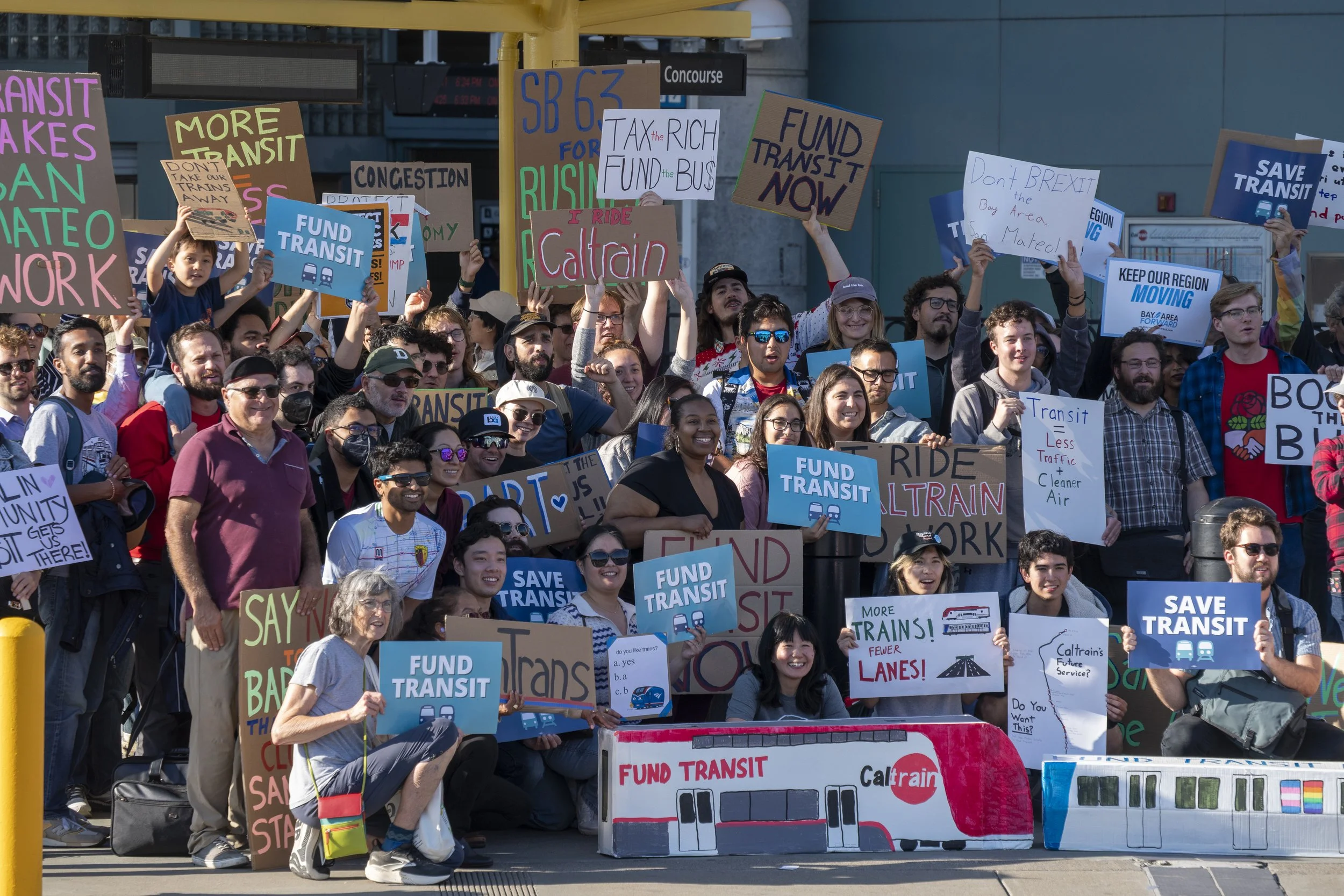
On July 1st, transit riders and advocacy organizations gathered at Millbrae Station at the Rally to Save BART and Caltrain in San Mateo County to push County leaders to join the regional transit funding measure.
San Francisco will also need a second ballot measure to prevent steep Muni service cuts, a story that was nearing a decision as the year ended. Muni’s budget had depended on the city’s General Fund and downtown parking revenue, funding sources that were especially hard hit by the pandemic.
A ballot measure in Marin and Sonoma Counties to keep SMART running also qualified for the ballot, bolstered by MASCOTS, an initiative to reorganize the North Bay transit system using SMART as the backbone.
Progress toward seamless transit
The Bay Area took major steps toward a more seamless transit system in 2025, with major progress on integrated and affordable fares. the long-awaited launch of free and reduced priced transfers, adding convenience and saving money for riders, and with open payment enabling people to pay with credit and debit cards serving 30% of BART rides out of SFO even before it was available on all agencies
The region’s popular BayPass all-agency pass pilot made progress this year when UC Berkeley students voted by over 90% to continue participation. A study of the pilot by MTC and partner agencies shows that the pilot increased ridership by 30-35%, made more than twice as many transfers between agencies as peers with single agency passes, and resulted in college students being 6-15% more likely to stay in school and employees being 44% more likely to stay at their current job.
The region’s all-agency “Clipper START” low-income discount program was made permanent, and ridership grew rapidly with better outreach and promotion. Plans to consider fare capping are in the queue for 2026. And the region advanced improvements to paratransit coordination with an initiative to pilot more “one-seat rides.”
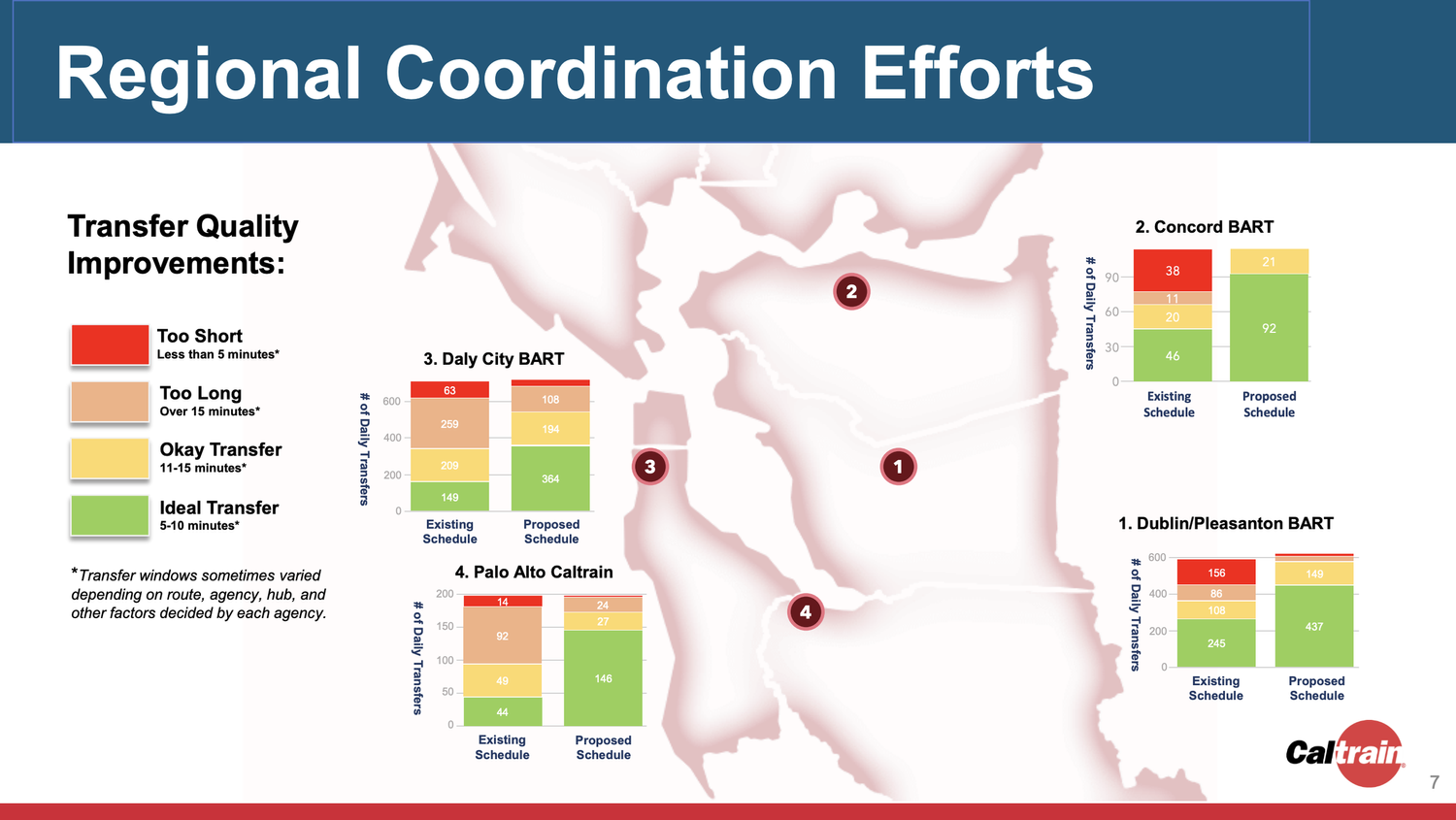
Agencies stepped up with the “Big Sync” to improve transfers at hubs around the region. The “Big Synch” is happening twice a year with new opportunities to improve transfers, now that agencies have aligned the schedule signups with labor unions. The “Clipper 2” system will provide better data about transfers, to help foster better coordination.
And the region moved to advance a network of fast and reliable buses with a Transit Priority Policy slated for approval early in 2026
Progress and challenges with state funding to keep transit running
Advocates for transit and housing won an important victory in 2025 with the passage of an extension to the state’s “Cap and Invest” program continuing funding for rail and transit capital and operations, plus funding for Affordable Housing for Sustainable Communities, the state’s largest funding program for affordable housing which supports developments near transit and transit improvements to support the housing.
Negotiations are still in the works to keep an agreement on a funding deal in last year’s budget with a deadline of January 10, 2026. In 2025, Advocates needed to keep the pressure on all year with the state budget, after the governor’s proposal in May proposed to cut funding. State budget advocacy with coalition partners and strong legislative leaders seemed to secure a $750 million loan to keep Bay Area transit running while the region works to pass the Connect Bay Area ballot measure. In September, when the Newsom administration seemed to walk away, advocates rallied and the deal was put back on the table.
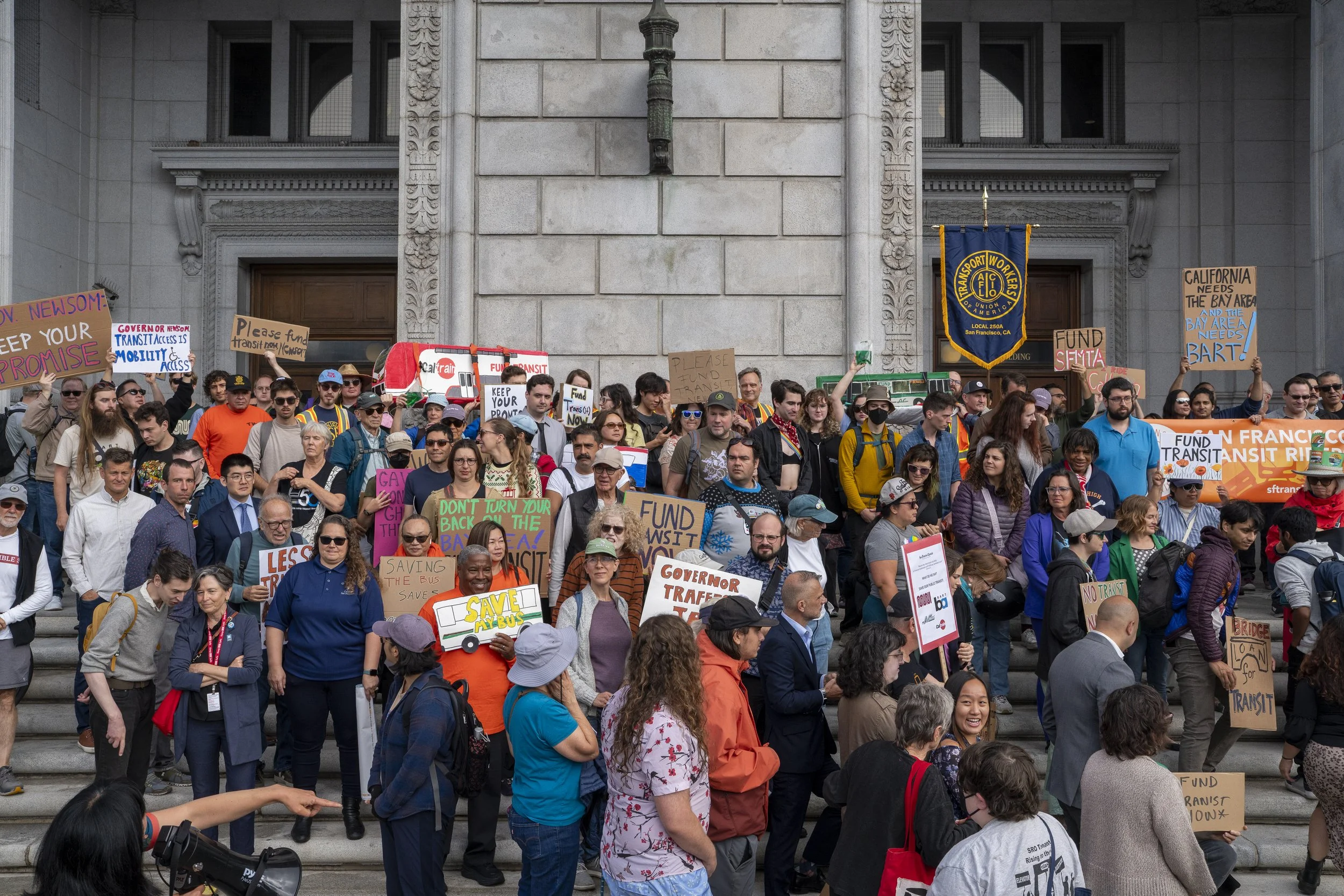
Advocates and elected officials helped revive negotiations for a $750M loan from the State government to keep Bay Area transit running before a 2026 regional transit funding measure at a San Francisco rally in early September.
One lesson is the importance of leadership by the state governor. We are working with coalition partners through Move California to raise transit as an issue in the governor’s race this year. Stay tuned for candidate interviews and forums.
State Task Force opens discussions about long-term transit funding and capital reforms
In December, 2025, the State Transit Transformation Task Force issued its final report (which still isn’t posted on the website). The Task Force had been established as part of the 2023 budget agreement with goals to consider long-term strategies to fund rail and transit, increase ridership and improve cost-effectiveness to achieve the state’s goals.
The final staff report toned down the near-universal support by Task Force members coming from advocacy, academia and agencies for the need to implement new state funding sources for to make rail and transit more frequent, fast, convenient and connected. Motivated by the discussion, Seamless Bay Area will be working with allies to educate and advocate for new funding sources in the next state administration.
The Task Force included a set of recommendations to improve accessible transportation for people with disabilities and seniors, setting the stage for badly needed improvements.
Regarding fare, schedule, mapping and wayfinding coordination, good staff recommendations called for regions to identify a lead agency or collaborate. While the task force ran out of time on the final day, there was enough support for the final task force recommendations to serve as a base for potential legislation, especially since the legislature’s mandate had called for recommendations on these topics.
The Task Force discussed and the report included multiple recommendations to reduce cost and speed delivery of capital projects across the project lifecycle, strengthening Service Led Planning to invest in projects with clear service goals and business justification, building up state capacity to speed up design cycles, reforming the permitting process which often adds delay. The Task Force process also opened discussion of reforms to state funding of capital projects to reduce delays caused by our current system of patchwork funding. The process opens the door for reforms and further education about international best practices.
Other regions set examples for California and the Bay Area
Meanwhile, other regions set good examples for the Bay Area and California. Illinois passed major reforms to fund and coordinate transit in 2025. In the Washington Metropolitan area, a task force finalized recommendations to advance a vision for seamless, integrated, and world-class transit including $460 million in new capital funding for Metro, starting in fiscal year 2028.
Seamless board member and co-founder travelled the world and reported on lessons we can use from Sweden about well-coordinated service and clearly defined roles and responsibilities among state, regional and local governments, and Taiwan’s fare integration driving ridership growth.
Setting the stage for 2026
The progress in 2025 has set the stage for an action-packed year in 2026. We’re looking forward to
a year-long race for must-pass regional and local transit funding.
opportunities to advance even more regional progress on seamless transit integrating fares, schedules and planning.
next steps toward more cost-effective projects to get us better transit faster.
lifting up transit and rail in the 2026 governor’s race to open the door toward funding and state support for more and better transit.
Sign up here to get our blog posts sent directly to your email.