
Federal Opportunities and Risks for Transit Reform: What the T&I Committee’s Surface Transportation Markup Means for Service, Costs, and the Bay Area
Introduction
This week the House Transportation and Infrastructure released a bipartisan markup of a Surface Transportation Re-Authorization called Build 250. This legislation, among other things, would govern transit, rail and other modes for the next five years.
It still needs to pass the Senate and may not become law before a new Congress is sworn in in early 2027. Nonetheless there are some interesting changes to transit that are worth noting.
Overall, the Build America 250 proposal has significantly lower investment in transit and rail relative to roads and bridges, as well as greater uncertainty for rail and transit year to year. However, lawmakers are bringing back a beneficial proposal to increase transit operations funding, with a goal to make it into the eventual final bill.
There are some other beneficial policy provisions with opportunities to enable wiser and more cost-effective investments in planning and strengthening the ability to invest in the core capacity of existing rail and transit systems.
Declines in Transit and Rail Investment
Overall the Build America 250 proposal has a significantly lower share of transit and rail investment relative to roads and bridges compared to the Biden-era Infrastructure Investment and Jobs Act (IIJA).
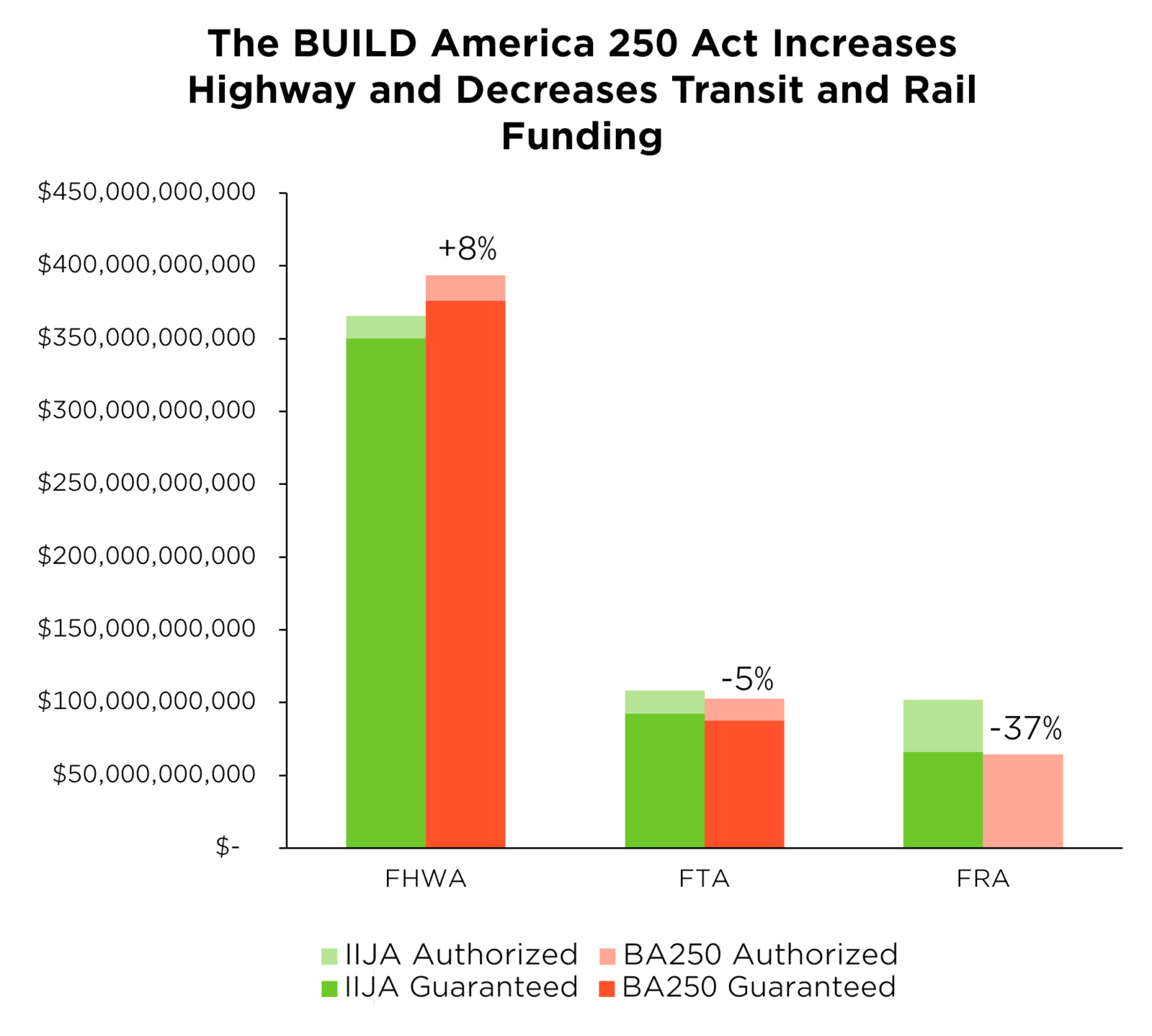
The proposed BUILD America 250 (BA250) Act increases funding to the Federal Highway Administration (FHWA) relative to the Infrastructure Investment and Jobs Act (IIJA), also known as the BIL. Of note, a higher proportion of Federal Transit Administration (FTA) and Federal Railroad Administration (FRA) funding is subject to appropriations (STA) from the General Fund. Full authorization spreadsheet. (Source: Union of Concerned Scientists Blog)
Critically many of these transit and rail investments lost their advanced appropriations status relative to the IIJA - which means capital investment is subject to more annual political uncertainty. As outlined by Eno, uncertainty drives sub-optimal service, routing, planning and construction decisions which in turn drives schedule and budget negatively.
Unfortunately Rep. Hank Johnson’s Stronger Communities through Better Transit bill to provide operations funding did not make the Build 250 markup. That operations support is sorely needed.
Build 250 imposes new obligations for transit in terms of safety. Operators receiving urbanized formula funding must spend 1% of their revenue on crime prevention. It also imposes new performance requirements for operators to improve workforce and passenger safety by reducing the numbers and rates of assaults and other violent crime and mitigating fare evasion.
There is also a consolidated transit fund option for states to spend money as a block grant. Theoretically this could provide states with more flexibility to spend money on operations. That flexibility, however, at least in California, is infrequently used by the DOT and MPOs.
Transit and Rail Planning
A persistent historical issue has been the lack of incentives and resources for local governments, operators and regions to plan via service-led planning in either rail or transit.
Instead project sponsors - such as transit agencies or local governments - have had to promise specific infrastructure (e.g. a subway from A to B; or BRT from C to D) to sell voters on tax measures to unlock detailed planning and design dollars. These early commitments to routing, infrastructure and technology prior to significant alternatives planning, environmental review and configuration design locks-in decisions where more cost-effective solutions may exist. As a result infrastructure scope and schedule are often far more expensive and lengthy than need be to provide good service.
A theme in Build 250 is an acknowledgement that transit and rail need access to early planning and design resources to break this negative feedback loop.
The new proposal has a provision for Metropolitan Planning Organisations (MPOs) like MTC to use Metropolitan Planning Program funds for fiscal administration, transportation studies, local technical assistance, and preliminary design.
This provision could enable wise MPOs to retain planners and designers on staff or through inter-agency agreements with large agencies like BART or LA Metro or Caltrans. Then these planners and designers can be deployed on a rotating basis to local governments and smaller transit operators. This retained state capacity would reduce the need for each project to overrely on large consultants for project design, and has been shown to be correlated with lower transit and infrastructure costs.
Unfortunately there is no explicit provision within Build 250 to provide for more regional or interregional service led planning or coordination activities. Nonetheless a motivated MPO could use the new eligible activities under Build 250 to support service planning, schedule coordination, fare integration, service development planning and other activities to create an integrated transport network.
Similarly, FTA Capital Investment Grants (CIG) programs will now explicitly allow for project sponsors to receive reimbursement for project development costs incurred prior to entry into FTA CIG Engineering and Construction phases. This reduces some of the incentive for operators to proceed to the ballot for construction funding with only conceptual designs with large amounts of undefined scope - which typically results in large cost escalations.
Local operators will still need to find sources of working capital for early design - either through MPOs as mentioned above or through loans provided by State DOTs. And there is still some risk that sponsors don’t proceed into the Engineering and Construction phase and don’t receive reimbursement - which should be an incentive for projects to hold down costs and maximize benefits to increase the likelihood that their projects will advance.
On the intercity rail side, Build 250 provides some project delivery reforms while also providing more scrutiny and administrative burden. The Corridor ID Program, a centralized pipeline to advance local passenger rail proposals into federally supported, construction-ready projects, was considerably strengthened under the IIJA and provides a clear stage-gated process for sponsors using Service-Led Planning. A stage-gated process provides clear steps for planning and public feedback so that decisions can be made transparently and at the appropriate time. It also provides progressive reimbursable Federal matches for project development.
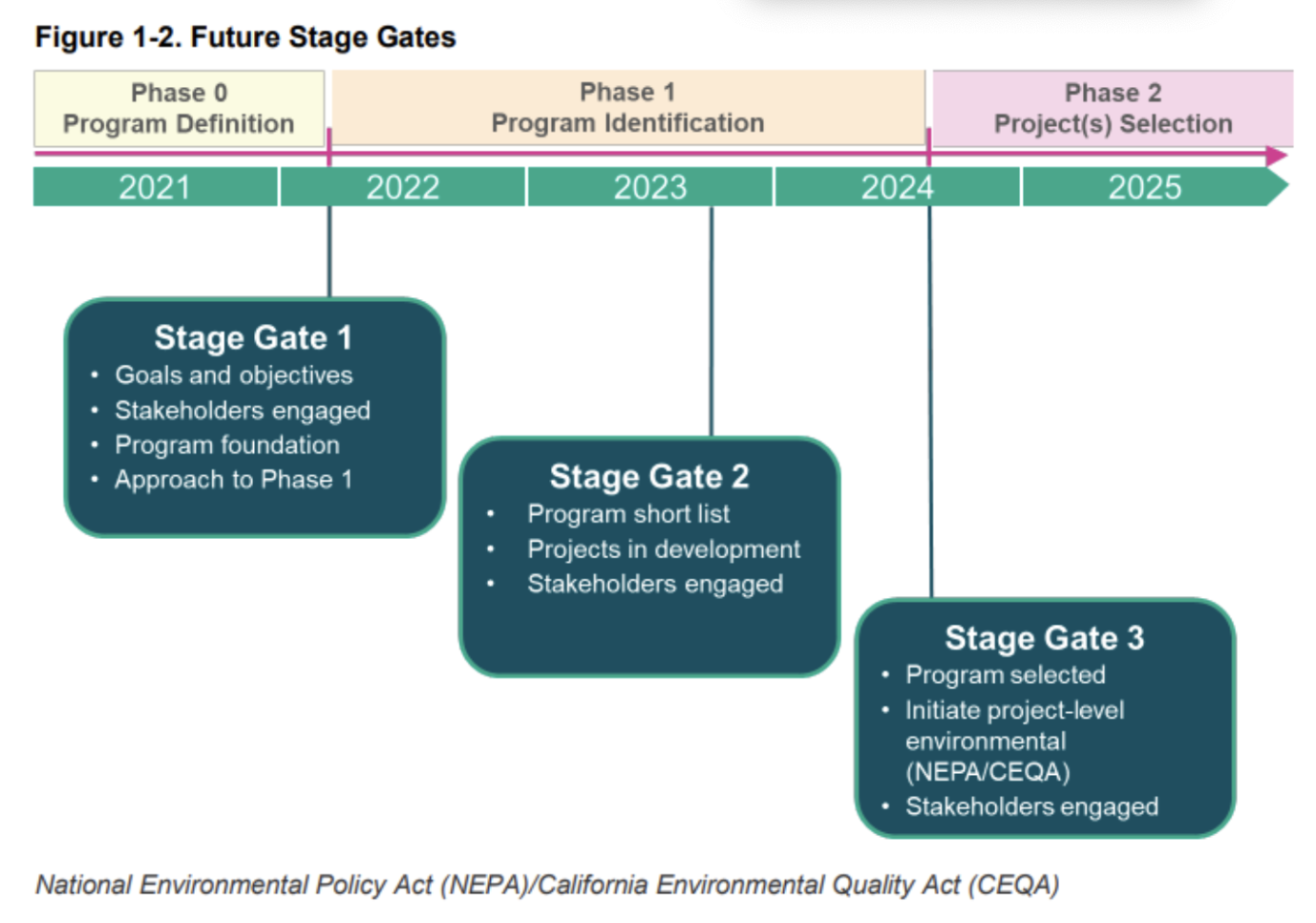
Under the Trump Administration, the Corridor ID Program has ground to a halt as the administration has refused to allow project Service Development Plans prepared to advance to the next stage. The FRA has imposed ad hoc and non-statutory requirements on Corridor ID sponsors’ Service Development Plans as well.
Build 250 states projects can now - with some discretionary guardrails - advance work like environmental review and preliminary design concurrently thereby speeding up project development timelines.
At the same time Build 250 would codify the new requirements pushed by the Trump FRA on Service Development Plans. These include: 1) analyses of impacts of service on freight; 2) required mitigation infrastructure for freight impacts; 3) a more rigorous financial plan review. Build 250 also states that no new Corridor ID applications will be selected after 2031 - effectively ending this planning program as a going concern. This would be a severe misstep since Corridor ID provides a clear and resource-backed path for states to improve passenger rail service.
Ultimately more transparency and scrutiny should be helpful in reducing costs and maximizing benefits for rail. It is worth noting, however, that none of these sort of accountability measures are applied to Federal Highway Administration (FHWA) road funding in Build 250.
Capital Investment Grants (CIG): Some Useful Reforms
Smarter Investments in Core Capacity
Another historic challenge for federal transit investment has been the focus on new extensions at the expense of investing in core service where land uses already support transit use. The Core Capacity program has provided some investment - such as signaling upgrades to modernize BART’s Transbay Tunnel to push trains per hour from 24 to 30 - but it has a narrow focus on pure capacity - projects that enable more buses or trains to run than current service.
Missing are other types of improvements to core service such as by reducing travel times, improving reliability and accessibility. More buses or longer trains may not be helpful if the travel times are slow or unreliable. Similarly the Core Capacity program has been narrowly focused on individual corridors rather than improvements that can help transit networks.
This is where Build250 shines. It opens up funding at up to 80% Federal share to projects that increase system capacity. Furthermore it requires applicants to show how they will reduce travel times, including for passengers with disabilities.
This is important for two reasons. First because it recognizes that transit is competing against other modes such as driving alone along the dimension of travel time. In many locations with ample parking and wide roads, transit is at a disadvantage due to the additional end-to-end travel times to and from stations. By prioritizing reductions in travel times broadly, Build250 allows planners to identify different ways to speed up trips: Converting a very high ridership bus line to a subway? Transit priority? Improved signaling? Platform screen doors? Level boarding? Faster and bigger elevators? All of these interventions could be wrapped into a Core Capacity modernization program to deliver service benefits to riders.
The second reason this is important is that it recognizes that transit improvements for speed and capacity are often more affordable when we conceive of transit as a network. A one seat ride for the corridor between Oakland to Palo Alto might cost $20bn via a new Transbay Tunnel. But in the medium-term it may be more cost effective to focus on extending Caltrain to the Transbay Terminal and building an underground pedestrian tunnel to Montgomery BART to facilitate this trip. And in the short-term improving the BART/Caltrain transfer at Millbrae and providing level boarding at Caltrain stations to reduce dwell times. Under the existing Core Capacity framework, it is unlikely that such projects would be competitive but under BUILD 250 they would be.
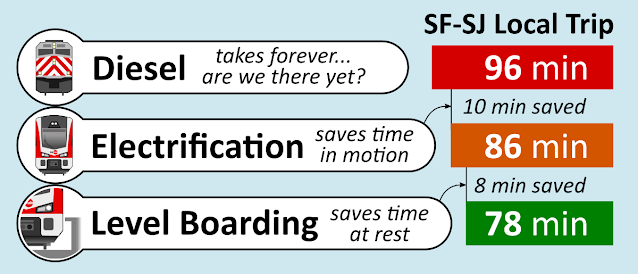
Caltrain travel time savings from Electrification and Level Boarding. Source: Caltrain HSR Compatibility blog.
Projects that would benefit from these Core Capacity projects include Caltrain Level Boarding (8 minutes travel time saved), SMART Passing Sidings Near Petaluma (reduces base headway from 32 minutes to 30 minutes to allow for integrated transit and ferry transfers), LA Metro A and E Line Grade Separation south and west of Downtown LA (decreases trip time and massively increases reliability), BART Metro Service via tail tracks and new yardspace (10 minute repeating interval schedule or base frequency all week), and BART Platform Screen Doors and Automation (Decreased trip time and more frequency).
An open question for Build 250 is whether agencies that propose to increase capacities or speeds through converting a high frequency bus line to elevated or subway will be penalized for retaining some local bus service. This is important in the context of the long gestating Geary Boulevard Subway. It’s hard to imagine that - even with a subway - that SFMTA would not run some bus service on Geary for shorter trips or transfers as station distances can reach 1-3 miles beyond the walkshed of many potential riders. Other FTA programs tend to punish capital projects that do not discontinue bus service, which is unfortunate. The best transit networks have bus and rail complement each other and Federal programs should encourage this.
Small Starts → “Streamlined Starts”
Under the Build 250 markup the Small Starts program is renamed Streamlined Starts. The project cost cap is raised from $400m to $1bn but the local/federal split has been reduced from 20/80 to 50/50.
Historically Small Starts has been focused on new fixed guideway systems, extending existing rail or BRT corridors. This has led to a proliferation of new streetcar, light rail and BRT projects under Bush II, Obama, and Trump I (to a lesser extent) in many Sunbelt locations. Oftentimes these have been far flung extensions or new services that have not driven ridership.
Streamlined Starts expands into core capacity improvements for existing systems. This would fund modernization programs, including double tracking, signals, electrification, platform extensions, new rolling stock for improved service, infill stations, and accessibility improvements. The text also includes a subjective catchall section to cover other capacity improvements at the discretion of the Secretary of the DOT.
As discussed above, these changes recognize that some of the highest value transit network improvements are located on existing transit lines. Other changes in the bill text emphasize that these modernization benefits need not accrue simply to a single corridor but to the “system.” These may seem like small changes are important because it shifts transit planning from conceiving a single BRT line to making improvements that help multiple bus lines or serve inter-operator transfers.
Intercity Rail Funding
Build 250 changes to FRA’s capital programs are mixed. The biggest blow is the loss of advanced appropriations provided for in IIJA. Advanced appropriations meant that FRA and project sponsors could spend and depend on $66 billion over 5 years. This allowed program managers to rationally advance planning and design so projects are “fundable” at the appropriate time.
Build 250 throws FRA funding programs back to discretionary annual fights with Congress. This uncertainty drives risk, delay and cost escalation for projects. Advanced appropriation does not provide as much certainty as the “contract authority” provided to DOT road projects but it is a meaningful improvement.
On the rail safety side, the Consolidated Rail Infrastructure and Safety Improvements (CRISI) Program becomes more friendly to freight rail and removes the cost benefit analysis requirement for certain eligibility categories that mostly accrue to freight rail.
Build 250 consolidates different grant programs for intercity rail into a single pot of money. This is probably helpful in terms of streamlining administrative burden for both FRA and sponsors and increasing total potential award sizes - although this is more challenging with a declining share of investment.
Equipment: Small but Meaningful Tweaks
Bus Procurement
The fastest way to improve transit service sometimes is simply for agencies to acquire more and more reliable buses to run more service. Unfortunately US bus prices have increased far faster than global peers. Buy America requirements - one contributor to the cost premium - are untouched by Build250. Another contributor is the tendency of bus agencies to issue bespoke bus procurement specs that effectively curtail access to a wider market of suppliers. While there may be very limited use cases for an agency to issue a particular spec, the vast majority of operators do not have a good use case for custom buses.
Build 250 encourages operators to specify performance outcomes rather than prescriptive bus designs. This can help increase competition in the bus market and limit delays and change orders that often plague vehicle procurement.
Rail Financing
Amtrak, state-supported services and regional rail operators have often struggled to proactively procure modern rail stock affordably and quickly. A large driver of this has been the reliance on discretionary funding from Congress, which makes it harder for potential equipment purchasers to join together in procurements and suppliers to plan for growth. This boom/bust cycle is a domestic worst practice for rail equipment.
Build 250 attempts to address this (not by providing steady funding for equipment) but by incentivizing interstate pooling of equipment by making changes to the Railroad Rehabilitation and Improvement Financing (RRIF) program to encourage pooling. These low-interest loans can help operators between different states to pool cash contributions from future years to pull forward equipment for tomorrow.
Other changes to RRIF make the program more attractive to freight, regional and intercity passenger rail through more favorable terms, alignment with other grant programs, and increased RRIF credit facilities.
Taken together, especially with changes to Core Capacity and Streamlined Starts, RRIF could be used to support modernization programs including electrification of regional and intercity rail.
NEPA Streamlining
Build 250 spends considerable time on streamlining NEPA for transportation projects. Some of these changes are sensible in any context - like allowing parallel review and requiring a “one decision maker framework” for collecting agency review and comments. Given, however, how tilted overall Build250 is towards freeway investment without scrutiny relative to transit the benefits of such changes will not be accrued primarily to transit.
On the plus side for transit and rail, Build 250 allows project sponsors to proceed with right of way and other construction land acquisition prior to completion of the NEPA document. This is a courtesy Congress has provided to State DOTs for a long time. Transit and rail, however, have had to delay ROW acquisition too late in the game when land prices have inflated. Late land acquisition also pushes out project schedules and increases program risks.
Conclusion
Build 250 contains useful but modest reforms, overshadowed by funding cuts and missed opportunities.
It is unclear whether it will pass this Congress in 2026. For significant improvements like Core Capacity, Streamlined Starts, support for planning and design and financing changes it is critical that these sections are part of any final bill passed in 2026 or in the future.
Where Build 250 falls short on transit and rail - such as the shift away from multi-year funding back to discretionary grants, and the lack of operations funding - significant pressure will be needed to be placed on Congress.
Seamless Bay Area readers are encouraged to stay engaged, support regional reforms to advance well-coordinated and cost-effective transit, and to push for a federal framework that aligns with what riders actually need.
Sign up here to get our blog posts sent directly to your email.