
Notes from Sweden: Centralized Capacity, Multi-Year Funding Frameworks, and Project Sponsorship Enable Transformative Capital Projects
This blog is the fourth and final in a series examining what lessons California can learn from Sweden’s public transit system, focusing on capital projects. The first post explained why Sweden is relevant to California; the second explored Sweden’s system of regional governance that enables coordination; and the third explained Sweden’s system of service contracting.
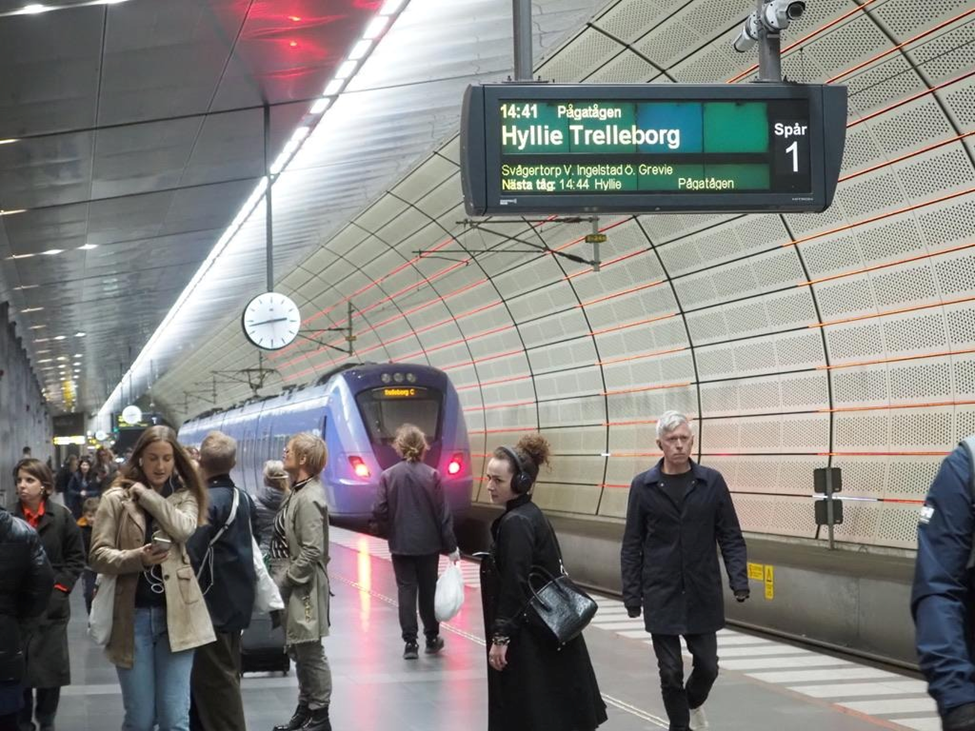
Öresundståg regional rail in Malmö (Skåne), southern Sweden, a project that transformed regional connectivity, opening in 2000.
Sweden has world-class public transportation infrastructure thanks to years of continuous investment, enabling expansion of metro, tram, regional rail, and bus networks across the country. Stockholm’s metro, the Tunnelbana, has over 100 stations—an impressively large system for a region of only 2.5 million people. High-quality intercity and regional rail connect all major populated areas in the country, which is larger than California and has just a quarter of the population.
Sweden not only spends heavily on transit infrastructure—it also gains tremendous value for each dollar spent. Numerous studies have found that Sweden has relatively low capital project costs compared to other wealthy nations—for example, tunnels cost 63% less to build in Sweden compared to the US.
While many factors contribute to Sweden’s effectiveness in delivering capital projects, in this blog I’ll focus on three specific practices that are particularly relevant to California at this point in time:
Centralized state capacity
Multi-year funding frameworks
Business cases and ‘project sponsorship’
California’s recent SB 125 Transit Transformation Task Force and the current governor’s race have created new momentum to bring down capital project costs and implement these practices in California - so understanding key lessons form Sweden is more timely than ever.
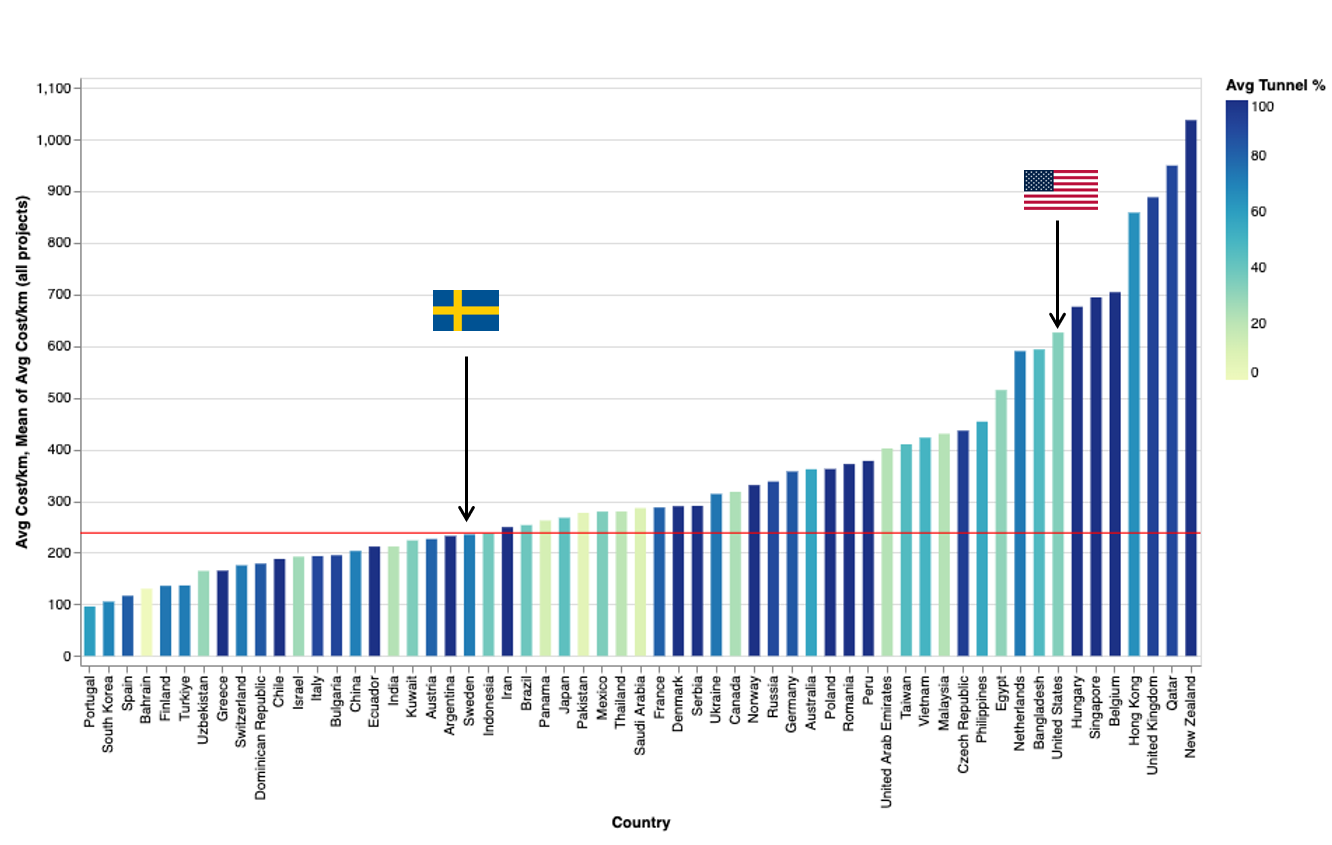
Average Tunneling Costs of various countries, with Sweden and the US highlighted (NYU Transit Costs Project).
Centralized Institutional Capacity at Trafikverket and Region Stockholm
Trafikverket headquarters in Solna, a city in Sweden’s Stockholm region.
Sweden’s Trafikverket, employing 11,000 people and overseeing all forms of transportation in the country, is at the heart of Sweden’s success in delivering major capital projects cost-effectively. It leads all long-range planning and determines what major capital projects to fund and build through multi-year funding frameworks. Unlike the US, where most railways are privately owned by freight railroads, Trafikverket owns, maintains, and oversees construction of the country’s highway and rail infrastructure. As such, it manages its use by both passenger and freight traffic.
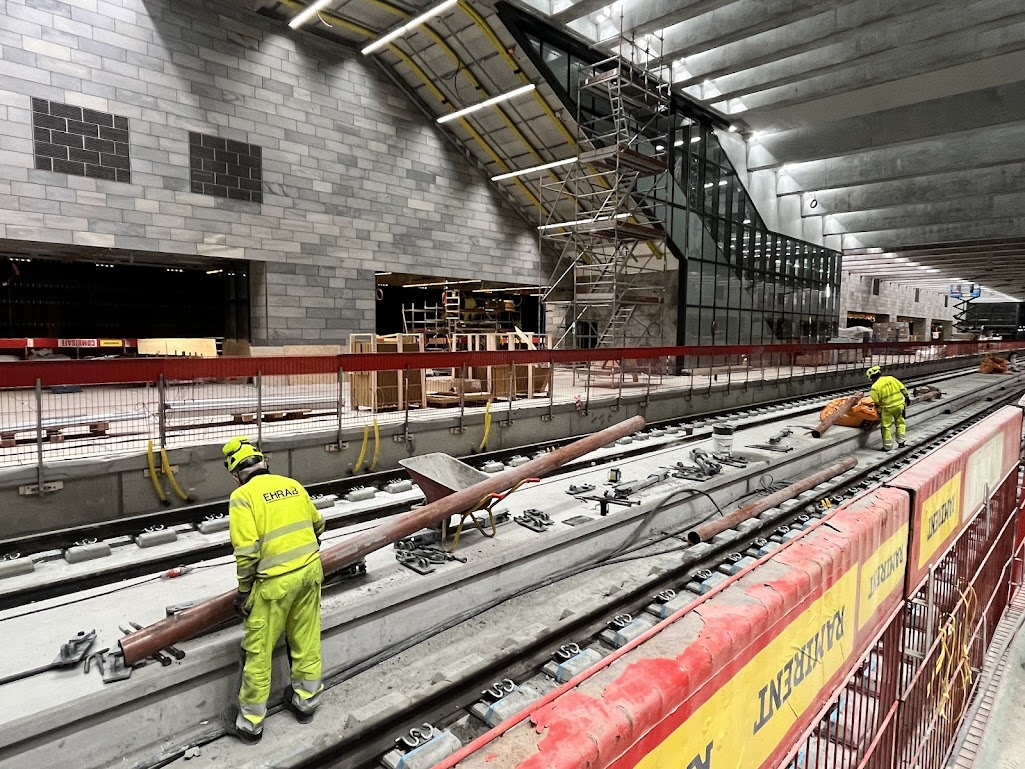
The West Link (Västlänken) project in Gothenburg will convert a stub-end central rail station to a through-running station. Costing 32 billion SEK ($3.5 billion), the project is being delivered directly by Trafikverket, in coordination with Västtrafik, the local PTA for the Gothenburg region.
A key difference between Trafikverket and many US state transportation agencies, such as California’s (CalSTA/Caltrans), is that Trafikverket directly oversees the delivery of most major transit projects in the country. By contrast, in California and many states, planning and design are left to local transit agencies which often lack capacity and expertise. Trafikverket generally leads all project development, design, and construction activities of major transit projects. The major exception to this is metro and tram projects in Stockholm, which are led by Stockholm’s Public Transit Authority (PTA), or regional network manager, Region Stockholm. This is because Stockholm’s metro and tram system is so large and extensive, and runs largely on its own infrastructure separate from the national rail network.
The fact that just two agencies—Trafikverket and Region Stockholm—take the lead on virtually all major transit capital projects results in centralized expertise in transit planning, design and construction, rather than individual agencies or regions trying to build capacity from scratch in order to do something they have never done before. Both Trafikverket and Region Stockholm employ transit experts directly and perform significant work in-house. They rely less heavily on outside consultant teams to design and deliver projects, as is more common in the US. The largest transit project in the country, the 18-station, 30-kilometer Nya Tunnelbana expansion of the Blue Line of the metro, is so large that Region Stockholm has created a special-purpose entity to oversee it.
Multi-Year Framework Funding
Like many other European countries, such as Switzerland, Norway, and France, Sweden determines its major capital investments through 12-year long-range plans, updated every 4–5 years. These plans evaluate various projects according to defined cost-benefit analyses and result in lists of projects that the national government agrees to fund, largely in full.
As Californians for Electric Rail’s report documents, this is very different from how California and most US states conduct long-range planning and funding. In the US, states or the federal government will often only fund a small portion of a project, and local agencies are forced to cobble together multiple sources of funding to move forward. It can take years to bring together all the funding that is required to move a project forward, and these delays cause further cost escalations, contributing to longer project timelines and higher project costs.
Sweden’s current 12-year National Plan, which covers the years 2026–2037, was released in draft form in September 2025, and it will be confirmed by the Swedish legislature no later than summer 2026. The plan identifies 1,171 billion SEK, or US$127 billion, worth of capital improvements over a 12-year period. Roughly half of that amount will go toward maintenance of existing road and rail infrastructure, and the other half to expansion projects. Of the investments in new rail and roadway infrastructure, rail is allocated 80% of funds, with roads receiving just 20%—consistent with Sweden’s major policy goals to promote mode shift and reduced emissions from transportation.
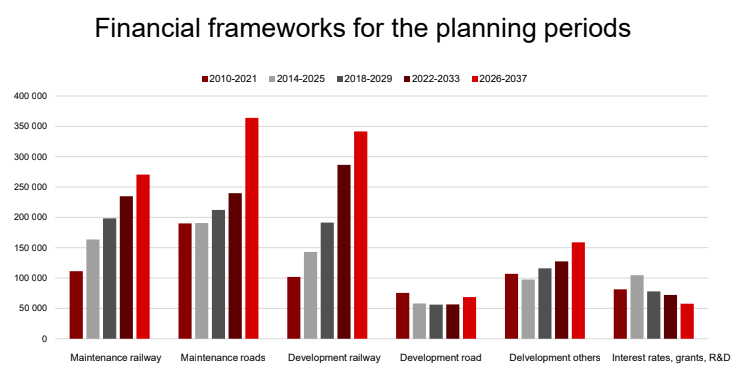
Excerpt from an English presentation of the current 12-year National Plan, indicating increasing investment in rail infrastructure, particularly relative to road infrastructure, over successive updates of the plan (Trafikverk.
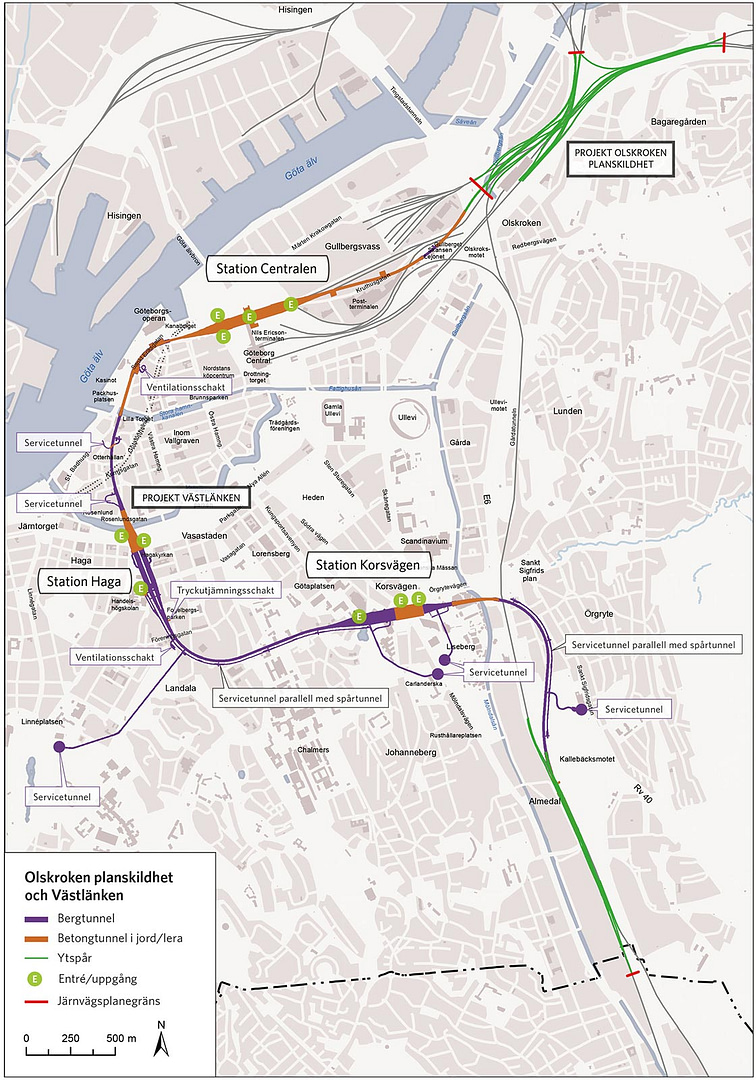
Map of the Västlänken project in Gothenberg, converting the main central station into a through-running station, and adding two additional stations, Haga and Korsvägen, and enabling significant additional service capacity.
To select which capital projects are included in the plan—and ultimately which receive funding—Trafikverket oversees a common cost-benefit methodology so that any project across the country can be compared using the same criteria. The ASEK guidelines, as they are known, are developed using scientific evidence and are maintained by Trafikverket so that they can be applied consistently to all public transport infrastructure investments in any part of the country. The guidelines define common principles, unit values, cost categories, discount rates, and valuation methods that are used in cost-benefit assessments (CBAs).
In the US, by contrast, while conducting a cost-benefit assessment is a requirement of federal funding for most transit projects, there is far less standardization in how they are prepared or the cost assumptions they should use. The analyses are prepared by local governments applying for funding—who then usually contract out to consultants—creating an incentive to inflate potential benefits and downplay potential costs in order to make a project more competitive. Sweden’s approach, where the analysis and methodology are closely managed by Trafikverket instead of local governments, reduces the likelihood of bias and has a better track record of accurately predicting project costs.
Business Cases and Project Sponsorship
Sweden’s standardized approach to cost-benefit analysis is part of a broader framework designed to ensure that infrastructure projects have a clear justification and deliver strong public value. Two central elements of this framework are business cases and project sponsorship, which together ensure that projects are not only well-justified at the outset, but remain justified as they evolve.
Business cases and project sponsorship are widely used across Europe, the United Kingdom, and increasingly in Canada for transportation investments. While these practices are common in private-sector infrastructure industries in the United States, such as oil and gas, they remain relatively uncommon in the U.S. public transportation sector.
Business Cases
A business case provides the structured rationale for undertaking a project. According to the UK’s Association for Project Management, a business case:
“provides justification for undertaking a project, programme or portfolio; it evaluates the benefit, cost, and risk of alternative options and provides a rationale for the preferred solution.”
Other regions and countries have developed standardized business-case frameworks to support consistent, evidence-based decision-making. For example, Metrolinx in greater Toronto has published a set of helpful documents detailing its standardized structure for business cases, which include four core components:
The Strategic Case: How does the investment achieve strategic goals and objectives?
The Economic Case: What are the economic benefits and costs of the investment?
The Financial Case: What are the financial implications of delivering the investment?
The Deliverability and Operations Case: What risks and requirements must be considered for delivering and operating the investment?
Sweden’s business case framework, overseen by Trafikverket, is referred to as Socio-Economic Decision Support. This process begins with Sweden’s four-step principles which tests whether new infrastructure is truly necessary before advancing to detailed design:
Rethink transport demand
Optimize existing infrastructure
Improve existing assets
Invest in new infrastructure
Reminiscent of the “organization before electronics before concrete” maxim, these principles act as an early-stage challenge function before a full business case is developed. For projects where a need for new infrastructure is clearly established, Sweden requires not only the development of a CBA, but also an overall impact assessment (similar to Metrolinx’s Economic Case), considering land use impacts, regional development effects, non-monetized environmental impacts, and other strategic considerations.
The mandatory preparation of a business case for any Swedish transit project results in a clear, comprehensive, and comparable summary document bringing together a project's complete set of costs and benefits that can be used to make funding decisions.
In the US and California, instead of using business cases, the environmental review process—CEQA in California, or NEPA for any project that includes federal funding—has come to be used as the main decision-support tool that informs what projects get funded and how they are designed.
CEQA and NEPA are fundamentally different from a business-case process because they are primarily concerned with minimizing impacts of a project rather than maximizing benefits from an investment. While both a standard business case framework used in Sweden and a CEQA framework used in California analyze various ‘project alternatives’—for example, different alignments for a new rail extension—Sweden’s business case framework focuses on identifying the best project that delivers the most public benefits relative to cost. By contrast, California’s environmental review framework can encourage selection of alternatives that minimize perceived impacts—even when those alternatives significantly increase costs without improving system performance.
Project Sponsorship
Developing a strong business case at the beginning of a project is essential—but maintaining that discipline throughout the project lifecycle is equally important. This is the role of project sponsorship.
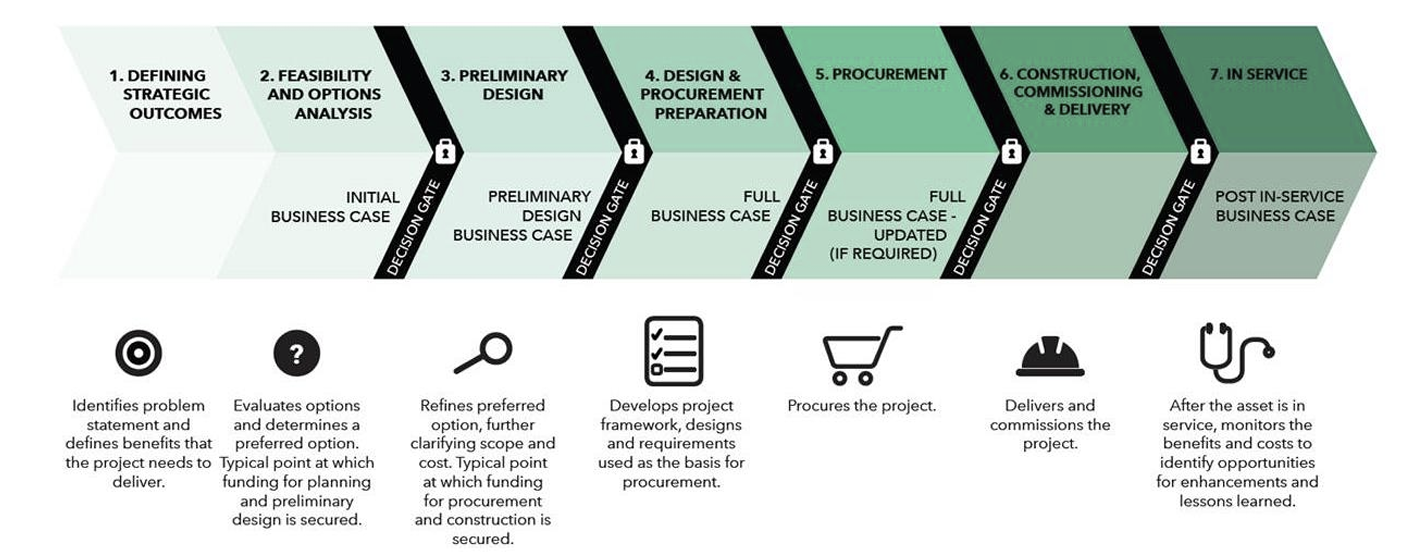
Metrolinx graphic showing how a business case analysis used and updated over the project lifecycle to support decision-making. A project sponsor is typically responsible owning the business case and ensuring the benefits of the project are delivered as a project moves through design and constructions.
Project sponsorship ensures that the benefits identified in the business case are continuously monitored and protected as a project moves through design and construction. A project sponsor is typically responsible for:
Owning and maintaining the business case
Tracking whether projected benefits are still achievable
Reviewing cost changes as design advances
Managing stakeholder expectations
Confirming at key milestones that the project still delivers value
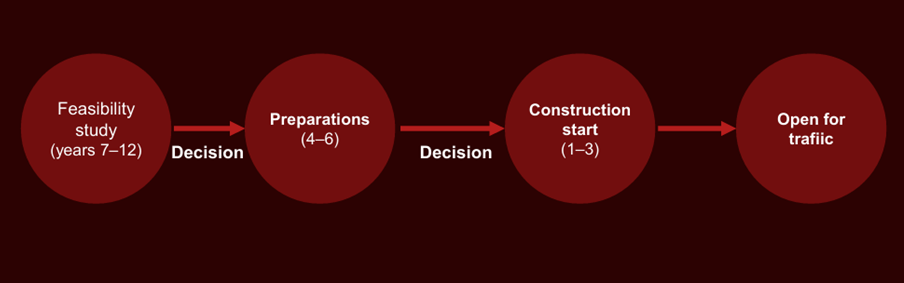
Excerpt from a presentation from Trafikverket describing Sweden’s 2026-2037 Multi-year funding plan and the key decision-points that a project sponsor must take a project though to receive full project funding. At each decision point, the cost-benefit analysis is updated to ensure that benefits still justify the cost.
This role is distinct from that of a project manager. While project managers oversee schedule, budget, scope, and quality, sponsors are responsible for ensuring that the project continues to deliver its intended public value.
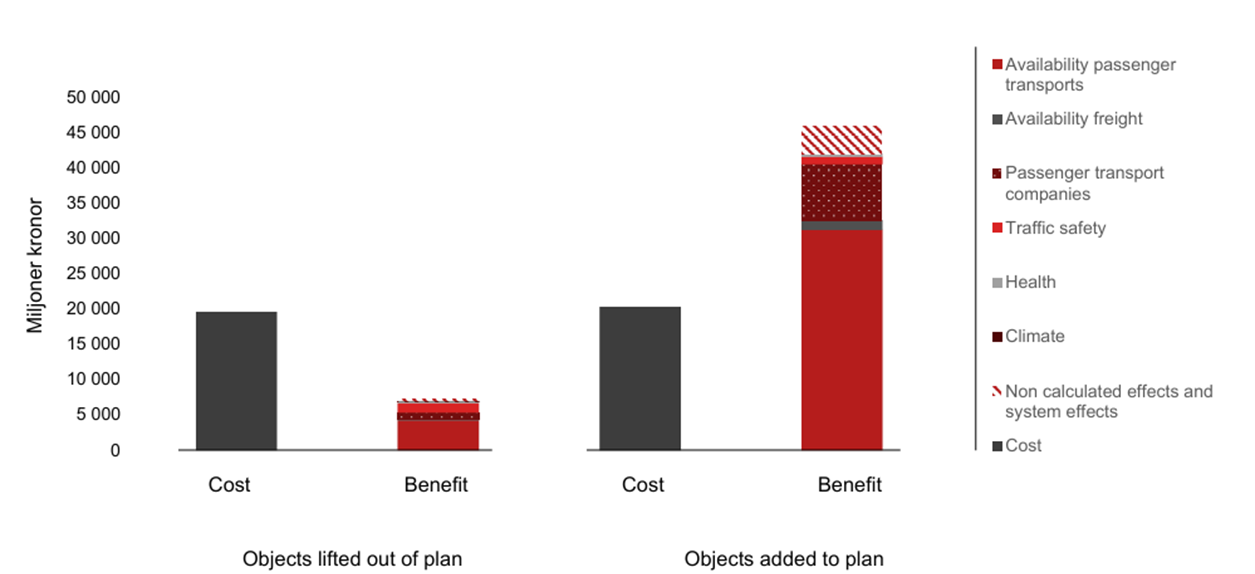
Excerpt from a presentation from Trafikverket showing that the combined costs and benefits of the lowest-performing projects, previously approved, that are being recommended for removal from the 2026–2037 multi-year funding framework, as well as the costs and benefits of new projects that are proposed to be added to the plan instead.
In Sweden, project sponsorship is embedded within the country’s multi-year funding framework. Projects must update their business cases as they move through major lifecycle stages—feasibility, design, and construction. Between each stage, a formal decision point determines whether funding should proceed.
If updated analyses show that costs have increased to the point where benefits no longer justify the investment, projects can be paused, modified, or removed entirely.
This is not theoretical. Sweden’s proposed 2026–2037 national plan includes the removal of several previously approved projects where expected benefits declined or costs increased significantly. Those projects were replaced with alternatives delivering greater value at a similar cost.
This disciplined approach ensures that funding decisions remain grounded in evidence—and that scarce public dollars are continuously redirected toward the projects that deliver the greatest benefit.
SB 125 Task Force Recommendations - an opportunity for California
Excitingly, there is some momentum to bring at least two of these three practices in use in Sweden to California, thanks to the SB 125 Transit Transformation Task Force, which published its final report in December 2025.
Cover of the SB 125 Transit Transformation Task Force report, approved in December 2025, which includes recommendations to reduce costs of capital projects.
To address the Task Force topic area of “Capital Construction Costs and Timelines,” Strategy 10 of the final report—“Grow Public Sector Capacity”—includes the following recommendations to establish business case guidelines and a project delivery ‘center of excellence’ to centralize statewide capacity for delivering megaprojects:
10.A. Develop guidance for development of business cases and enhance benefit cost analysis, including project scope, cost, schedule, risks, and technical assistance, for various funding programs and grant applications with a goal of more robust decision making to support federal investment.
10.D. Consider authorizing regional collaboratives to develop institutional expertise, available for project consultation along with a statewide center of excellence to aid with hiring. Consider possible new models for project delivery that rely on larger organizations to deliver megaprojects, such as a shared single project delivery organization per region.
Unfortunately, in spite of several task force members requesting that the state include a recommendation to consider developing multi-year funding frameworks for California, the recommendation was not included.
Sweden’s centralized state capacity, multi-year funding frameworks, and robust tradition of business cases—prioritizing projects that deliver the greatest value for money—are important models for California to consider as the state seeks to implement the recommendations of the SB 125 Task Force.
As California enters a new gubernatorial cycle, leadership decisions will play a major role in determining whether these reforms are implemented. Seamless Bay Area will continue to track implementation of the SB 125 Task Force recommendations and advocate for practices that countries like Sweden have used successfully to speed up the delivery and reduce the cost of major capital projects - essential to building a world-class transit system in California.