
Larkspur Ferry Parking Proposal Would Bury Seamless SMART/Ferry Transfer for Good
Seamless Bay Area has previously highlighted the subpar connection at Larkspur between SMART’s rail station and the ferry terminal.
The current set-up requires riders to travel 11-15 minutes to transfer - crossing parking lots and busy streets without adequate wayfinding or comfortable facilities.
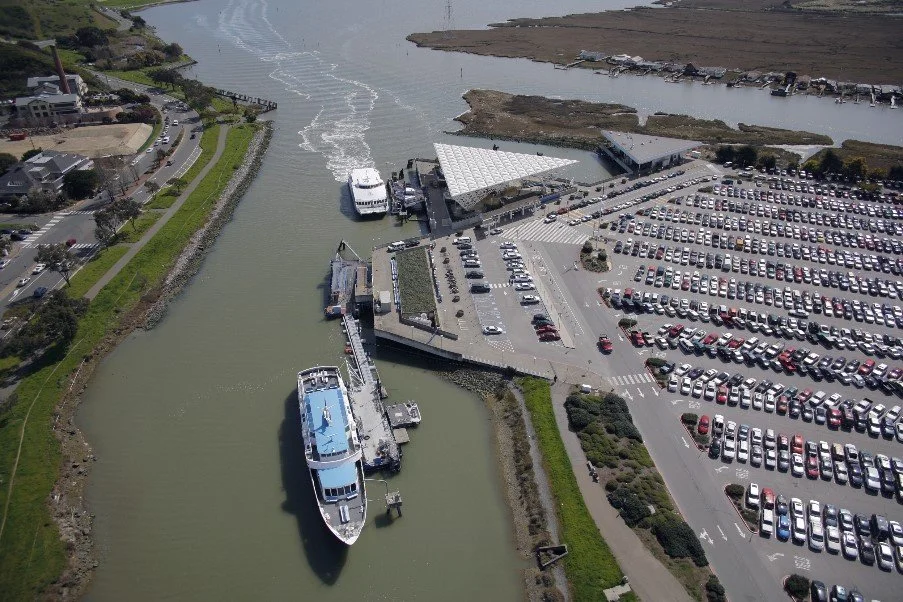
Nonetheless we are excited that the Golden Gate Transportation District wants to nearly double ferry trips between SF and Larkspur by 2050. That would mean increasing current ferry trips from 42 to 76 per day; a capacity increase from 8,000 to 17,000 passengers. This would allow 38 round trips a day, which means a ferry every half hour. That means many more transit riders making regional trips to access jobs, education and recreation.
Unfortunately the proposed infrastructure plans to accommodate that increased capacity fail to correct the challenging transfer between SMART and the ferry.
Instead the Draft Environmental Impact Report (DEIR), which is taking public comment through December 3, 2026, proposes two scenarios with thousands of additional structured parking spots.
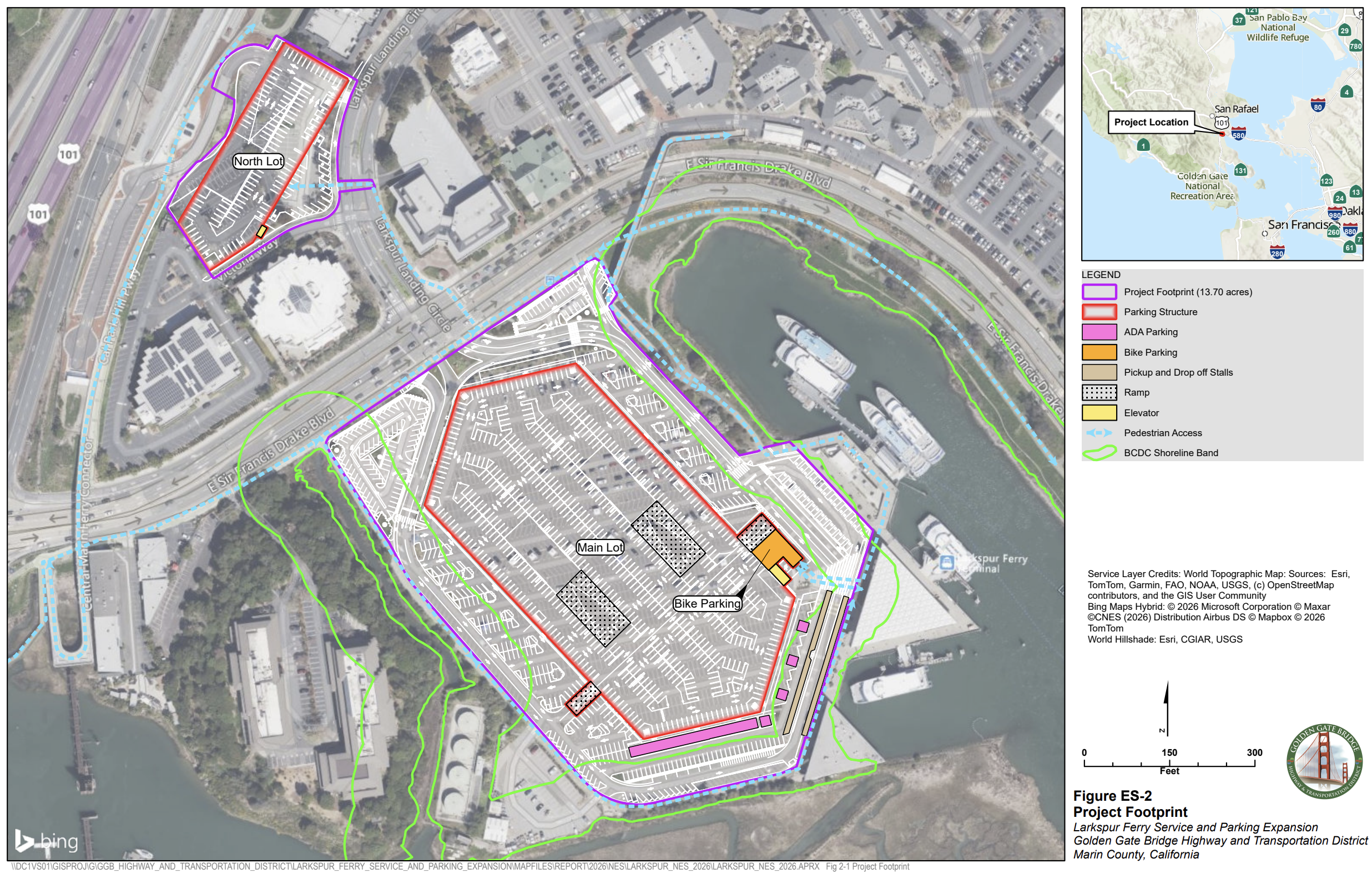
Source: Draft Environmental Impact Report Executive Summary for the Larkspur Ferry Service Expansion and Parking Project
Alternative 1 would create two parking garages, one with 850 stalls at six stories tall and another with 3,998 stalls at five stories tall.
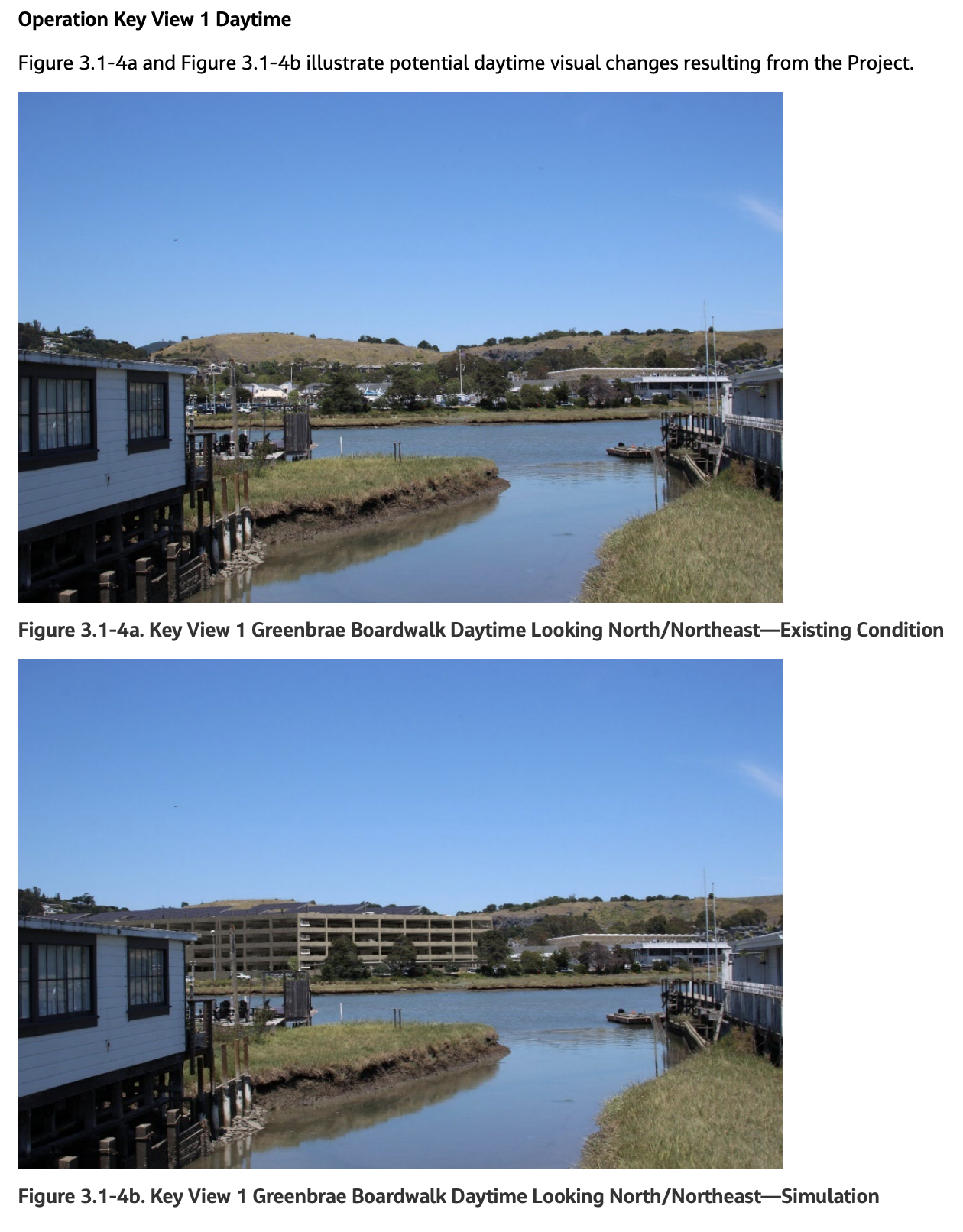
Source: Draft Environmental Impact Report Aesthetics for the Larkspur Ferry Service Expansion and Parking Project
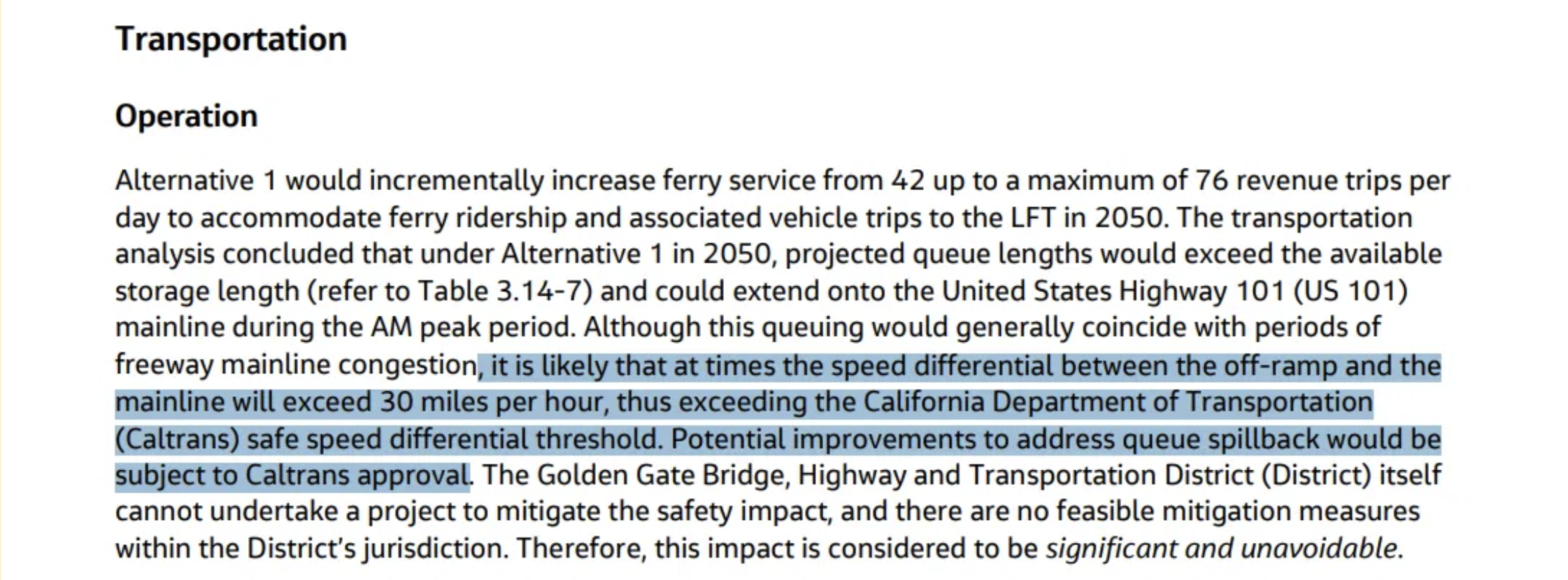
The induced traffic congestion would create a 1/4 mile of queuing for the SB 101 offramp and create a safety risk due to the speed differential between the mainline and offramp. This would require Caltrans to widen the intersection to mitigate the safety risk. The DEIR, however, proposes no mitigations because GGTD "itself cannot undertake a project to mitigate the safety impacts." (emphasis added).
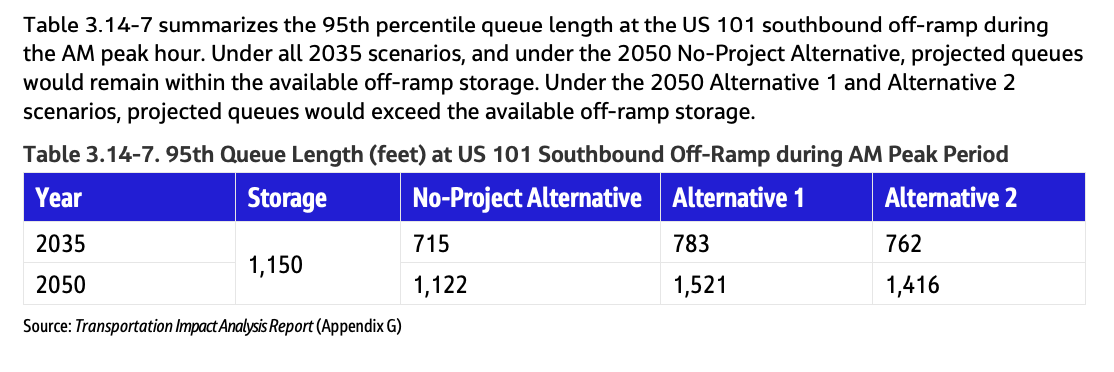
Source: Draft Environmental Impact Report, Transportation Section, for the Larkspur Ferry Service Expansion and Parking Project,
The additional shuttle service by 2035 is unlikely to mitigate the impacts created by all this extra parking. SMART’s own website reveals the constraints of this shuttle:
Due to vehicle capacity limits, priority is given to those with limited mobility or those who feel they may not be able to walk from the train station to the ferry terminal…
The shuttle is not intended to make tight train–ferry connections. In order to serve all riders, the shuttle may not be able to accommodate transfers of less than 15 minutes between the train and ferry.
What’s missing from the DEIR is analysis of a third alternative: extending the SMART southern terminal to the Larkspur Ferry terminal.
This would provide a seamless connection between rail and ferry. It would turn Larkspur into an intermodal destination, providing even more reason for Sonoma and Marin residents to ditch cars for visiting San Francisco and make off-peak and reverse peak trips for visitors to the North Bay even more attractive.
Even better? This transfer has already been studied as part of SMART’s original planning and environmental impact report.
In 2003 proto-SMART planners identified a ½ mile of elevated guideway right at the entrance of the Larkspur ferry as a seamless transfer station for North Bay rail. The station would be 2-3 stories high.
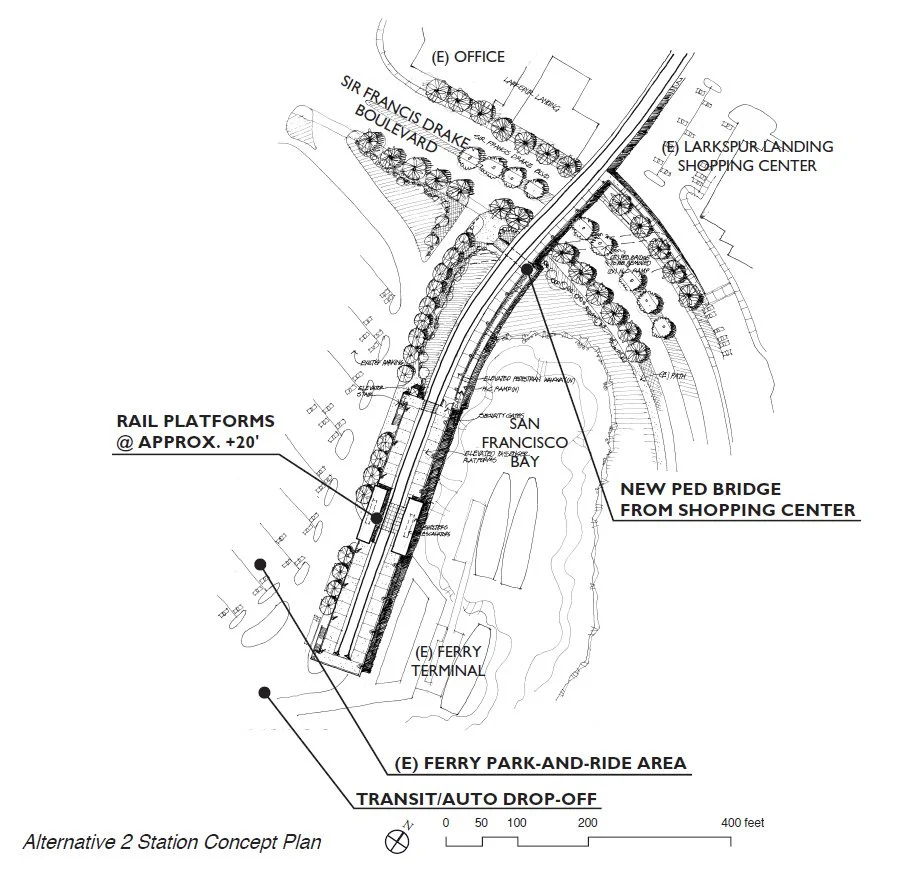
Per SMART staff’s planning report from 2006, Larkspur City Council objected to the elevated guideway in 2003 due to “significant impacts related to interference with views of the Bay and high construction costs.”
Under pressure from Larkspur, SMART decided to build the station beyond the shopping mall and with a 15 minute transfer to the ferry. The costs in terms of views seemingly won out over the convenience of transit riders and a fiscally healthy transit system.
Now with the DEIR, between four and six stories of structured parking is proposed for Larkspur ferry - which will certainly have much higher visual impacts on the Bay. Furthermore, large 4-6 story concrete structures on the piled structure holding the Larkspur Ferry parking lot will certainly require expensive civil infrastructure improvements to support the weight of all that structured parking on Bay fill. It is likely that either Alternative 1 or Alternative 2 3200-4800 parking stalls exceed the cost of extending SMART .5 mile on an elevated guideway.
Moreover, both Alternatives 1 and 2 would preclude the most cost effective alignment for future SMART extension to the Larkspur Ferry.
The Union Pearson Express Line in Ontario uses the exact same rolling stock as SMART. Twelve years ago it was extended 3km using an elevated guideway and added a single station. The cost was $130m CAD (2012) or $91m USD. Escalated to 2026 USD that's $133m. Given that the SMART extension is approximately .5 mile, that comes out to $40-70m.
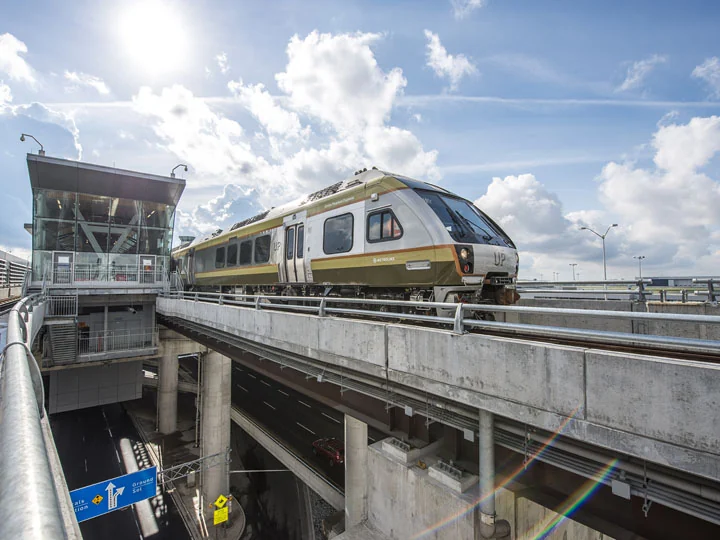
New Union Pearson Express guideway and station. Note the exact same rolling stock as SMART.
By contrast, structured parking on Bay mud and piles will cost between $320-500m. Add in $50-100m for improvements to the SB-101 intersections to mitigate the safety impacts of all that induced traffic congestion caused by the extra parking, and the potential cost of the DEIR plan exceeds half a billion 2026 dollars.
With Golden Gate Transportation District’s increased service plans, free transfers thanks to regional network integration, and coordinated scheduling between operators, it is now time to seriously plan a connection between SMART and Larkspur ferry.
To do that, first, Golden Gate Transportation District needs to study a SMART extension within its DEIR to mitigate or avoid the impacts of Alternative 1 and Alternative 2 on induced vehicles miles travelled, GHG emissions, particulate emissions and water quality. Email those comments to LFEP@goldengate.org.
Second, MTC’s Regional Network Management Council can help lead by supporting SMART, Golden Gate Transportation District and other operators in developing a strategic business case for the Larkspur connection that evaluates goals, alternatives (including a SMART extension), costs, benefits and next steps for each approach.
This can help relieve Golden Gate Transportation District from having to plan its service increases in a siloed manner without expecting them to plan and solve for operational, capital and other challenges that face SMART. That strategic business case can also take into account what SMART needs to plan for if ferry service were to double. This might include procurement of additional trainsets for 3-car sets, double tracking to allow for 30 minute service (as opposed to 32 minute service currently), and electrification.
Third, MTC and the State Legislature need to think seriously how they can support planning and project development through in-house staffing to take plans like the Larkspur Ferry SMART extension from conceptual plan to engineered drawings to construction to service. Caltrans’ Division of Rail - bolstered by more planners, engineers and project managers - or a specific regional entity in the Bay Area could help support regional rail projects so that policymakers can adequately understand their costs, benefits and risks prior to committing construction dollars.
As an example, Metrolinx - an agency of the Government of Ontario - was created to improve the coordination and integration of all modes of transportation in the Greater Toronto and Hamilton Area. Through its teams developing business cases, conducting early planning, developing design and engineering standards, and supporting procurement activities for rolling stock and capital projects, Metrolinx provides essential planning and project development support for operators.
Sign up here to get our blog posts sent directly to your email.