
A major decision for SMART's Healdsburg Station in the North Bay.
In the coming weeks, unless riders speak up, SMART is at risk of creating yet another Bay Area “missed connection”, just as it did when it opted to build the Larkspur station at its south end a long walk from the ferry terminal it was intended to connect to. Now, at the other end of the corridor, SMART is set to decide whether to locate its new Healdsburg station in the heart of downtown Healdsburg, steps from the city’s vibrant historic plaza - a hub of jobs, shopping, recreation, and transit connections - or at the Depot site, a location further south of downtown that provides far less access to jobs and housing and would result in significantly less ridership and network connectivity.
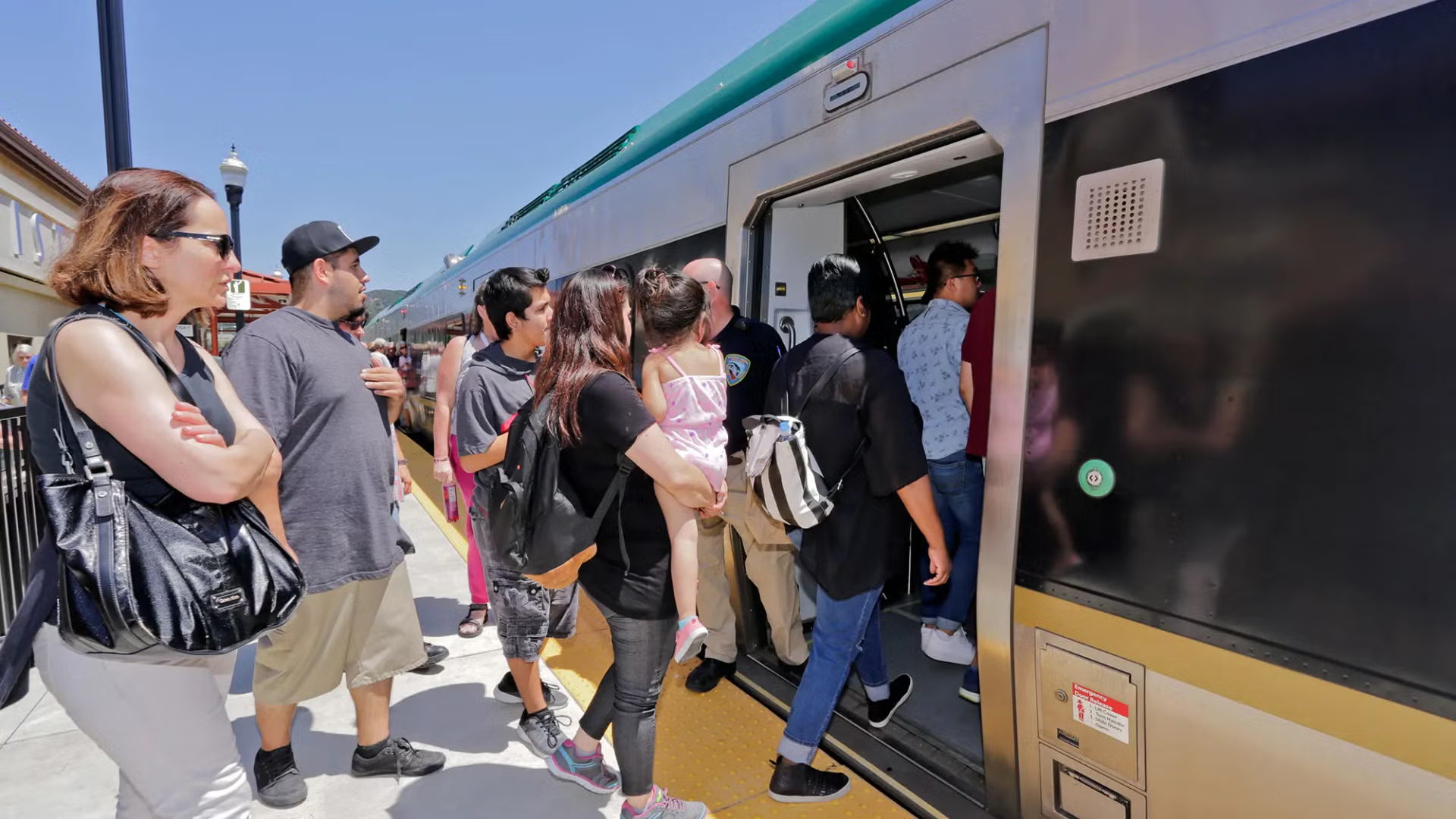
Riders boarding a SMART Train. Credit: Kingmond Young.
More details are in the below post - but most importantly, riders across the region who use SMART can do two things to help speak up in support of the downtown site:
Sending a letter urging SMART board members to chose the downtown site
Signing up to give public comment at the October 18th SMART Board Meeting
SMART’s decision for the Healdsburg station location has large implications for ridership, bus transfers, SMART operations and housing and job access.
There are many instances where Bay Area planning decisions have mis-stepped to create stations and services that inhibit ridership, penalize transfers and isolate transit access from jobs and housing.
These include
The decision to locate the SMART Larkspur station more than half a mile from the Larkspur Ferry terminal - forcing people to walk approximately 15 minutes to make a connection. The walk is so challenging for people with limited mobility that SMART must operate a shuttle bus to help riders make the connection.
Millbrae and BART to SFO design that penalizes BART to Caltrain transfers through ROW design, station design and service patterns.
The absence of a direct connection between the BART and Muni Metro stations in downtown San Francisco, forcing riders to take a circuitous path to transfer.
The addition of the SMART Novato - San Marin infill station without adding additional passing loops shifting SMART’s schedule from 30 to 32 minutes - penalizing bus to SMART transfers even with MASCOTS.
Difficult transfers for Capitol Corridor with VTA light rail at Great America and BART at Coliseum.
It’s easy to look at these outcomes in retrospect. Far harder and more important is for transit riders and policymakers to avoid similar mistakes going forward.
SMART has two choices before it in Healdsburg: a station at the Depot/Hudson St. site, or the Downtown site, near Vine Street.
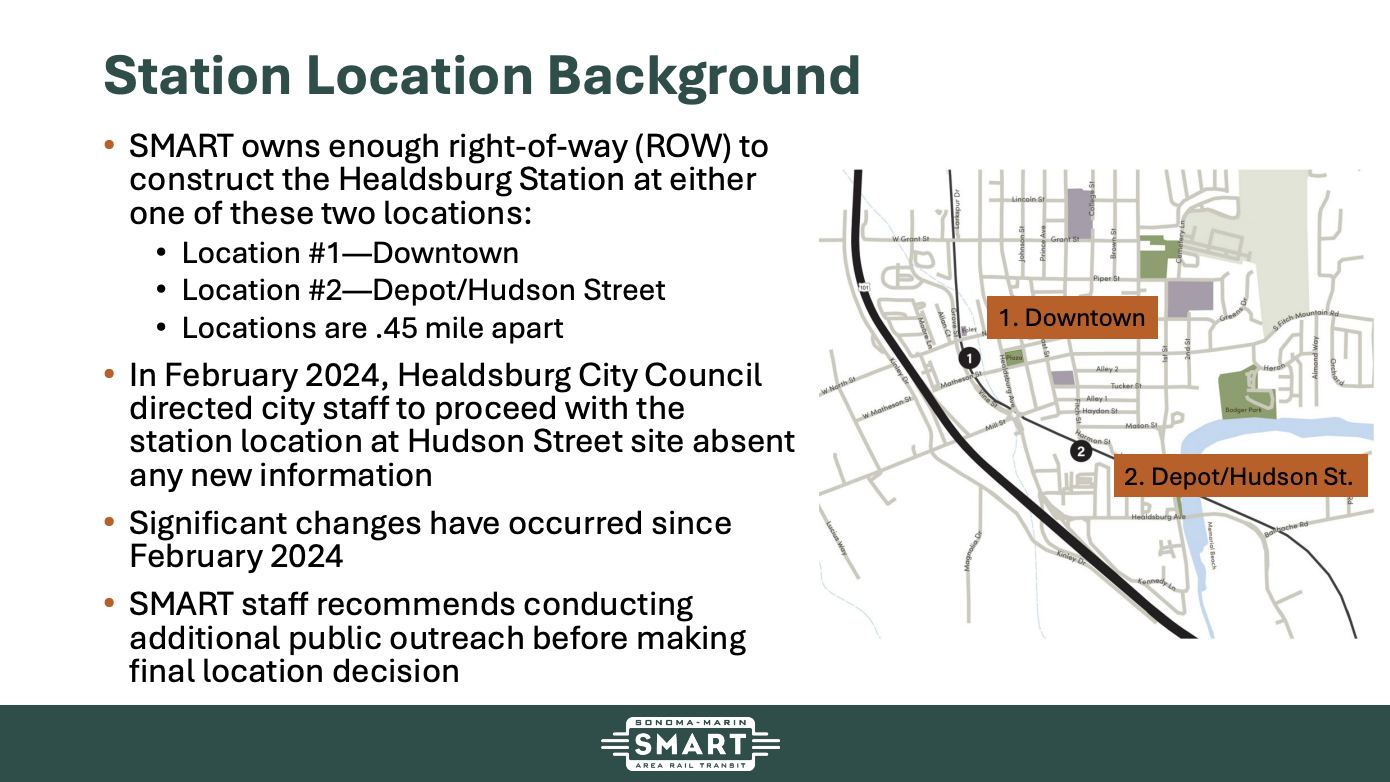
Source: Consideration of the Healdsburg Station Location and Request Direction to Conduct Public Outreach (SMART, September 2026 Board Meeting).
The Depot site is located ¼ mile from the city limits at the Russian River, has a wider right of way, is surrounded by industrial uses and lower density housing and bus stops are currently further away. Facilitating bus transfers at the Depot site would require re-routing and adding additional run time and potential delay to current bus service timetables. Transit operators have indicated they would be unable to re-locate the stops under the current infrastructure configuration.
The Downtown/Vine site by contrast is located within the heart of downtown Healdsburg near businesses, restaurants, retailers, wine tasting rooms, denser housing and social infrastructure. It is served by Sonoma County Transit’s 67 Local and Regional 60 services. Route 60 is the highest ridership transit line in Sonoma County Transit’s entire network.
The station location is critical because of the access it provides to the community. In part due to high housing costs, 84% of Healdsburg’s workforce lives outside of the city limits. 42% of those workers live in places that are currently or will soon be served by SMART service. That means SMART can achieve a reverse peak ridership of people traveling from other parts of Sonoma and Marin County, such as Santa Rosa and the Canal District, to work in downtown Healdsburg jobs.
In addition, increasing numbers of SMART riders are using the service for recreation and leisure. These are potential customers for Healdsburg downtown businesses.
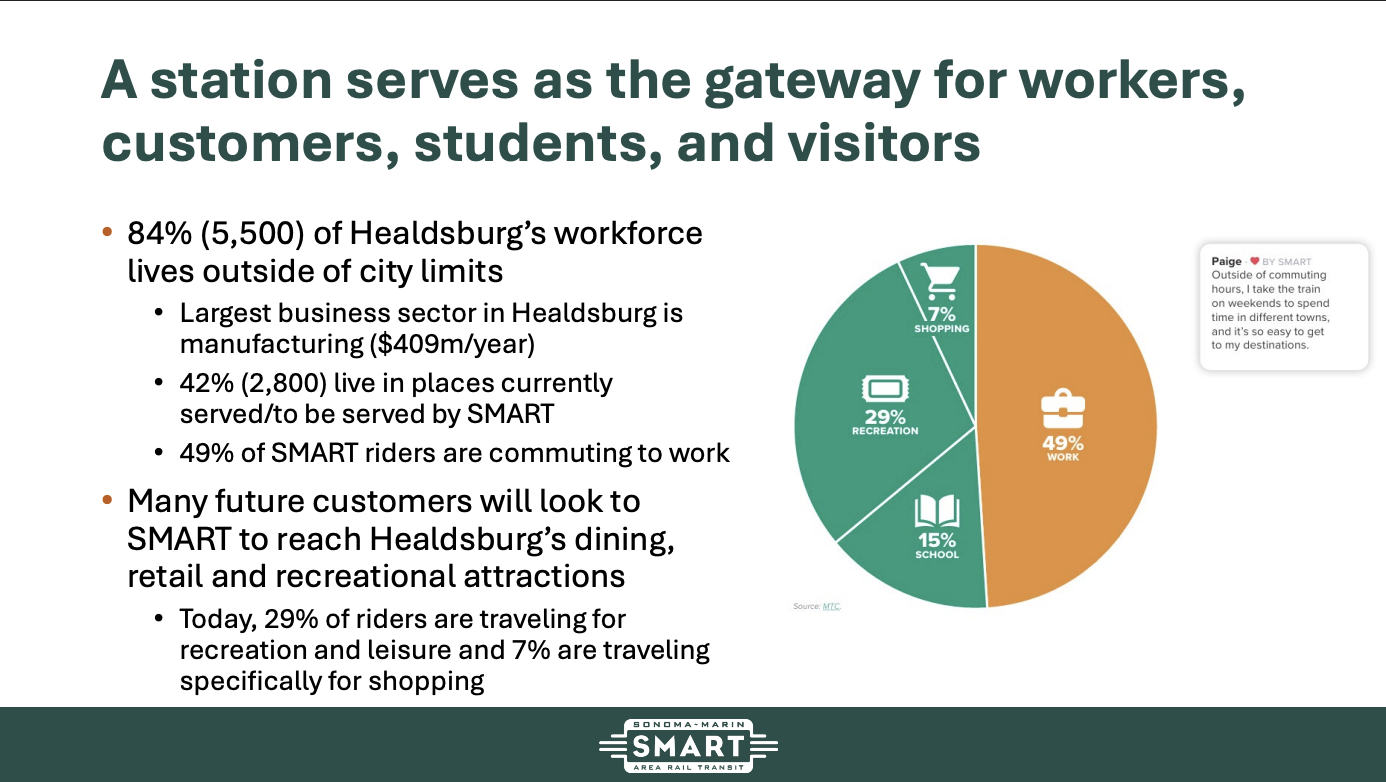
Source: Consideration of the Healdsburg Station Location and Request Direction to Conduct Public Outreach (SMART, September 2026 Board Meeting).
This means that SMART ridership and Healdsburg economic development are intimately tied to station location and whether riders can easily access jobs and destinations.
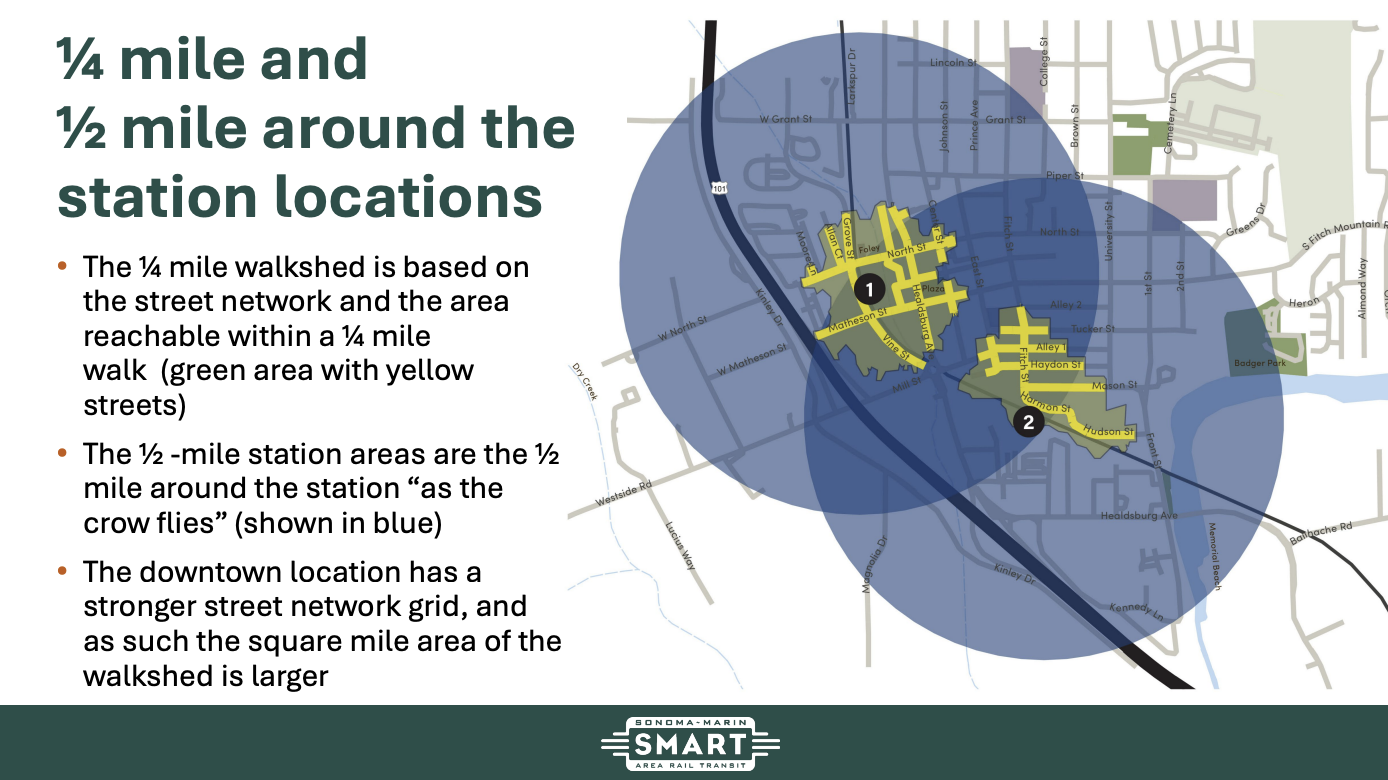
Source: Consideration of the Healdsburg Station Location and Request Direction to Conduct Public Outreach (SMART, September 2026 Board Meeting).
The academic literature strongly shows that while walking ½ mile is feasible for transit station ridership, ¼ mile is a much stronger draw; it also shows that, for office uses in particular, there is a substantial drop-off in likelihood for workers to use transit the further that an office location is located from a transit station, with particularly high rates of transit use for offices located within about an 1/8th of a mile from rail stations.
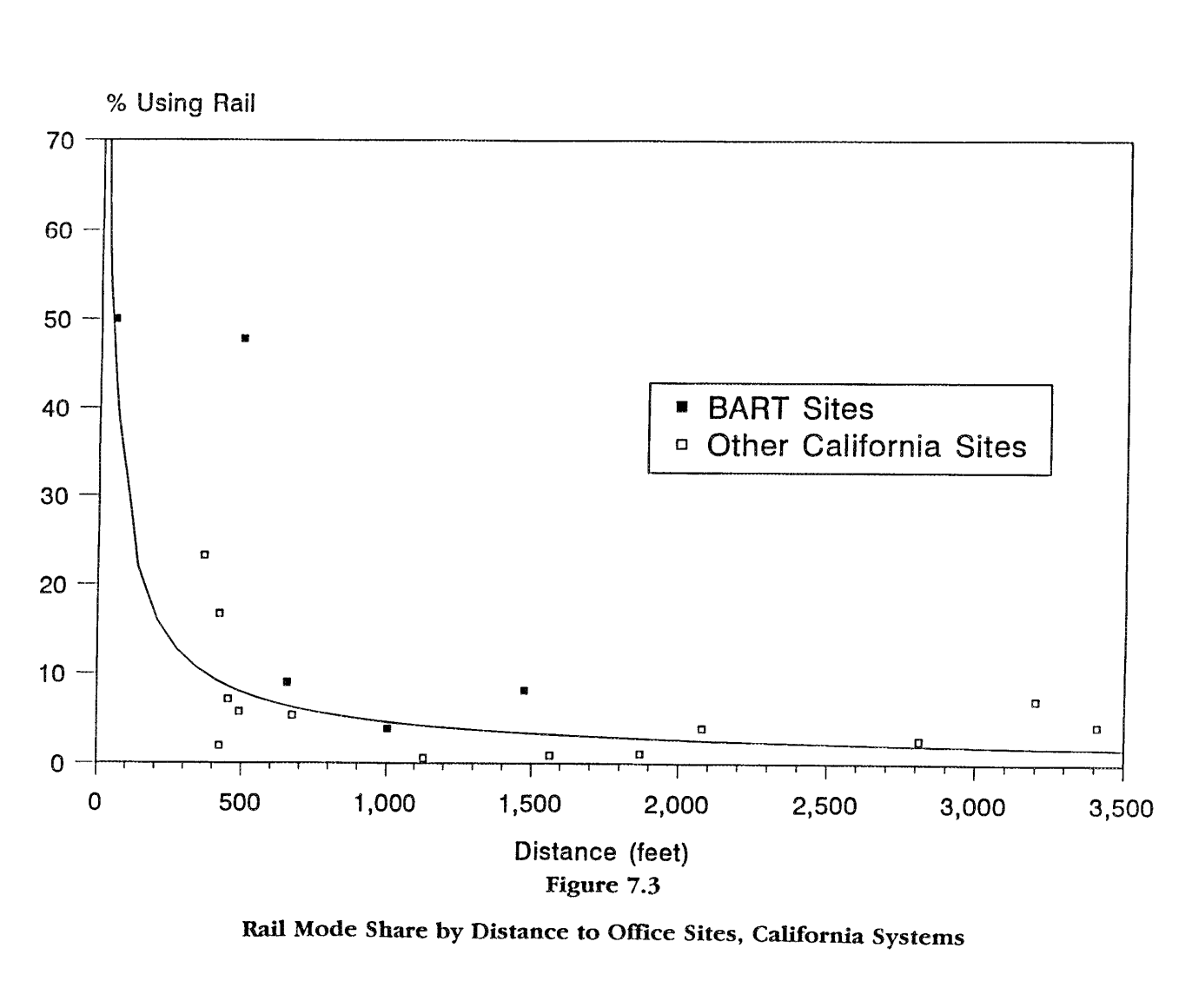
Figure from a well-known and often sited study of TOD projects indicating the likelihood to use transit for commuting compared to the distance of office sites from a station - indicating that it’s especially important for jobs to be located in close proximity to transit in order to promote transit use for commuting.
Furthermore, the distance traveled for riders is not experienced as the crow flies but by the street grid. The Historic Depot will be isolated from downtown jobs and even the mixed-use area directly to the south of it - unless expensive pedestrian overcrossings or undercrossing are constructed. By contrast Vine Street provides within a ¼ mile immediate access to the lion’s share of Healdsburg's economic engine. It also allows for seamless transfers to 67 and 60 bus service.
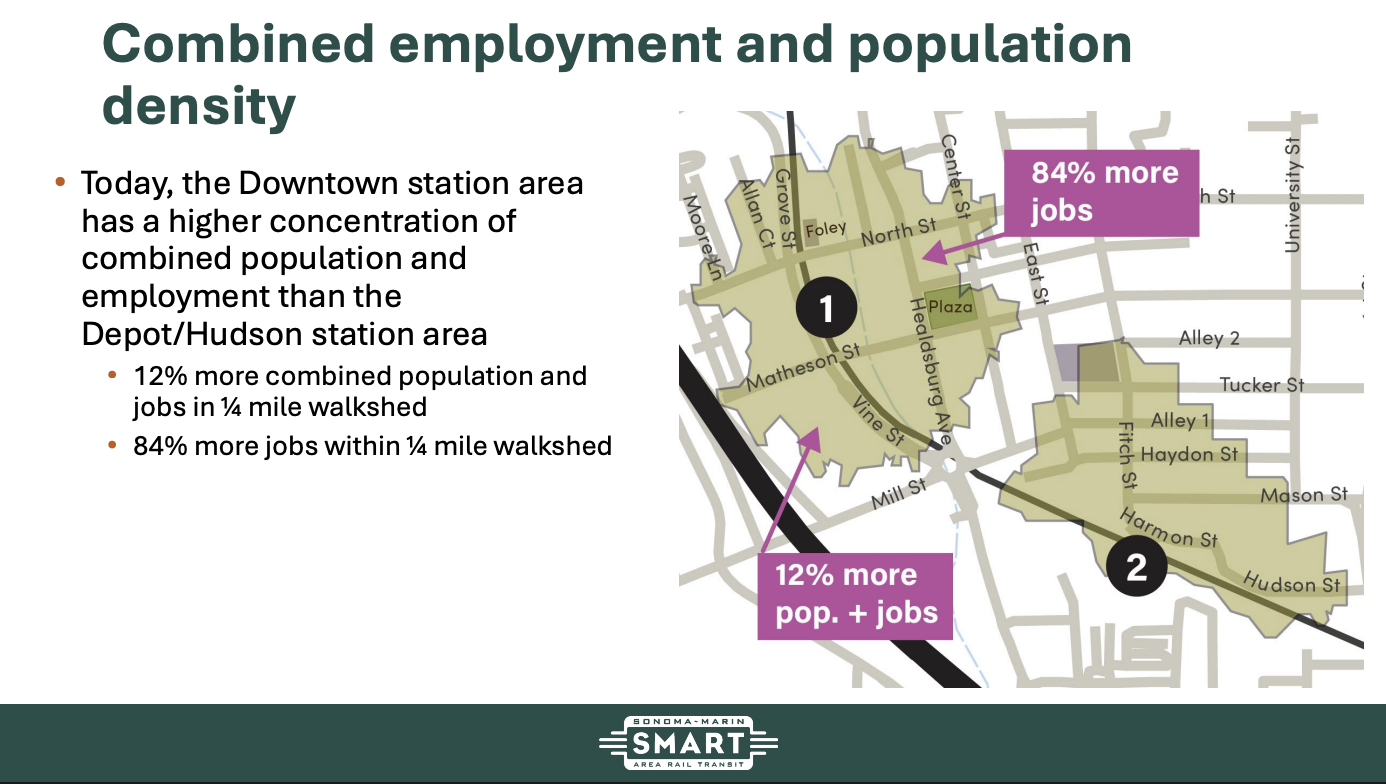
Source: Consideration of the Healdsburg Station Location and Request Direction to Conduct Public Outreach (SMART, September 2026 Board Meeting).
This means that a Vine Street location is likely to have a significantly higher ridership than a Depot station. The analysis shows that the Depot station will also require significant increases in parking facilities - including demolition of existing structures and additional traffic congestion - in order to have any significant ridership. And even that ridership would be limited to Healdsburg outbound traffic - and not be poised to capture inbound ridership from workers or visitors - relative to a Vine Street location.
With so much upside, why might people be opposed to a Vine Street station? It appears much of the opposition is driven by 1) loss of surface parking at city-owned Vine Street; 2) traffic congestion at the Healdsburg traffic circle.
The loss of street parking is offset by the fact that many more Healdsburg workers who currently drive into town from other locations will now be able to travel by transit.
The concerns about traffic congestion at the Healdsburg traffic circle are real. There is, however, evidence that SMART and the city can manage this issue. A mere five miles away SMART has traveled through downtown Windsor’s traffic circle two times per hour without much congestion or fanfare since 2025.
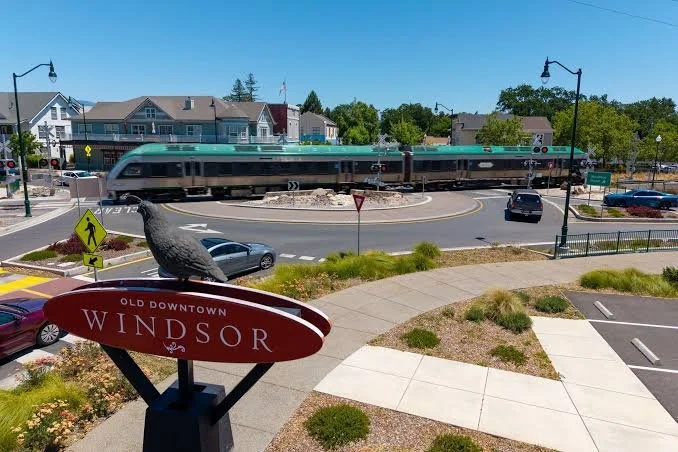
These Vine Street challenges are manageable with proactive planning and coordination between SMART and Healdsburg.
Please take a few minutes to speak up in support of the downtown site:
Please send a letter urging SMART board members to choose the downtown site
Sign up to give public comment at the October 18th SMART Board Meeting
Sign up here to get our blog posts sent directly to your email.