
Why is my AC Transit bus always cancelled?
By Bryan Culbertson, Volunteer for Transbay Coalition
You are not alone. AC Transit riders all across the East Bay are noticing that their bus is cancelled, arriving very late, or too full to board, and it has been getting increasingly worse over the past year. When a bus that is supposed to arrive every 20 minutes is cancelled, that creates a 40-minute gap in service, and sometimes a 60-minute gap when buses are cancelled in a row! Delays that long mean you miss work, school, and appointments, and so many other important things in your life.
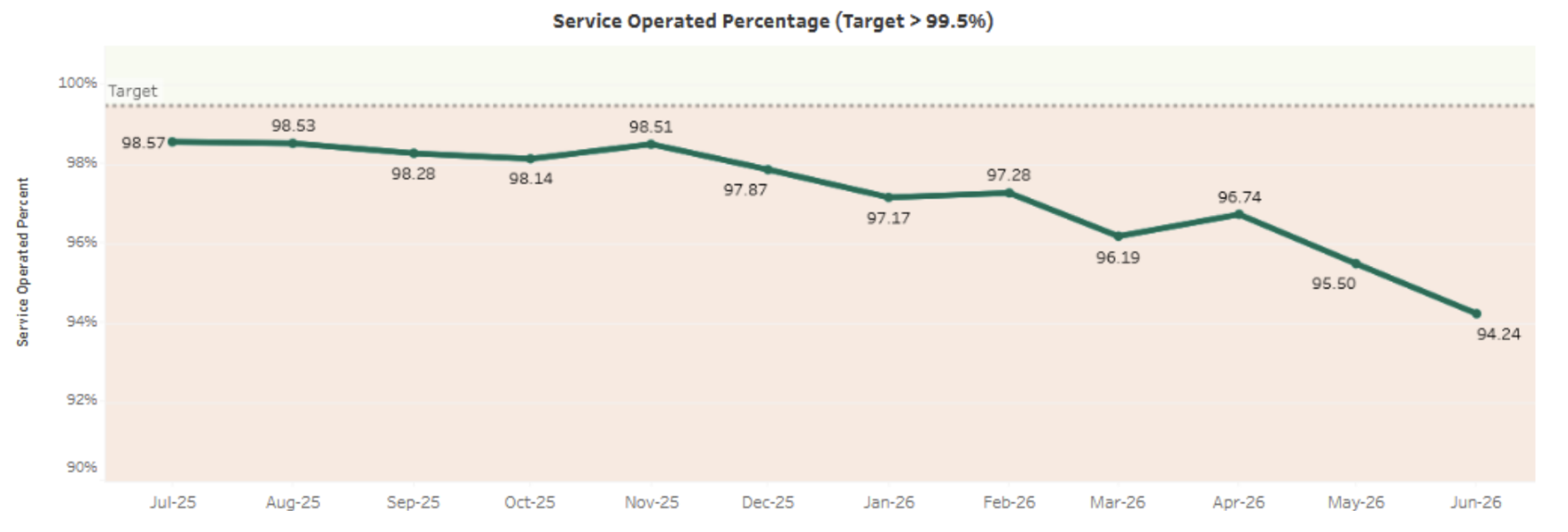
At the September 9th AC Transit board meeting, staff presented a report about the extent of the reliability problems. Starting December 2025, the percentage of Service Operated started falling. This metric tracks actual operated trips against scheduled trips. By June 2026, service had taken a nosedive with only 94% of Service Operated, and most recently, as of September 2026, the number has worsened to an abysmal 92%. This percentage represents more than 11,000 buses that did not run at all last month! AC Transit takes service away from routes with the most frequency first, so service on 1T, 72/72M, 14, 60, 62, 35, and NL all have more than 10% of their trips cancelled. This looks like no buses running on 1T for 30 minutes during evening rush hour.
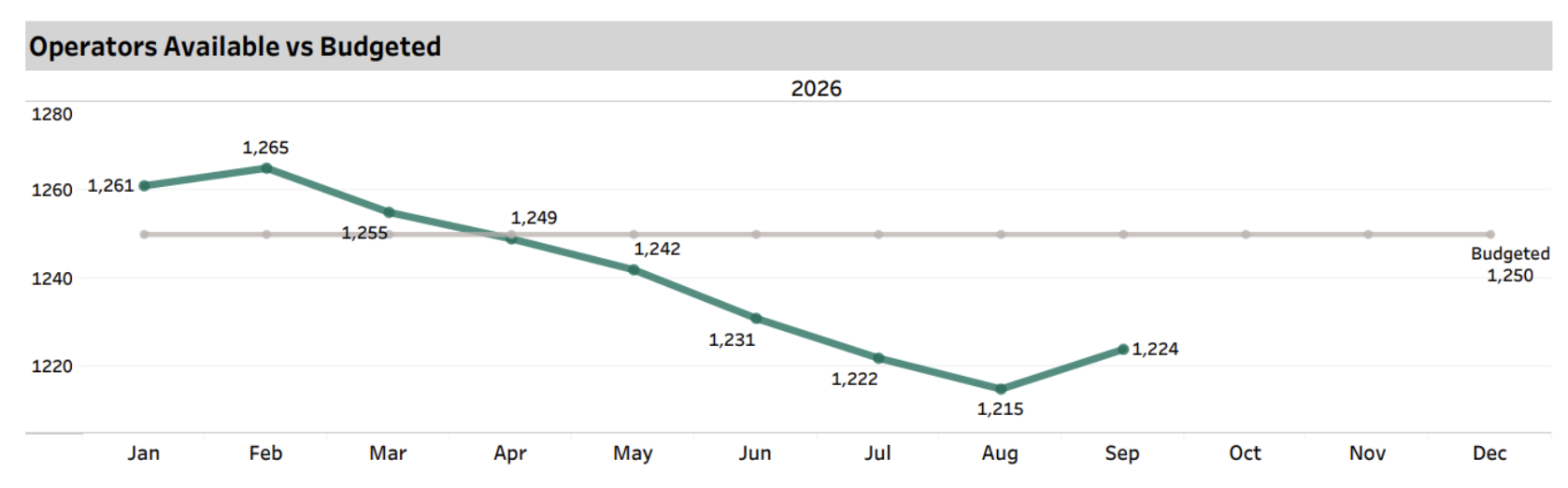
The most direct cause for the cancelled buses is that AC Transit does not have enough bus operators to run service as scheduled, and so every day buses are cancelled based on a lack of bus operator availability.
This reliability crisis of cancelled buses was created with a combination of unrealistic schedules introduced with Realign (major overhaul to routes and schedules), a FY2025-26 budget that reduced operator headcount, and a January 2026 reduction in targeted Extra Board (operators on standby to pick up shifts) to help fix those unrealistic schedules. These changes may have saved AC Transit $157M in operating costs as recorded in MTC's Bay Area Financial Efficiency report, but the result of those changes was 21% less service and an increased rate of cancelled buses from 1-2% to as high as 18% for the 1T.
AC Transit failed to respond to the crisis until recently because there is only a service report to the board every six months, and reported metrics are delayed by three months. It wasn't until September 2026 that the Board was acutely aware of a reliability crisis that had been going on for nine months by then!
Why are there not enough operators?
Prior to the Realign schedule changes, AC Transit budgeted for 1,379 bus operators but had been only able to hire 1,280. Staff reported difficulties hiring the full 1,379 operators and recommended to the Board that the budgeted headcount be reduced to 1,250 and service miles be reduced to 50k to reflect the number of operators AC Transit is able to hire. With the fiscal crisis on the horizon, staff only provided options that decreased costs, and so did not provide a path to hire enough operators to reliably operate the 54k pre-Realign service miles or even the 64k pre-pandemic service miles:
The authorized service levels from FY 2024-25 symbolize the desire to return to the 100% pre-pandemic service level, which is no longer achievable given the projected structural deficits ahead. Despite efforts to attract and retain more bus operators, the reality is that this is not achievable in the foreseeable future. — FY2025-26 Budget Book
The AC Transit Board approved a reduction in service and lower headcount with the expectation that a 21% reduction in service would be a worthwhile trade to provide 99.5% reliable service to riders. While the decrease in service happened, the promised reliability did not materialize.
What happened to the reliability promise?
At the December 2025 board meeting, staff presented service changes in response to rider and operator feedback. Many of the new routes had proven over the past couple months to have unrealistic schedules that could not be completed in the time allotted, and some routes were overcrowded with riders being left behind. The schedule changes required increasing operator headcount by 20 operators from 1,250 to 1,270.
AC Transit already had the operators available to handle the schedule changes with the current headcount of 1,280, but staff was reluctant to budget for 1,270 positions due to the upcoming fiscal cliff. Instead, staff optimistically decided to decrease the targeted Extra Board even though the Service Operated was below the 99.5% target even with 1,280 operators:
With the percentage of the District’s service operated steadily increasing and consistently exceeding 98%, staff is able to confidently reduce the targeted Extra Board requirement to cover open runs from 38% to 36.4%. This allows the District to reallocate Bus Operators from the Extra Board to more assigned runs while staying within the 1,250 budgeted operator count for FY25-26, therefore no change is needed in the operating budget. — January 2026 Service Changes
The fiscal cliff created tremendous pressure to cut operating costs. This led to the Board budgeting for only 1,250 operators when the Realign schedule actually needed at least 1,270 operators, and staff decreasing the targeted Extra Board even though the Service Operated was not high enough to justify such a decrease. This decrease was especially not justified when the reliability metrics were tracking a period with 1,280 operators, not with the budgeted 1,250.
Why didn't AC Transit hire more operators sooner?
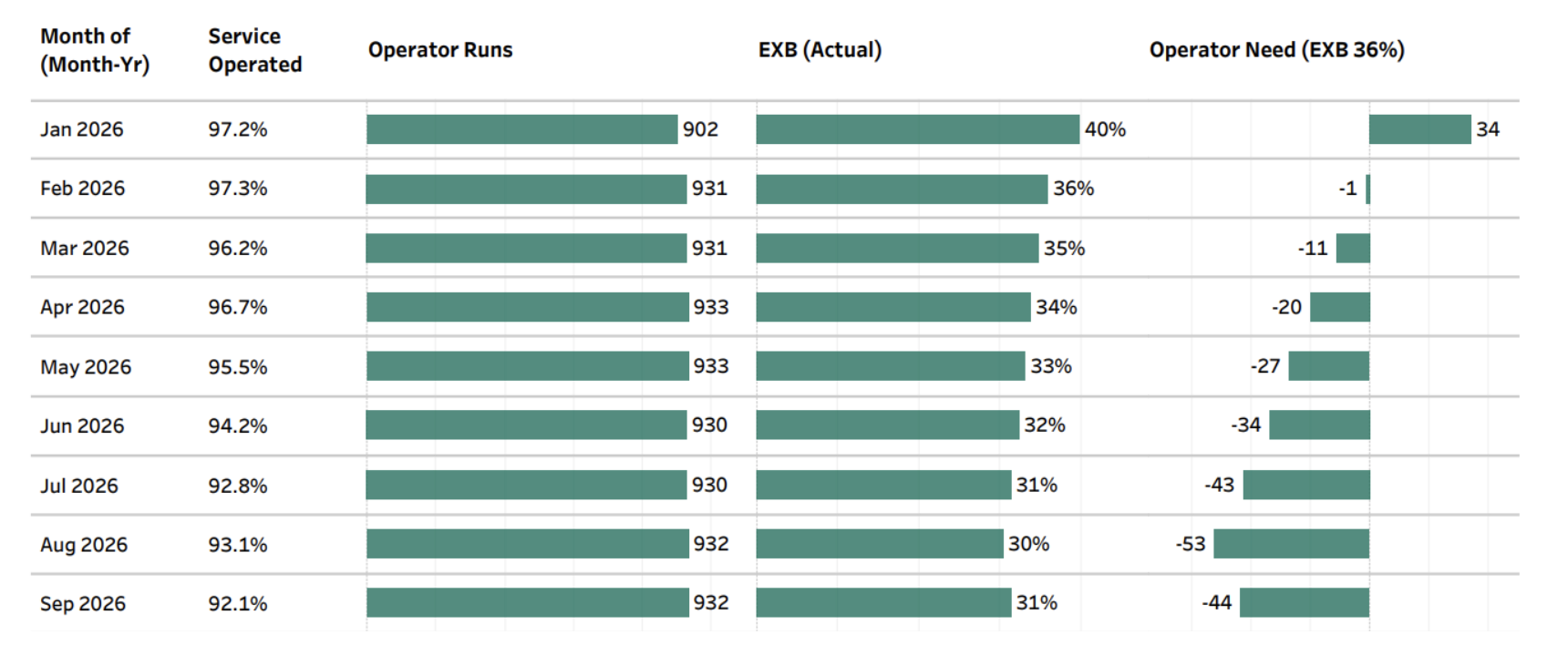
AC Transit reduced hiring while they waited for enough operators to leave to go below the 1,250 budgeted headcount. However, they miscalculated and more operators left than expected. By April 2026, there were 1,249 operators but hiring did not restart, so by August there were only 1,215 operators. With so few operators, the resulting 30% Extra Board fell well short of the 38%+ needed for 99.5% reliability.
As the cancelled buses were piling up, the metrics presented to the board didn't show it. In March 2026, staff presented the semi-annual Service Reliability Report claiming that Service Operated had been increasing after implementing Realign. At the time this report was presented in March Service Operated had actually reduced to 96%, but the March report claimed an increase because it only looked at data through December 2025!
During the first half of FY2026, Service Operated averaged 98.31%, a 1.68% improvement over the prior period's average of 96.62%. With a smaller dataset, there was little variation when viewed on a quarterly basis, with Q2 averaging 98.17% from 98.44% in Q1. The District fell slightly below the 99.5% target in each month of Q2: 98.14% in October, 98.51% in November, and 97.87% in December. — March 2026 Service Reliability Report
The next semi-annual service report wouldn't be until September 2026, so for nine months riders have been struggling with deteriorating reliability without the Board knowing about it. If the prior schedule of quarterly service reports had been maintained, then this reliability crisis would have been identified much sooner.
You can help by passing the Regional Transit Measure!
AC Transit is now hiring operators and will hopefully soon hire enough to maintain the budgeted 1,250. Reliability will start recovering as more operators are hired. However, past performance indicates that 1,250 is not enough operators to provide 99.5% Service Operated with current schedules and current operator availability. Short of reducing service even further, AC Transit needs to budget for more operators to get to 99.5%.
The reliability problem primarily stemmed from an attempt to tightly optimize the 2026 budget due to the upcoming fiscal crisis. Trying to be more "cost efficient" by reducing reliability is balancing the budget on the backs of transit riders, many who don't have other transportation options and need to get to work or school on time every single day. The only real solution to the funding gap is voters passing the Regional Transit Measure this November. The best way you can help your bus to arrive on time is to volunteer to canvas for the Regional Transit Measure. See you out there!
Sign up here to get our blog posts sent directly to your email.